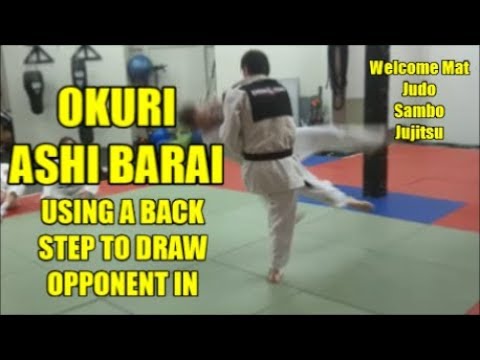
OKURI ASHI BARAI USING A BACK STEP TO DRAW OPPONENT IN
0
Standard Okuri Ashi Barai·welcomematstevescott·Added by Admin
This video shows how to apply Okuri Ashi Barai (Sliding Foot Sweep) using Taisabaki (Body Management in a Circular Patte…
Translation: standard sliding foot sweep
The Standard Okuri Ashi Barai executes the fundamental sliding foot sweep where the attacker uses hand control (tsurite and hikite) to drive the opponent laterally, then sweeps both feet out from under them at the moment they slide together during the lateral movement. [1] The attacker's sweeping foot contacts the opponent's near ankle and drives it into the far ankle, sweeping both feet in the direction of movement. [1],[2] The timing window is extremely narrow — the sweep must occur at the precise moment the opponent's weight is transitioning between feet during the lateral step. [2] The result is a clean throw where the opponent appears to be swept off their feet with minimal physical effort. [2],[3]
Okuri ashi barai (sliding foot sweep) is highly effective against laterally moving opponents because it catches both feet moving in the same direction. [1] The technique requires exceptional timing to sweep at the precise moment the opponent's weight is transferring between feet during lateral movement. [1] When executed with proper timing, the opponent falls cleanly for ippon. [2]
No images yet for this technique.
Sign in to suggest an image.
This video shows how to apply Okuri Ashi Barai (Sliding Foot Sweep) using Taisabaki (Body Management in a Circular Patte…
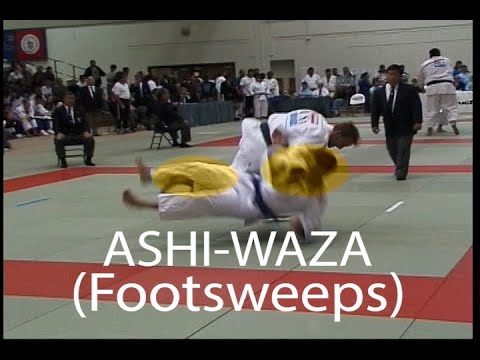
Buy DVD or Video Download at: https://em3video.com/judo-vol-25-ashi-waza-footsweeps/ JUDO - Vol-25 ASHI-WAZA (Footsweep…
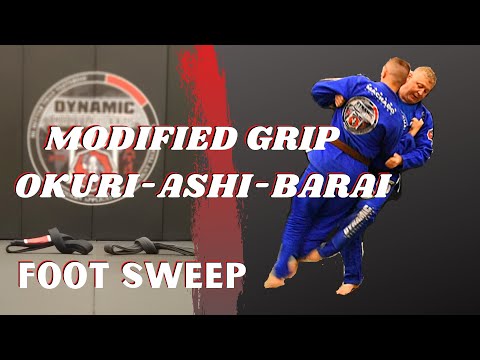
#kumikata #okuriashiharai #footsweep In this video, we demonstrate an armpit grip that will improve your Kuzushi (off b…
The standard okuri ashi barai (sliding foot sweep) is executed through a coordinated shuffling motion combined with precise off-balancing and leg mechanics. WelcomeMattStevescott emphasizes the foundational footwork pattern: stepping backward while turning the body, then executing the sweep in a rhythmic sequence that draws the opponent forward before the technique is applied. The instructor recommends practicing this movement pattern—step back, turn, sweep—repeatedly to develop proper timing and rhythm. Takedowns For Jiu-Jitsu provides a critical grip modification that enhances effectiveness: rather than gripping the lapel, the attacker reaches under the opponent's armpit to control the gi material, which produces superior body tilting and off-balancing with minimal hand movement from the attacker. This grip change creates reactive foot movement from the opponent, making the sweep substantially easier to execute. The sweep itself involves the attacking foot sliding across to collide with the opponent's supporting foot, disrupting their base. Both lateral side-to-side and circular motion patterns are viable, with the circular approach allowing more controlled, adjustable throw intensity. MastersMagazine demonstrates the technique within complex combinations and grip-fighting scenarios, showing how okuri ashi barai integrates into broader judo sequences. The fundamental principle across all instruction is synchronized movement: the attacker's body tilt, foot placement, and timing must coordinate to overcome the opponent's balance before leg contact occurs.
Synthesized from 4 instructors
No instructional courses yet for this technique.
Sign in to suggest a course.
Risk of injury to the person this technique is applied to
Timing-based sweep; lower force than trips
Skill level needed to execute this technique reliably
Whether this technique is allowed under major competition rule sets
Kodokan Judo — Official Nage-waza Classification
Traditional Judo throwing/takedown terminology (Kodokan Institute)
Official Kodokan ground technique classification system
Standard Japanese martial arts terminology (kanji/hiragana)
Established Japanese martial arts naming convention — native Japanese term (和語/漢語)
Traditional Judo throwing/takedown terminology (Kodokan Institute)
timing, balance, upper body control for push-pull
good coordination and sense of opponent's weight distribution
core stabilisers, hip adductors/abductors, calves
The standard okuri ashi barai uses a lateral shuffling motion side to side, then you execute the sweep. Takedowns For Jiu-jitsu also notes that the motion can be circular—as you step in, you maintain close contact, then sweep your opponent's foot into their other foot to bring them down.
Takedowns For Jiu-jitsu recommends modifying your grip by reaching underneath and grabbing under the armpit instead of just the lapel, which gives you more control and more rotational force on the opponent's body. This allows you to control the throw gently or execute it with power depending on your intention.
Time the tilt of your opponent's body with your sweep by coordinating your foot movement against theirs—for example, your left foot versus their right foot. This timing combined with pulling your opponent in a circular path around you rather than straight in front allows better control of the throw.
The Standard Okuri Ashi Barai executes the fundamental sliding foot sweep where the attacker uses hand control (tsurite and hikite) to drive the opponent laterally, then sweeps both feet out from under them at the moment they slide together during the lateral movement. The attacker's sweeping foot contacts the opponent's near ankle and drives it into the far ankle, sweeping both feet in the direction of movement.
Standard okuri ashi barai has been practised in judo since the art's creation and is one of the most frequently attempted ashi-waza in Olympic judo competition. Mastery of this technique is considered a hallmark of advanced judo skill.
IJF: legal — Legal (ashi-waza) — trips executed without grabbing opponent's legs are permi…; IBJJF: legal — Legal at all belt levels, scored as takedown (2 points); UWW: restricted — Legal in freestyle, restricted in Greco-Roman (leg-to-leg contact prohibited); Unified MMA: legal — Legal takedown technique; ADCC: legal — Legal, scored 2-4 points in second half of match; FIAS Sport Sambo: legal — Legal — all takedowns permitted; FIAS Combat Sambo: legal — Legal; NCAA Folkstyle: legal — Legal, scored as takedown (2 points)
Danger rating 4/10. Moderate — timing-based sweep; lower force than trips
The standard setup chain: Establish Contact → Create Off-Balance → Execute the Takedown → Follow to Ground.
Standard counters include: Sprawl — drop hips back and drive weight down to stuff the takedown attempt / Underhook — establish inside position to control distance and prevent the takedown entry / Post and Circle — post on the attacker's head and circle away to break their angle / Level Change Defence — recognize the shot early and react with appropriate hip defence.
Common variants: Standard trip (blocking or sweeping the support leg while driving the up…); Combination trip (chaining an inside trip with an outside trip when the opp…); Counter trip (using the trip as a counter when the opponent attacks); Clinch trip (executing the trip from a tight clinch position).
Okuri ashi barai is one of the most commonly scored ashi-waza (foot techniques) in Olympic and World Championship judo, appearing across all weight categories. Mifune's demonstrations of the technique remain legendary in judo's historical record.
Top errors to watch for: Sweeping when the feet are wide apart — zero effect because their base is strong / Not generating enough lateral movement with the hands before attempting the sweep / Sweeping in the wrong direction (against their movement) — always sweep with their momentum / Bending your sweeping knee, turning it into a kick that lifts instead of sweeps.
The Standard Okuri Ashi Barai is also known as Okuri Ashi Barai, Standard Sliding Foot Sweep, Okuri Ashi Harai, Lateral Foot Sweep.