OKURI ASHI BARAI BASICS
0
Okuri Ashi Barai·welcomematstevescott
Okuri Ashi Barai (Sliding Foot Sweep) exemplifies all the technical skills that make a throwing technique work. In this …
Translation: sliding foot sweep
Okuri Ashi Barai (sliding foot sweep) is a foot sweep subfamily where the attacker sweeps both of the opponent's feet simultaneously or in rapid succession as they slide laterally, catching both feet together with one sweeping motion. [1] The technique exploits lateral movement — when the opponent is moving sideways, there is a moment where both feet are close together and the weight is transferring between them, making them vulnerable to being swept as a unit. [1],[2] The attacker drives the opponent laterally with hand control, then times the sweep to catch both feet at the moment of transfer. [2] Okuri ashi barai produces spectacular, seemingly effortless throws when timed correctly. [2],[3]
Okuri ashi barai has scored ippon at the highest levels of judo competition, including the Olympic Games and World Championships. [1]
No images yet for this technique.
Sign in to suggest an image.
Okuri Ashi Barai (Sliding Foot Sweep) exemplifies all the technical skills that make a throwing technique work. In this …
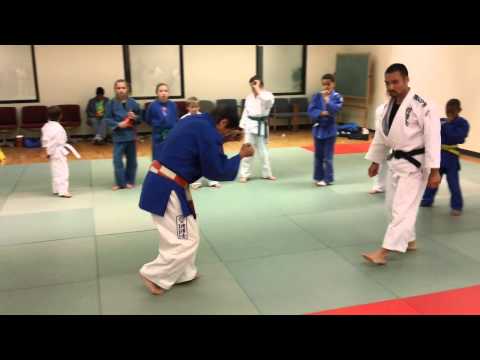
Nori Bunasawa demonstrates Okuri Ashi Barai (Sliding Foot Sweep) at his clinic on April 6, 2013 at the Welcome Mat Judo …
No instructional courses yet for this technique.
Sign in to suggest a course.
Risk of injury to the person this technique is applied to
Timing-based sweep; lower force than trips
Skill level needed to execute this technique reliably
Whether this technique is allowed under major competition rule sets
Kodokan Judo — Official Nage-waza Classification
Traditional Judo throwing/takedown terminology (Kodokan Institute)
Official Kodokan ground technique classification system
Standard Japanese martial arts terminology (kanji/hiragana)
Established Japanese martial arts naming convention — native Japanese term (和語/漢語)
Traditional Judo throwing/takedown terminology (Kodokan Institute)
timing, balance, upper body control for push-pull
good coordination and sense of opponent's weight distribution
core stabilisers, hip adductors/abductors, calves
Every move, in any martial art, shares a few universal traits. Mix and match below to pinpoint the right tool — or compare equivalents across styles.
Okuri ashi barai (following foot sweep) sweeps both of the opponent's feet as they step laterally. The sweep catches the feet as they come together during lateral movement. One of the most elegant throws when executed with correct timing. (Kano, Kodokan Judo)
Timing is fundamental to the technique—Nori Bunasawa emphasizes that even if you step in slightly at the wrong moment, the entire setup falls apart. Practice the footwork rhythm (one, two, one, two) before adding strength, since timing carries you much further than power alone.
No—keep your hands relaxed and focused on control only. Your foot sweep and hip-driven movement will do the work; using your hands to pick up or crunch your opponent actually stops your kinetic energy and undermines the technique.
Wrap your foot around the ankle like your hand would, then drive both ankles together with a straight sweep rather than a bent-leg kick or swinging motion. This is a controlling skill, not a club or strike, and should be practiced deliberately to develop proper mechanics.
Start with footwork and body movement—don't use your hands yet. Lead with your hips, maintain good posture without bobbing, and let your stepping movement control your opponent before you even think about hand techniques.
Okuri Ashi Barai (sliding foot sweep) is a foot sweep subfamily where the attacker sweeps both of the opponent's feet simultaneously or in rapid succession as they slide laterally, catching both feet together with one sweeping motion. The technique exploits lateral movement — when the opponent is moving sideways, there is a moment where both feet are close together and the weight is transferring between them, making them vulnerable to being swept as a unit.
Okuri ashi barai is a classical judo throw from the Kodokan system, classified as an ashi-waza foot technique. The technique is famous for producing some of the most beautiful and perfectly timed throws in judo competition history.
IJF: legal — Legal (ashi-waza) — trips executed without grabbing opponent's legs are permi…; IBJJF: legal — Legal at all belt levels, scored as takedown (2 points); UWW: restricted — Legal in freestyle, restricted in Greco-Roman (leg-to-leg contact prohibited); Unified MMA: legal — Legal takedown technique; ADCC: legal — Legal, scored 2-4 points in second half of match; FIAS Sport Sambo: legal — Legal — all takedowns permitted; FIAS Combat Sambo: legal — Legal; NCAA Folkstyle: legal — Legal, scored as takedown (2 points)
Danger rating 4/10. Moderate — timing-based sweep; lower force than trips
The standard setup chain: Establish Contact → Create Off-Balance → Execute the Takedown → Follow to Ground.
Standard counters include: Sprawl — drop hips back and drive weight down to stuff the takedown attempt / Underhook — establish inside position to control distance and prevent the takedown entry / Post and Circle — post on the attacker's head and circle away to break their angle / Level Change Defence — recognize the shot early and react with appropriate hip defence.
Common variants: Standard trip (blocking or sweeping the support leg while driving the up…); Combination trip (chaining an inside trip with an outside trip when the opp…); Counter trip (using the trip as a counter when the opponent attacks); Clinch trip (executing the trip from a tight clinch position).
Okuri ashi barai has scored ippon at the highest levels of judo competition, including the Olympic Games and World Championships.
Top errors to watch for: Trying to sweep when the opponent is stationary — okuri ashi barai requires lateral movement / Sweeping before the feet come together — if they're spread apart, you only get one / Not driving them laterally hard enough with the hands — the movement creates the opening / Sweeping against the direction of movement instead of with it.
The Okuri Ashi Barai is also known as Okuri Ashi Barai, Sliding Foot Sweep, Following Foot Sweep.