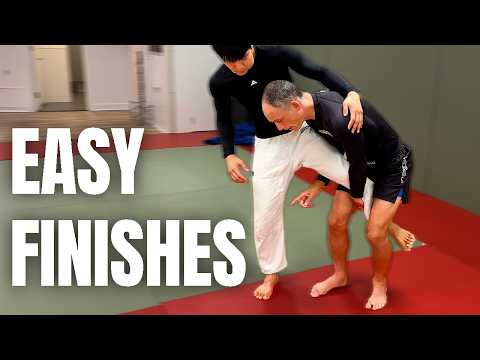
2 EASY Single Leg FINISHES!
0
Single Leg Finish·TeachMeGrappling Coach Brian
This video I show a couple finishes for the single leg takedown. Check out the details and you are sure to find somethi…
Translation: single leg finish (katakana)
The Single Leg Finish subfamily covers the various finishing methods used to complete a single-leg takedown once the attacker has secured the opponent's leg. [1] Capturing the leg is only the first phase — the finish requires the attacker to overcome the opponent's defensive reactions (hopping, whizzer, sprawl, limp leg) to bring them to the mat. [1],[2] Finish methods include running the pipe (lateral circular drive), dump finishes (lifting and rotating the opponent over the captured leg), inside trip finishes (tripping the standing leg), limp arm finishes (releasing one arm to create an angle), and tree-top finishes (elevating the leg overhead). [2] The ability to chain between multiple finishes is what separates elite wrestlers from novices. [2],[3]
Single-leg finishing systems were developed and refined in American folkstyle wrestling, where the single leg's prevalence drove the development of systematic finishing methods and counter-counter techniques. [1] The chain-wrestling philosophy — linking finishes together based on defensive reactions — became a hallmark of American wrestling coaching methodology. [2],[3]
Single leg finishes are taught as a system in American wrestling programmes, with each finish designed to counter specific defensive positions. [1]
Single leg finishes are fundamental scoring techniques in NCAA and international freestyle competition. [1]
No images yet for this technique.
Sign in to suggest an image.
This video I show a couple finishes for the single leg takedown. Check out the details and you are sure to find somethi…
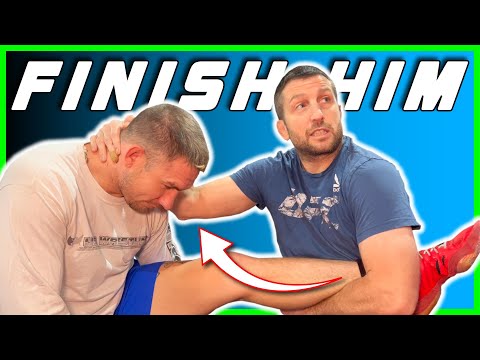
3 simple finishes for your single leg takedown. Wrestling, yes - but BJJ specific! Thanks for watching 😊 Want to supp…
No instructional courses yet for this technique.
Sign in to suggest a course.
Risk of injury to the person this technique is applied to
Single leg is one of the safest takedowns; controlled descent (John Smith methodology)
Skill level needed to execute this technique reliably
Whether this technique is allowed under major competition rule sets
Japanese amateur wrestling terminology
Japanese amateur wrestling terminology
Standard katakana transliteration of Western martial arts terminology (外来語) — used in Japanese MMA, boxing, and BJJ communities
Standard katakana transliteration used in Japanese wrestling (レスリング)
penetration step speed, upper body endurance for finishing, balance
longer arms for reach, quick hips for level change
quadriceps, hip flexors, shoulders, grip/forearms
Every move, in any martial art, shares a few universal traits. Mix and match below to pinpoint the right tool — or compare equivalents across styles.
The Dump Finish completes the single leg by lifting the captured leg high while rotating the opponent over it, 'dumping' them sideways or backward onto the mat. [1] The attacker elevates the captured leg to hip height or above, then uses a combination of lifting and rotational force to tip the opponent past their balance point over the elevated leg. [1,2] The dump finish is effective when the opponent is resisting by hopping toward the attacker, as their forward momentum can be redirected into the rotational dump. [2] The finish typically results in the attacker landing in side control or a scramble position. [2,3]
The Inside Trip Finish completes the single leg by using the attacker's inside leg to trip or hook the opponent's standing (free) leg while maintaining control of the captured leg. [1] With one leg secured and the opponent hopping on the remaining foot, the attacker threads their inside leg behind the opponent's standing ankle and reaps or blocks it, eliminating the last point of balance. [1,2] The inside trip finish is particularly effective against opponents who defend the single leg by hopping and maintaining balance on one foot. [2] The simultaneous control of one leg and trip of the other creates an irrecoverable base collapse. [2,3]
The Limp Arm Finish completes the single leg by deliberately releasing one arm from the leg grip and using it to create an angle change or secondary attack while maintaining control with the remaining arm. [1] When the opponent defends the single leg with a whizzer (overhook) on the attacker's head-side arm, the attacker 'limps' that arm free by relaxing it and circling behind the opponent, using the momentum to create a back-take or angle for completion. [1,2] The limp arm is a counter-to-the-counter technique that turns the opponent's whizzer defence into a vulnerability. [2] The key is timing the arm release with a simultaneous level change or direction shift. [2,3]
The Run The Pipe finish completes the single leg by driving laterally in a circular arc while maintaining control of the captured leg, forcing the opponent to hop until they lose balance. [1] The attacker keeps the leg secured tight to the chest, maintains head pressure on the inside hip, and runs in a half-circle while lifting the captured leg. [1,2] The circular running motion generates centrifugal force that makes single-leg hopping defence progressively more difficult. [2] This is the most commonly taught and highest-percentage single-leg finish in wrestling. [2,3]
The Tree-Top Finish completes the single leg by elevating the captured leg as high as possible — over the attacker's shoulder — so the opponent is balanced on one foot with their leg extended nearly vertical. [1] The extreme elevation makes balance impossible, and the opponent falls backward as their centre of gravity shifts behind the supporting foot. [1,2] The tree-top requires significant upper body strength to elevate the leg overhead while maintaining control. [2] The finish is named for the visual image of the opponent's foot being lifted 'to the tree tops' while they topple backward. [2,3]
No. Coach Brian emphasizes that you should focus on technique rather than muscling the leg up—use efficient mechanics combined with technique, not pure strength, especially when your opponent is bigger than you.
Brian Glick explains that instead of pinching your knees (which some people do to free up their hands), you should use wider legs and focus on your two hands pulling your partner's leg in for a more effective finish.
When your partner's leg is low, they have plenty of balance and can escape by hopping; bringing the leg up high clears their base and allows you to drive your hips forward to complete the takedown.
The Single Leg Finish subfamily covers the various finishing methods used to complete a single-leg takedown once the attacker has secured the opponent's leg. Capturing the leg is only the first phase — the finish requires the attacker to overcome the opponent's defensive reactions (hopping, whizzer, sprawl, limp leg) to bring them to the mat.
Single-leg finishing systems were developed and refined in American folkstyle wrestling, where the single leg's prevalence drove the development of systematic finishing methods and counter-counter techniques. The chain-wrestling philosophy — linking finishes together based on defensive reactions — became a hallmark of American wrestling coaching methodology.
IJF: banned — Banned since 2010 leg grab prohibition — direct hansoku-make for touching opp…; IBJJF: legal — Legal at all belt levels, scored as takedown (2 points); UWW: restricted — Legal in freestyle (2-4 points), banned in Greco-Roman (no attacks below waist); Unified MMA: legal — Legal takedown technique; ADCC: legal — Legal, scored 2-4 points in second half of match; FIAS Sport Sambo: legal — Legal — all takedowns permitted; FIAS Combat Sambo: legal — Legal; NCAA Folkstyle: legal — Legal, scored as takedown (2 points)
Danger rating 3/10. Moderate — single leg is one of the safest takedowns; controlled descent (John Smith methodology)
The standard setup chain: Level Change → Penetration Step → Head Position → Grip the Leg → Drive and Finish.
Standard counters include: Sprawl — drop hips back and drive weight down to stuff the takedown attempt / Whizzer (Overhook) — overhook the attacking arm and drive hip pressure to kill the angle / Cross-Face — push the attacker's head across their body to break their grip and alignment / Limp Leg — pull the attacked leg free by going limp and circling away.
Common variants: Inside single (shooting to the inside of the lead leg, head inside position); Outside single (attacking from the outside of the lead leg); High crotch (securing the thigh above the knee with head in the hip); Low single (attacking the ankle from outside range without deep penet…).
Single leg finishes are fundamental scoring techniques in NCAA and international freestyle competition.
Top errors to watch for: Only knowing one finish, so a single defensive action stops the entire takedown / Holding the leg passively and waiting instead of immediately attacking with a finish / Head too far from the opponent's body, giving them space to pummel or whizzer / Carrying the leg too low (at the ankle) instead of up at the thigh for maximum control.
The Single Leg Finish is also known as Shinguru Reggu Finisshu, Single Leg Completion, Single Leg Finish Method, Shiage Waza.