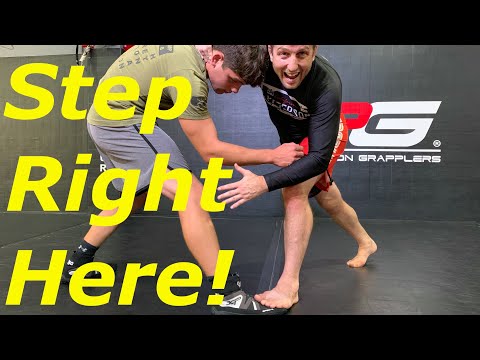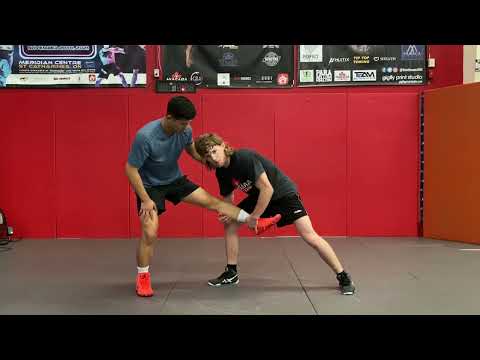
Wrestling basics #2: Single Leg Takedown
0
Single Leg Takedown·Niagara Top Team
Niagara Top Team's rec class wrestling coach Alex Moher breaks down the basics of the highest percentage wrestling taked…
Translation: single leg takedown (katakana)
The Single Leg Takedown family is one of the most versatile and commonly used takedown categories, where the attacker captures and controls one of the opponent's legs while maintaining head position and driving to complete the takedown. [1] Single legs are categorised by the height of the initial attack — high crotch (attacking above the knee at hip level), sweep singles (attacking at the knee), and low singles (attacking at the ankle) — and by the finishing method used once the leg is captured. [1],[2] The single leg is the most frequently attempted takedown in folkstyle wrestling and is extremely common in MMA due to its versatility, multiple finishing options, and relatively low risk compared to double legs. [2],[3] The technique allows the attacker to chain between different finishes based on the opponent's defensive reactions. [3]
Single-leg takedowns have been practised across wrestling cultures for millennia, but the modern systematised single leg was developed primarily in American folkstyle wrestling during the 20th century. [1] The single leg became the dominant takedown in MMA because its multiple finishing options — run the pipe, dump, trip, tree-top — provided answers to every defensive reaction. [2],[3]
The single leg takedown isolates one of the opponent's legs, controlling it to off-balance and ground them. [1],[2] It is the most versatile takedown in wrestling, with multiple entries and finishes. [1] The single leg is lower risk than the double leg because the attacker maintains a more defensive posture. [2],[3]
The single leg is the second most commonly attempted takedown in UFC competition after the double leg. [1] In Olympic freestyle wrestling, single leg entries are among the most frequently scored techniques. [2] Wrestlers like John Smith (two-time Olympic gold, 1988 and 1992) built their careers on the low single leg. [3]
No images yet for this technique.
Sign in to suggest an image.
Niagara Top Team's rec class wrestling coach Alex Moher breaks down the basics of the highest percentage wrestling taked…
This video I breakdown a very easy single leg entry. Check out the details and you are sure to find something useful! …
No instructional courses yet for this technique.
Sign in to suggest a course.
Risk of injury to the person this technique is applied to
Single leg is one of the safest takedowns; controlled descent (John Smith methodology)
Skill level needed to execute this technique reliably
Whether this technique is allowed under major competition rule sets
Japanese amateur wrestling terminology
Japanese amateur wrestling terminology
Standard katakana transliteration of Western martial arts terminology (外来語) — used in Japanese MMA, boxing, and BJJ communities
Standard katakana transliteration used in Japanese wrestling (レスリング)
explosive lower body power, level change speed, forward drive
stocky build with strong legs and low centre of gravity
quadriceps, glutes, hamstrings, core, shoulders
Every move, in any martial art, shares a few universal traits. Mix and match below to pinpoint the right tool — or compare equivalents across styles.
The High Crotch Single Leg subfamily attacks the opponent's leg at the highest point — the inner thigh or hip crease — by driving the head to the inside and reaching deep between the legs. [1] The high crotch position provides tremendous lifting power because the attacker's head and shoulder are positioned directly under the opponent's centre of mass, allowing for powerful elevation. [1,2] High crotch entries are typically initiated from a standard penetration step and can be finished with a lift, a trip, or a transition to a double leg. [2] The high crotch is particularly effective against wrestlers with strong sprawl defence because the deep inside position makes it difficult to sprawl the hips back. [2,3]
The Low Single Leg subfamily attacks the opponent's leg at the lowest point — the ankle or lower shin — requiring a deep level change where the attacker often drops to one or both knees. [1] The low single is initiated from a greater distance than other single-leg entries because the attacker needs to reach all the way to the ankle. [1,2] The primary advantage is that the low target is extremely difficult to defend with a standard sprawl, and the opponent often doesn't recognise the attack until the ankle is already captured. [2] Low singles are commonly used as surprise attacks, change-of-pace techniques, and entries from unconventional angles. [2,3]
The Single Leg Finish subfamily covers the various finishing methods used to complete a single-leg takedown once the attacker has secured the opponent's leg. [1] Capturing the leg is only the first phase — the finish requires the attacker to overcome the opponent's defensive reactions (hopping, whizzer, sprawl, limp leg) to bring them to the mat. [1,2] Finish methods include running the pipe (lateral circular drive), dump finishes (lifting and rotating the opponent over the captured leg), inside trip finishes (tripping the standing leg), limp arm finishes (releasing one arm to create an angle), and tree-top finishes (elevating the leg overhead). [2] The ability to chain between multiple finishes is what separates elite wrestlers from novices. [2,3]
The Sweep Single Leg subfamily attacks the opponent's lead leg with a sweeping motion at knee height, combining a reach for the leg with a lateral sweeping force to collapse the opponent's base. [1] Unlike direct-drive single legs that attack in a straight line, the sweep single uses an arcing, crescent-shaped attack path that approaches the leg from the outside and sweeps it inward. [1,2] Sweep singles include knee taps and standard sweep singles, both of which use the sweeping mechanic to off-balance the opponent. [2] The lateral force vector makes sweep singles effective from angles where direct shots would be telegraphed. [2,3]
The single leg takedown is the second most common takedown in MMA after the double leg. It offers more entries and finishes than any other takedown — inside single, outside single, high crotch single. (Gable, Coaching Wrestling Successfully)
Your lead leg needs to be close to the leg you're attacking. If you're in a cross stance, you won't be able to execute the technique effectively—you need to pull your opponent into a mirrored stance first so you can take a proper penetration step.
Keep your head looking into your opponent's chest or ribs the entire time. If your head is on their chest, they can break your posture and sprawl you out, but if your head is locked in properly, they can't put pressure or come over top of you.
Use your head pressure and body pressure to push them backwards rather than pulling with your arms, which is too heavy. Grip behind the knee and curl the leg down toward the calf while keeping your chest heavy on their leg to force them to hop on their back foot.
Stay super squatted in your stance. If you go straight-legged, your opponent can manipulate your posture and knock your head to the side, but staying low keeps your head in place and prevents them from coming over top.
Once you secure the leg in your armpit, free up your arm and look for trips—one main option is taking the collar, pulling them backwards, and tripping with your knee. Make sure to kick above the knee rather than at the ankle, otherwise they can hop over it.
The Single Leg Takedown family is one of the most versatile and commonly used takedown categories, where the attacker captures and controls one of the opponent's legs while maintaining head position and driving to complete the takedown. Single legs are categorised by the height of the initial attack — high crotch (attacking above the knee at hip level), sweep singles (attacking at the knee), and low singles (attacking at the ankle) — and by the finishing method used once the leg is captured.
Single-leg takedowns have been practised across wrestling cultures for millennia, but the modern systematised single leg was developed primarily in American folkstyle wrestling during the 20th century. The single leg became the dominant takedown in MMA because its multiple finishing options — run the pipe, dump, trip, tree-top — provided answers to every defensive reaction.
IJF: banned — Banned since 2010 leg grab prohibition — direct hansoku-make for touching opp…; IBJJF: legal — Legal at all belt levels, scored as takedown (2 points); UWW: restricted — Legal in freestyle (2-4 points), banned in Greco-Roman (no attacks below waist); Unified MMA: legal — Legal takedown technique; ADCC: legal — Legal, scored 2-4 points in second half of match; FIAS Sport Sambo: legal — Legal — all takedowns permitted; FIAS Combat Sambo: legal — Legal; NCAA Folkstyle: legal — Legal, scored as takedown (2 points)
Danger rating 3/10. Moderate — single leg is one of the safest takedowns; controlled descent (John Smith methodology)
The standard setup chain: Level Change → Penetration Step → Head Position → Grip the Leg → Drive and Finish.
Standard counters include: Sprawl — drop hips back and drive weight down to stuff the takedown attempt / Whizzer (Overhook) — overhook the attacking arm and drive hip pressure to kill the angle / Cross-Face — push the attacker's head across their body to break their grip and alignment / Limp Leg — pull the attacked leg free by going limp and circling away.
Common variants: Blast double (high-impact forward drive through the opponent without ch…); Snatch double (pulling both legs together and driving laterally); Run-the-pipe double (running through the opponent in a linear drive); Low double (deep penetration step attacking below the knees).
The single leg is the second most commonly attempted takedown in UFC competition after the double leg. In Olympic freestyle wrestling, single leg entries are among the most frequently scored techniques.
Top errors to watch for: Head on the outside of the captured leg — the number one single-leg mistake at all levels / Holding the leg at arm's length instead of tight to the chest — no control / Stopping after capturing the leg without immediately initiating a finish / Grabbing the ankle instead of securing at thigh level — ankle grips are easily shaken off.
The Single Leg Takedown is also known as Shinguru Reggu Teikudaun, Single Leg, Single, Leg Pick.