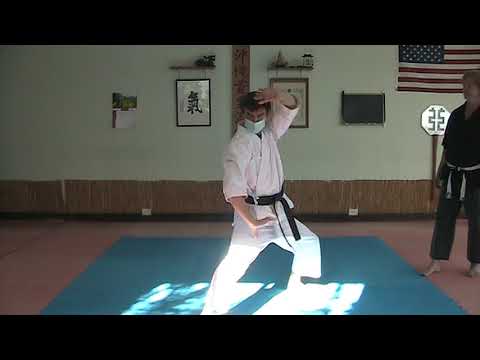
Wansu Kata (Dragon Boy/Girl Dumping Form/Strong Arm Form
0
Dump Finish·AncientArts Family Karate/Ju-Jitsu Academy·Added by Admin
Informal rendition of Wansu Kata
Translation: dump finish (katakana)
The Dump Finish completes the single leg by lifting the captured leg high while rotating the opponent over it, 'dumping' them sideways or backward onto the mat. [1] The attacker elevates the captured leg to hip height or above, then uses a combination of lifting and rotational force to tip the opponent past their balance point over the elevated leg. [1],[2] The dump finish is effective when the opponent is resisting by hopping toward the attacker, as their forward momentum can be redirected into the rotational dump. [2] The finish typically results in the attacker landing in side control or a scramble position. [2],[3]
The dump finish trips the opponent over the captured leg using a lateral driving motion, a standard single leg completion in folkstyle and freestyle wrestling. [1]
The dump finish is a common single leg completion in NCAA and freestyle competition. [1]
No images yet for this technique.
Sign in to suggest an image.
Informal rendition of Wansu Kata
No instructional courses yet for this technique.
Sign in to suggest a course.
Risk of injury to the person this technique is applied to
Single leg is one of the safest takedowns; controlled descent (John Smith methodology)
Skill level needed to execute this technique reliably
Whether this technique is allowed under major competition rule sets
Japanese amateur wrestling terminology
Japanese amateur wrestling terminology
Standard katakana transliteration of Western martial arts terminology (外来語) — used in Japanese MMA, boxing, and BJJ communities
Standard katakana transliteration used in Japanese wrestling (レスリング)
penetration step speed, upper body endurance for finishing, balance
longer arms for reach, quick hips for level change
quadriceps, hip flexors, shoulders, grip/forearms
Keiko-ken is a hidden movement in the form that consists of a single knuckle strike performed at chest height. According to AncientArts Family Karate/Ju-Jitsu Academy, it's an important detail practitioners often miss when performing the technique.
You should stack the elbows on top of each other when executing this technique to generate proper power and control through the movement.
The Dump Finish completes the single leg by lifting the captured leg high while rotating the opponent over it, 'dumping' them sideways or backward onto the mat. The attacker elevates the captured leg to hip height or above, then uses a combination of lifting and rotational force to tip the opponent past their balance point over the elevated leg.
The dump finish has been part of wrestling's single-leg finishing system for decades, developed as a reliable completion method when forward-drive finishes are blocked. It is one of the first single-leg finishes taught to developing wrestlers.
IJF: banned — Banned since 2010 leg grab prohibition — direct hansoku-make for touching opp…; IBJJF: legal — Legal at all belt levels, scored as takedown (2 points); UWW: restricted — Legal in freestyle (2-4 points), banned in Greco-Roman (no attacks below waist); Unified MMA: legal — Legal takedown technique; ADCC: legal — Legal, scored 2-4 points in second half of match; FIAS Sport Sambo: legal — Legal — all takedowns permitted; FIAS Combat Sambo: legal — Legal; NCAA Folkstyle: legal — Legal, scored as takedown (2 points)
Danger rating 3/10. Moderate — single leg is one of the safest takedowns; controlled descent (John Smith methodology)
The standard setup chain: Establish Contact → Create Off-Balance → Execute the Takedown → Follow to Ground.
Standard counters include: Sprawl — drop hips back and drive weight down to stuff the takedown attempt / Underhook — establish inside position to control distance and prevent the takedown entry / Post and Circle — post on the attacker's head and circle away to break their angle / Level Change Defence — recognize the shot early and react with appropriate hip defence.
Common variants: Inside single (shooting to the inside of the lead leg, head inside position); Outside single (attacking from the outside of the lead leg); High crotch (securing the thigh above the knee with head in the hip); Low single (attacking the ankle from outside range without deep penet…).
The dump finish is a common single leg completion in NCAA and freestyle competition.
Top errors to watch for: Not elevating the leg high enough — the dump requires significant elevation to work / Rotating without driving forward, so the opponent hops away instead of falling / Letting the captured leg drop during the rotation, losing all your leverage / Trying to dump a crouching opponent who has lowered their center of gravity — switch to a trip.
The Dump Finish is also known as Danpu Finisshu, Dump Takedown, Rotate-And-Dump, Leg Dump.