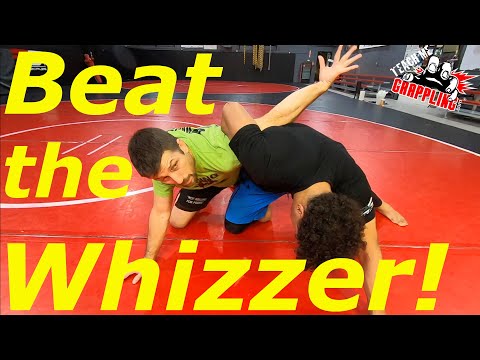
SLICK Way to BEAT the Whizzer!... LIMP ARM!
0
Limp Arm Finish·TeachMeGrappling Coach Brian·Added by Admin
PLEASE Click this link to SUPPORT the TeachMeGrappling Channel!!! https://www.patreon.com/TeachMeGrappling or https:/…
Translation: limp arm finish (katakana)
The Limp Arm Finish completes the single leg by deliberately releasing one arm from the leg grip and using it to create an angle change or secondary attack while maintaining control with the remaining arm. [1] When the opponent defends the single leg with a whizzer (overhook) on the attacker's head-side arm, the attacker 'limps' that arm free by relaxing it and circling behind the opponent, using the momentum to create a back-take or angle for completion. [1],[2] The limp arm is a counter-to-the-counter technique that turns the opponent's whizzer defence into a vulnerability. [2] The key is timing the arm release with a simultaneous level change or direction shift. [2],[3]
The limp arm finish was developed in American folkstyle wrestling as a counter to the whizzer defence, which is the most common defensive reaction to single-leg attacks. [1] The technique represents the chain-wrestling philosophy where every defence has a counter and every counter has a re-counter. [2],[3]
The limp arm finish is a standard technique in American folkstyle wrestling, developed as a counter to the overhook/whizzer defence. [1]
The limp arm finish is commonly used in NCAA and freestyle competition. [1]
No images yet for this technique.
Sign in to suggest an image.
PLEASE Click this link to SUPPORT the TeachMeGrappling Channel!!! https://www.patreon.com/TeachMeGrappling or https:/…
No instructional courses yet for this technique.
Sign in to suggest a course.
Risk of injury to the person this technique is applied to
Single leg is one of the safest takedowns; controlled descent (John Smith methodology)
Skill level needed to execute this technique reliably
Whether this technique is allowed under major competition rule sets
Japanese amateur wrestling terminology
Japanese amateur wrestling terminology
Standard katakana transliteration of Western martial arts terminology (外来語) — used in Japanese MMA, boxing, and BJJ communities
Standard katakana transliteration used in Japanese wrestling (レスリング)
penetration step speed, upper body endurance for finishing, balance
longer arms for reach, quick hips for level change
quadriceps, hip flexors, shoulders, grip/forearms
Turn your palm up before pulling your arm out, similar to giving a high-five. Coach Brian emphasizes rolling your hand so your palm faces up, which allows your arm to come straight out cleanly rather than getting stuck and risking an elbow lock.
Make sure to bring your head over your opponent's spine after the limp arm sweep. If you leave your head positioned incorrectly, your opponent can come back with a new wizzer attack, so getting your head across their spine is critical to preventing follow-up attacks.
The limp arm is a response to the wizzer attack from half guard. Coach Brian recommends transitioning to back control with hooks rather than going for a headlock, as this gives you better positioning and control.
Place your right hand on the opponent's biceps and your left hand on their neck/shoulder area with elbows creating a frame. When you kick to throw them over your head, your hand sweeps under their armpit to their shoulder to create the necessary tension.
The Limp Arm Finish completes the single leg by deliberately releasing one arm from the leg grip and using it to create an angle change or secondary attack while maintaining control with the remaining arm. When the opponent defends the single leg with a whizzer (overhook) on the attacker's head-side arm, the attacker 'limps' that arm free by relaxing it and circling behind the opponent, using the momentum to create a back-take or angle for completion.
The limp arm finish was developed in American folkstyle wrestling as a counter to the whizzer defence, which is the most common defensive reaction to single-leg attacks. The technique represents the chain-wrestling philosophy where every defence has a counter and every counter has a re-counter.
IJF: banned — Banned since 2010 leg grab prohibition — direct hansoku-make for touching opp…; IBJJF: legal — Legal at all belt levels, scored as takedown (2 points); UWW: restricted — Legal in freestyle (2-4 points), banned in Greco-Roman (no attacks below waist); Unified MMA: legal — Legal takedown technique; ADCC: legal — Legal, scored 2-4 points in second half of match; FIAS Sport Sambo: legal — Legal — all takedowns permitted; FIAS Combat Sambo: legal — Legal; NCAA Folkstyle: legal — Legal, scored as takedown (2 points)
Danger rating 3/10. Moderate — single leg is one of the safest takedowns; controlled descent (John Smith methodology)
The standard setup chain: Establish Contact → Create Off-Balance → Execute the Takedown → Follow to Ground.
Standard counters include: Sprawl — drop hips back and drive weight down to stuff the takedown attempt / Underhook — establish inside position to control distance and prevent the takedown entry / Post and Circle — post on the attacker's head and circle away to break their angle / Level Change Defence — recognize the shot early and react with appropriate hip defence.
Common variants: Inside single (shooting to the inside of the lead leg, head inside position); Outside single (attacking from the outside of the lead leg); High crotch (securing the thigh above the knee with head in the hip); Low single (attacking the ankle from outside range without deep penet…).
The limp arm finish is commonly used in NCAA and freestyle competition.
Top errors to watch for: Going limp with both arms instead of just the whizzered arm — you'll lose the leg / Not circling to a new angle after the limp, staying in the same dead position / Releasing the limp arm slowly instead of suddenly — the surprise is essential / Losing grip on the captured leg during the arm transition.
The Limp Arm Finish is also known as Rinpu Āmu Finisshu, Limp Arm, Whizzer Counter Finish, Arm Release Finish.