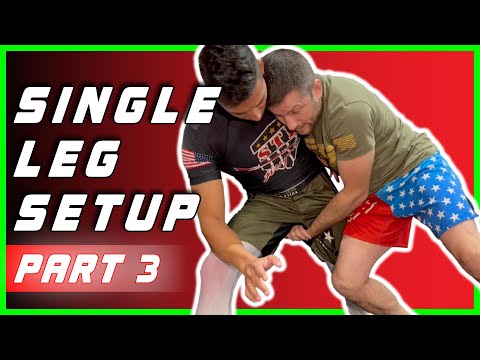
Run the Pipe off the CAGE... Part 3
0
Run-The-Pipe Double·TeachMeGrappling Coach Brian
This video is part 3 of showing my guys a single leg with a running the pipe finish when you push your opponent against …
Translation: run-the-pipe double (katakana)
The Run-The-Pipe Double subfamily executes the double leg with a lateral running motion after securing the legs, driving the opponent sideways rather than straight back. [1] After the initial penetration and leg contact, the attacker 'runs the pipe' by stepping laterally while lifting the opponent's legs, forcing them to hop on one foot until they lose balance and topple sideways. [1],[2] This lateral finishing method is effective when the opponent's initial sprawl or weight distribution prevents a direct forward drive. [2] The name 'run the pipe' refers to the circular running path the attacker takes while holding the opponent's legs. [2],[3]
Run-the-pipe is a finishing mechanic taught in American folkstyle and freestyle wrestling. [1]
The run-the-pipe finish is commonly used in NCAA and international wrestling competition. [1]
No images yet for this technique.
Sign in to suggest an image.
This video is part 3 of showing my guys a single leg with a running the pipe finish when you push your opponent against …
No instructional courses yet for this technique.
Sign in to suggest a course.
Risk of injury to the person this technique is applied to
Double leg drives through opponent; moderate impact on landing
Skill level needed to execute this technique reliably
Whether this technique is allowed under major competition rule sets
Japanese amateur wrestling terminology
Japanese amateur wrestling terminology
Standard katakana transliteration of Western martial arts terminology (外来語) — used in Japanese MMA, boxing, and BJJ communities
Standard katakana transliteration used in Japanese wrestling (レスリング)
explosive lower body power, level change speed, forward drive
stocky build with strong legs and low centre of gravity
quadriceps, glutes, hamstrings, core, shoulders
Every move, in any martial art, shares a few universal traits. Mix and match below to pinpoint the right tool — or compare equivalents across styles.
According to Coach Brian at TeachMeGrappling, the wizard—a counter to the single leg—actually helps set up run-the-pipe. When your opponent pulls you into the wizard, they create the opportunity for you to start running the pipe.
Coach Brian emphasizes that you can use the wall or cage just like you would in a back escape to help you get up and prevent your opponent from establishing hooks.
If your opponent blocks your movement, Coach Brian advises hooking the leg and re-engaging rather than giving up on the position.
The Run-The-Pipe Double subfamily executes the double leg with a lateral running motion after securing the legs, driving the opponent sideways rather than straight back. After the initial penetration and leg contact, the attacker 'runs the pipe' by stepping laterally while lifting the opponent's legs, forcing them to hop on one foot until they lose balance and topple sideways.
The run-the-pipe finish became a standard wrestling technique as coaches systematised lateral finishing methods for double legs that stalled on initial contact. The term originated in American folkstyle wrestling rooms and has been adopted globally.
IJF: banned — Banned since 2010 leg grab prohibition — direct hansoku-make for touching opp…; IBJJF: legal — Legal at all belt levels, scored as takedown (2 points); UWW: restricted — Legal in freestyle (2-4 points), banned in Greco-Roman (no attacks below waist); Unified MMA: legal — Legal takedown technique; ADCC: legal — Legal, scored 2-4 points in second half of match; FIAS Sport Sambo: legal — Legal — all takedowns permitted; FIAS Combat Sambo: legal — Legal; NCAA Folkstyle: legal — Legal, scored as takedown (2 points)
Danger rating 4/10. Moderate — double leg drives through opponent; moderate impact on landing
The standard setup chain: Establish Contact → Create Off-Balance → Execute the Takedown → Follow to Ground.
Standard counters include: Sprawl — drop hips back and drive weight down to stuff the takedown attempt / Underhook — establish inside position to control distance and prevent the takedown entry / Post and Circle — post on the attacker's head and circle away to break their angle / Level Change Defence — recognize the shot early and react with appropriate hip defence.
Common variants: Blast double (high-impact forward drive through the opponent without ch…); Snatch double (pulling both legs together and driving laterally); Run-the-pipe double (running through the opponent in a linear drive); Low double (deep penetration step attacking below the knees).
The run-the-pipe finish is commonly used in NCAA and international wrestling competition.
Top errors to watch for: Running in a straight line instead of an arc — the circular motion is what off-balances them / Letting the legs separate during the run — keep them pinched tight / Stopping the run when the opponent tries to base — that's exactly when you need to keep moving / Head not driving into their hip, so they can rotate their body to face you.
The Run-The-Pipe Double is also known as Ran Za Paipu Daburu, Lateral Double Leg, Circle Double, Run The Pipe.