The Perfect Double Leg
0
Low Double Leg·wrestlejitsu
Check out the wrestlejitsu blog: http://wrestlejitsu.wordpress.com Subscribe to my blog and channel! Like the video! Tha…
Translation: low double leg (katakana)
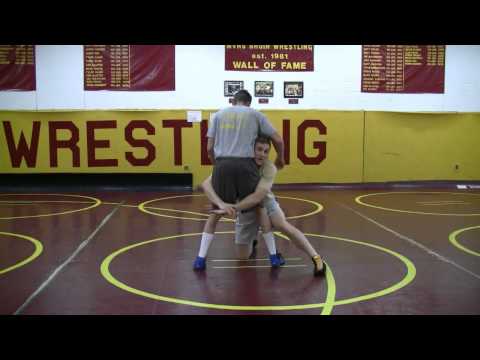
The Low Double Leg subfamily attacks both legs below the knee, targeting the shins or ankles rather than the thighs. [1] The low double requires an extremely deep level change, often dropping to both knees during the penetration step, to reach the low target. [1],[2] The advantage of the low attack is that it is difficult to sprawl against — the opponent's legs are attacked below the fulcrum point, so sprawling actually helps the attacker by loading the opponent's weight onto the already-captured legs. [2] The trade-off is the deep level change required, which can leave the attacker vulnerable if the shot is poorly timed. [2],[3]
Low double leg attacks developed as a counter to improved sprawl defence in competition wrestling, with wrestlers seeking entries that bypassed the hip-level sprawl. [1] Japanese shoot-wrestling and catch wrestling traditions also emphasised low-level leg attacks that influenced modern technique. [2],[3]
The low double leg is a standard variation in freestyle and folkstyle wrestling, adapted into MMA and BJJ. [1]
The low double leg is used in both wrestling and MMA competition. [1]
No images yet for this technique.
Sign in to suggest an image.
Check out the wrestlejitsu blog: http://wrestlejitsu.wordpress.com Subscribe to my blog and channel! Like the video! Tha…
www.cumulussport.com Step by step instructions on how to execute a wrestling double leg takedown.
No instructional courses yet for this technique.
Sign in to suggest a course.
Risk of injury to the person this technique is applied to
Double leg drives through opponent; moderate impact on landing
Skill level needed to execute this technique reliably
Whether this technique is allowed under major competition rule sets
Japanese amateur wrestling terminology
Japanese amateur wrestling terminology
Standard katakana transliteration of Western martial arts terminology (外来語) — used in Japanese MMA, boxing, and BJJ communities
Standard katakana transliteration used in Japanese wrestling (レスリング)
explosive lower body power, level change speed, forward drive
stocky build with strong legs and low centre of gravity
quadriceps, glutes, hamstrings, core, shoulders
Every move, in any martial art, shares a few universal traits. Mix and match below to pinpoint the right tool — or compare equivalents across styles.
You need to be within touching distance of your opponent. If you're too far away, your opponent will see the shot coming and can defend with a sprawl before you even make contact.
Once you get in close, take a lot of little quick steps to drive through your opponent—what some coaches call 'twinkle toes.' This keeps you moving forward aggressively to complete the takedown.
Focus on good penetration with your step while tracking the opponent's knee and turning your hips. Make sure you have solid collar control and maintain that close touching distance before driving forward.
The Low Double Leg subfamily attacks both legs below the knee, targeting the shins or ankles rather than the thighs. The low double requires an extremely deep level change, often dropping to both knees during the penetration step, to reach the low target.
Low double leg attacks developed as a counter to improved sprawl defence in competition wrestling, with wrestlers seeking entries that bypassed the hip-level sprawl. Japanese shoot-wrestling and catch wrestling traditions also emphasised low-level leg attacks that influenced modern technique.
IJF: banned — Banned since 2010 leg grab prohibition — direct hansoku-make for touching opp…; IBJJF: legal — Legal at all belt levels, scored as takedown (2 points); UWW: restricted — Legal in freestyle (2-4 points), banned in Greco-Roman (no attacks below waist); Unified MMA: legal — Legal takedown technique; ADCC: legal — Legal, scored 2-4 points in second half of match; FIAS Sport Sambo: legal — Legal — all takedowns permitted; FIAS Combat Sambo: legal — Legal; NCAA Folkstyle: legal — Legal, scored as takedown (2 points)
Danger rating 4/10. Moderate — double leg drives through opponent; moderate impact on landing
The standard setup chain: Setup with Strikes or Feint → Level Change → Penetration Step → Head in Chest → Lift and Drive.
Standard counters include: Sprawl — drop hips back and drive weight down to stuff the takedown attempt / Sprawl and Cross-Face — combine hip drop with head push to flatten the attacker / Guillotine Choke — wrap the head during the shot attempt and apply front headlock pressure / Knee Strike — time a rising knee to meet the incoming level change.
Common variants: Blast double (high-impact forward drive through the opponent without ch…); Snatch double (pulling both legs together and driving laterally); Run-the-pipe double (running through the opponent in a linear drive); Low double (deep penetration step attacking below the knees).
The low double leg is used in both wrestling and MMA competition.
Top errors to watch for: Not dropping low enough — if you're grabbing at knee height, you're doing a regular double, not a low double / Both knees on the mat simultaneously, eliminating your forward drive / Pulling the legs without driving forward — you need both actions together / Head down looking at the mat, unable to react to sprawl or guillotine attempts.
The Low Double Leg is also known as Rō Daburu Reggu, Low Double, Knee-Level Double Leg, Deep Double.