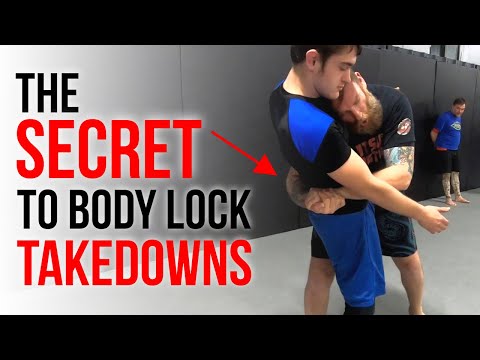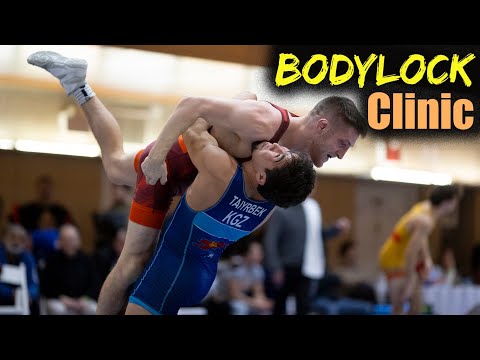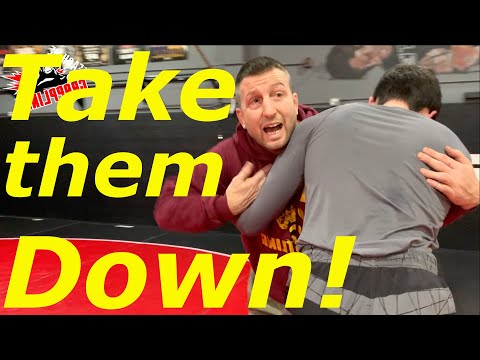
Basic CLINCH Bodylock Takedowns for EVERYONE!
0
Standard Body Lock Wall TD·TeachMeGrappling Coach Brian
This video I teach my morning class a basic series I like from the pummel position. Check out the details and you are s…
Translation: standard body lock wall takedown
The Standard Body Lock Wall TD executes the fundamental body lock takedown against the cage wall, where the attacker pins the opponent against the fence with a locked body grip, then lifts and turns to bring them to the mat. [1] The attacker positions the hips underneath the opponent's centre of mass, locks a Gable or S-grip around the waist, and uses a combination of hip lift and lateral rotation to peel the opponent off the wall and onto the mat. [1],[2] The wall prevents the opponent from creating distance or sprawling, making this a very difficult takedown to defend once the lock is secured. [2] The technique typically lands the attacker in a dominant top position. [2],[3]
The body lock wall takedown combines the cage's backstop effect with the control of a locked body clinch, creating one of the most reliable takedown positions in MMA. [1] Once the body lock is secured against the cage, the attacker can use trips, lifts, or sustained driving pressure to bring the opponent down. [1]
The standard body lock wall takedown is the baseline cage wrestling technique derived from Greco-Roman body lock mechanics. [1]
Khabib Nurmagomedov's cage body lock takedowns became a defining feature of his fighting style during his 29-0 career, with opponents unable to prevent the takedown once the lock was secured against the fence. [1] Daniel Cormier also used body lock wall takedowns extensively as UFC heavyweight and light heavyweight champion (2015-2019). [2]
No images yet for this technique.
Sign in to suggest an image.
This video I teach my morning class a basic series I like from the pummel position. Check out the details and you are s…
Your body is unique—your training should be too. Take our survey to get a FREE 14-day Jiu-Jitsu plan custom-tailored to …
► Become a Member via Patreon: https://www.patreon.com/dpsbreakdowns ► Become a Member via YouTube Memberships: https:/…
The standard body lock wall takedown is established from the clinch through pummeling to achieve double underhooks, followed by a controlled descent executed against an opponent's body or a wall. TRITAC Martial Arts emphasizes targeting the kink at the opponent's hip—the space between the floating ribs and hip socket—rather than the muscular center of the back, as this anatomically weak point requires less strength to control and fold. The grip is secured by tucking the hands into this pocket and using chest pressure combined with core tension rather than arm strength. TeachMeGrappling Coach Brian describes the entry similarly, stressing that once double unders are obtained with elbows flared and high positioning on the neck/upper back, the practitioner lifts and twists the opponent, using either a throw-by maneuver (pivoting to deepen the arm lock) or a trip/knee block to take the opponent down. Both instructors note that from double unders, if the opponent attempts a headlock defense, the defender should maintain a solid base with hips in and snap both hands upward to adjust to a bear hug if needed. DPS Breakdowns provides advanced context through Zhumashbek's matches, revealing that the front uchimata (elevated twisting throw using the inside knee to elevate and rotate the opponent's inner thigh) combined with the body lock creates a high-percentage finishing technique, with footwork pivots that twist the opponent horizontally to the ground. All three instructors agree that proper hip positioning, maintaining the lock's integrity, and understanding the mechanical angles—rather than raw strength—are critical to consistent execution.
Synthesized from 3 instructors
No instructional courses yet for this technique.
Sign in to suggest a course.
Risk of injury to the person this technique is applied to
Cage/wall-assisted takedowns; controlled descent against structure
Skill level needed to execute this technique reliably
Whether this technique is allowed under major competition rule sets
Japanese MMA standard terminology
Japanese MMA standard terminology
Standard katakana transliteration of Western martial arts terminology (外来語) — used in Japanese MMA, boxing, and BJJ communities
Katakana transliteration used in Japanese MMA/Shooto
upper body squeeze strength, lifting power, hip drive
thick chest and arms for tight lock, strong lower back for lifts
pectorals, biceps, erector spinae, glutes
You need to establish a solid base and come up into the lock to prevent the headlock. Coach Brian emphasizes that you cannot be in a position where you're vulnerable to headlocks—maintain proper posture as you secure the double under.
If the opponent head blocks you, take both hands and turn up facing upward, then hard snap on the back of the shoulders. This counter-move is called the double snap and helps you break through their defense.
Look for underhook entries when your opponent's elbow space opens on one side, which creates the opportunity to transition into the double under bodylock position. DPS Breakdowns notes that consistently getting into the bodylock position starts with capitalizing on these underhook entries.
From the bodylock, you can transition to submissions like the Kimura and chokes. TRITAC Martial Arts explains that once you have the bodylock secured, you can switch your grip from a seatbelt position to an arm grip to establish a Kimura, or attack chokes depending on your positioning.
The Standard Body Lock Wall TD executes the fundamental body lock takedown against the cage wall, where the attacker pins the opponent against the fence with a locked body grip, then lifts and turns to bring them to the mat. The attacker positions the hips underneath the opponent's centre of mass, locks a Gable or S-grip around the waist, and uses a combination of hip lift and lateral rotation to peel the opponent off the wall and onto the mat.
This cage-specific technique was developed by MMA wrestlers who recognised that the fence neutralised many traditional takedown defences. Khabib Nurmagomedov's systematic use of body lock wall takedowns in the UFC demonstrated the technique's effectiveness at the highest level.
IJF: legal — Legal takedown technique; IBJJF: legal — Legal at all belt levels, scored as takedown (2 points); UWW: legal — Legal in both freestyle and Greco-Roman; Unified MMA: legal — Legal takedown technique; ADCC: legal — Legal, scored 2-4 points in second half of match; FIAS Sport Sambo: legal — Legal — all takedowns permitted; FIAS Combat Sambo: legal — Legal; NCAA Folkstyle: legal — Legal, scored as takedown (2 points)
Danger rating 4/10. Moderate — cage/wall-assisted takedowns; controlled descent against structure
The standard setup chain: Close Distance → Establish the Lock → Hip Pressure → Lift or Trip.
Standard counters include: Sprawl — drop hips back and drive weight down to stuff the takedown attempt / Underhook Pummeling — fight for inside position to neutralize the lock / Hip Switch — rotate hips to break the grip angle and create separation / Knee Tap — redirect opponent's momentum with a quick leg attack.
Common variants: Front body lock (securing the lock face-to-face and driving laterally or b…); Rear body lock (securing from behind for mat returns or lifts); Side body lock (angled body lock for trips and throws); Body lock to trip (combining the lock with a foot trip for the finish).
Khabib Nurmagomedov's cage body lock takedowns became a defining feature of his fighting style during his 29-0 career, with opponents unable to prevent the takedown once the lock was secured against the fence. Daniel Cormier also used body lock wall takedowns extensively as UFC heavyweight and light heavyweight champion (2015-2019).
Top errors to watch for: Lifting straight up without lateral movement — the opponent grabs the cage or braces with their feet / Not sinking the hips before the lift, trying to muscle them off the fence / Depositing them right at the base of the cage where they can immediately wall-walk / Losing the grip during the rotation because it wasn't tight enough before lifting.
The Standard Body Lock Wall TD is also known as Bodi Rokku Kēji Teikudaun, Cage Body Lock TD, Fence Wrestling Body Lock, Wall Body Lock Dump.