Strike & defenceLocksClose rangeFighting multiple people
Distance
CloseMiddleLong
Body target
Upper bodyMiddle bodyLower body
Overview
The Standard Dirty Boxing TD executes the fundamental dirty boxing takedown where the attacker uses a collar tie to snap the opponent's posture down while simultaneously stepping offline and driving the opponent to the mat. [1] The attacker pulls the head forward with the collar tie, steps the lead foot to the outside of the opponent's lead leg, and drives forward-and-downward to collapse the opponent's base. [1],[2] Short uppercuts or knees may be incorporated during the entry to distract the opponent from the takedown attempt. [2] The finish typically lands the attacker in top position with the collar tie still controlling the head. [2],[3]
This fundamental dirty boxing technique was refined in MMA competition where the integration of striking and takedowns from the clinch became a critical tactical element. [1] Fighters from wrestling backgrounds adapted their collar tie and snap-down skills into the dirty boxing framework. [2],[3]
Country of origin· shown in random order
🇧🇷BrazilMMA
🇺🇸USAMMA
Effectiveness
Dirty boxing takedowns are effective in MMA because they combine striking pressure with takedown attempts, making it difficult for the opponent to defend both threats simultaneously. [1] The clinch striking distracts the opponent and creates the weight shifts and posture breaks that enable takedown entries. [1]
Lineage
Dirty boxing as a distinct fighting method was popularised in MMA by Randy Couture, who combined Greco-Roman clinch wrestling with close-range strikes against the cage. [1] Couture's 'clinch-and-pound' approach became a foundational MMA strategy. [1]
Competition Record
Randy Couture used dirty boxing takedowns throughout his UFC career, winning the UFC heavyweight championship three times and the UFC light heavyweight championship once (1997-2008). [1] The dirty boxing approach has since been adopted by numerous MMA fighters as a primary tactical framework. [2]
Images
No images yet for this technique.
Sign in to suggest an image.
Biomechanical Mechanism
Primary Action — Upper body manipulation — using head, arm, or collar control to break posture and create angle for takedown
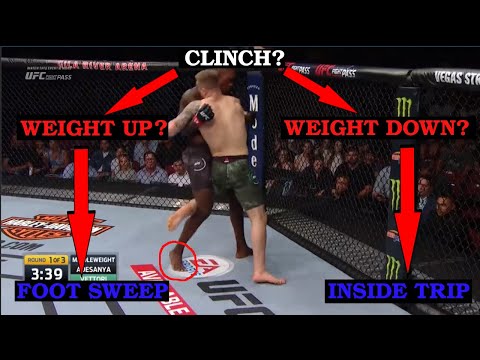
Learn just two moves for unstoppable clinch takedowns
0
Standard Dirty Boxing TD·Traditionalist Tolkienist
Once you have the clinch--in wrestling or MMA--switching between the inside trip and the foot sweep takedowns is extreme…
1 / 2
3 videos
What Instructors Say
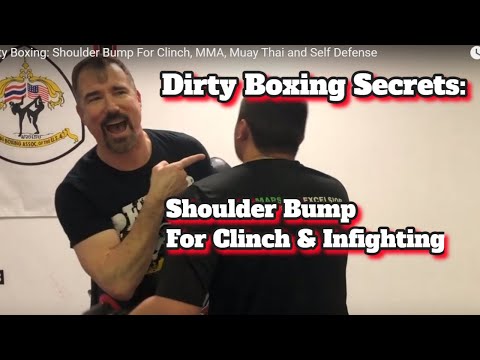
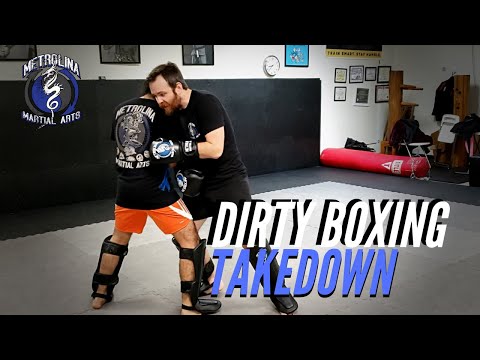
The standard dirty boxing takedown leverages clinch positioning to create space for strikes that transition into takedown attempts. Coach Ray emphasizes the shoulder bump as the foundational technique, executed by driving through the hips and legs while maintaining head-to-shoulder contact to generate sufficient separation for uppercuts, hooks, and crosses. He details single and double bumps, with variations including forward-up-forward sequences and directional adjustments based on opponent head position. Ray notes that the shoulder bump can also load the rear shoulder for subsequent elbows, particularly diagonal elbows thrown with body rotation rather than arm extension alone. Metrolina Martial Arts contextualizes the technique within kickboxing rule sets where traditional clinches are restricted, describing the dirty boxing approach as a way to maintain close control using knee and shoulder pressure while keeping the opponent's tricep trapped to prevent escape. From this trapped position, the takedown involves dropping the body weight while maintaining control, though legality varies by ruleset. Both instructors agree the technique operates in an extremely close range where conventional striking angles are compromised, requiring hip-driven power generation and body rotation. Coach Ray explicitly connects the approach to MMA application, noting it derives from wrestling, Kali, and clinch fighting experience. The Traditionalist Tolkienist transcript lacks coherent instructional content and provides no usable signal.
Synthesized from 2 instructors
Coach Ray — Dirty Boxing: Shoulder Strike For Clinch, MMA, Muay Thai and Self Defense: Detailed mechanics of shoulder bumps (single/double), hip-driven power generation, directional variations, integration with uppercuts and elbows, application across close-range clinch scenarios, and multi-strike combinations that create openings.
Metrolina Martial Arts — Dirty Boxing Takedown! | Unorthodox clinch takedown they won't see coming: Rule-set dependent application in kickboxing, tricep control to prevent opponent escape, knee-and-shoulder positioning to establish trapped clinch, body-weight drop mechanics for the takedown finish, and discussion of legal variations across different rulesets.
Learn This Technique
No instructional courses yet for this technique.
Sign in to suggest a course.
Ratings
Danger Rating
Risk of injury to the person this technique is applied to
5
High5/10
Takedowns from striking range; combines strikes with wrestling
Difficulty
Skill level needed to execute this technique reliably
Advanced
Competition Legality
Whether this technique is allowed under major competition rule sets
How do I create space to throw strikes when my opponent is controlling me in the clinch?
Coach Ray emphasizes using a shoulder bump to pop your opponent's head up and create an opening, then follow with an uppercut, hook, and cross. The key is making that initial space with the bump, which allows you to land your striking combinations.
What should I do to prevent my opponent from escaping when I have them in a close clinch?
According to Metrolina Martial Arts, keep close quarters with your knees on the inside and shoulders on the outside, then track your opponent with your hand on their tricep—this way if they try to run away, they're stuck to you and can't create distance.
How do I protect myself when throwing elbows in the clinch?
Coach Ray stresses that you must cover yourself with one hand while elbowing, since if you can elbow your opponent, they can elbow you—so defensive positioning is essential when executing elbow strikes.
How does the Standard Dirty Boxing TD work?
The Standard Dirty Boxing TD executes the fundamental dirty boxing takedown where the attacker uses a collar tie to snap the opponent's posture down while simultaneously stepping offline and driving the opponent to the mat. The attacker pulls the head forward with the collar tie, steps the lead foot to the outside of the opponent's lead leg, and drives forward-and-downward to collapse the opponent's base.
Where does the Standard Dirty Boxing TD come from?
This fundamental dirty boxing technique was refined in MMA competition where the integration of striking and takedowns from the clinch became a critical tactical element. Fighters from wrestling backgrounds adapted their collar tie and snap-down skills into the dirty boxing framework.
Is the Standard Dirty Boxing TD legal in competition?
IJF: legal — Legal takedown technique; IBJJF: legal — Legal at all belt levels, scored as takedown (2 points); UWW: legal — Legal in freestyle, may be restricted in Greco-Roman depending on technique; Unified MMA: legal — Legal takedown technique; ADCC: legal — Legal, scored 2-4 points in second half of match; FIAS Sport Sambo: legal — Legal — all takedowns permitted; FIAS Combat Sambo: legal — Legal; NCAA Folkstyle: legal — Legal, scored as takedown (2 points)
How dangerous is the Standard Dirty Boxing TD?
Danger rating 5/10. High — takedowns from striking range; combines strikes with wrestling
How do I set up the Standard Dirty Boxing TD?
The standard setup chain: Establish Contact → Create Off-Balance → Execute the Takedown → Follow to Ground.
How do I defend against the Standard Dirty Boxing TD?
Standard counters include: Sprawl — drop hips back and drive weight down to stuff the takedown attempt / Underhook — establish inside position to control distance and prevent the takedown entry / Post and Circle — post on the attacker's head and circle away to break their angle / Level Change Defence — recognize the shot early and react with appropriate hip defence.
What are the variants of the Standard Dirty Boxing TD?
Common variants: Collar tie snap-down (snapping with hand on the nape of the neck); Two-on-one snap (using two-on-one grip to snap the posture down); Snap-down to front headlock (following the snap with a front headlock for further attacks).
How effective is the Standard Dirty Boxing TD in competition?
Randy Couture used dirty boxing takedowns throughout his UFC career, winning the UFC heavyweight championship three times and the UFC light heavyweight championship once (1997-2008). The dirty boxing approach has since been adopted by numerous MMA fighters as a primary tactical framework.
What are common mistakes when doing the Standard Dirty Boxing TD?
Top errors to watch for: Snapping too gently — the head snap needs to genuinely break their posture or it's just a warning / Shooting without the setup strikes, so the opponent reads the takedown entry / Standing up between the snap and the shot, giving them time to recover posture / Collar tie grip too shallow (on the back of the head instead of the nape), reducing snap power.
What are other names for the Standard Dirty Boxing TD?
The Standard Dirty Boxing TD is also known as Dātī Bokushingu Teikudaun, Dirty Boxing TD, Couture Clinch Takedown, Short-Range Clinch Takedown.