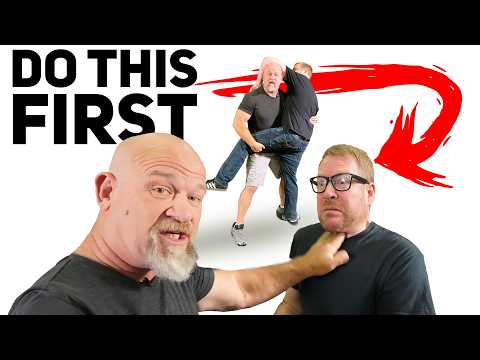
The Easiest Street Takedown: Dirty Boxing to Single Leg (Cliff Odette)
0
Dirty Boxing Takedown·Strip Mall Sensei
Single leg takedown for street fighting with Cliff Odette. Dirty fighting hand-control from a boxing guard to create the…
Translation: dirty boxing takedown (katakana)
The Dirty Boxing Takedown family covers takedowns initiated from the dirty boxing clinch — a close-quarters position borrowed from boxing and Muay Thai where the fighters are in punching range with collar ties, wrist control, or head position. [1] The 'dirty boxing' label refers to the infighting clinch work where short punches, elbows, and positional manipulation occur simultaneously with takedown attempts. [1],[2] Takedowns from this position typically involve off-balancing the opponent with a push-pull action on the head or arms, then capitalising on the resulting posture break to execute a trip, drag, or snap-down. [2] This family bridges striking and grappling in a way unique to MMA. [2],[3]
Dirty boxing clinch work emerged from the intersection of boxing, Muay Thai, and wrestling in early MMA competition. [1] Randy Couture is widely credited with systematising the dirty boxing clinch as an offensive framework in the early 2000s, combining Greco-Roman wrestling clinch work with short-range striking. [2],[3]
No images yet for this technique.
Sign in to suggest an image.
Single leg takedown for street fighting with Cliff Odette. Dirty fighting hand-control from a boxing guard to create the…
No instructional courses yet for this technique.
Sign in to suggest a course.
Risk of injury to the person this technique is applied to
Takedowns from striking range; combines strikes with wrestling
Skill level needed to execute this technique reliably
Whether this technique is allowed under major competition rule sets
Japanese MMA standard terminology
Japanese MMA standard terminology
Standard katakana transliteration of Western martial arts terminology (外来語) — used in Japanese MMA, boxing, and BJJ communities
Katakana transliteration used in Japanese MMA/Shooto
timing, balance, upper body control for push-pull
good coordination and sense of opponent's weight distribution
core stabilisers, hip adductors/abductors, calves
Every move, in any martial art, shares a few universal traits. Mix and match below to pinpoint the right tool — or compare equivalents across styles.
Dirty boxing takedowns use short punches from the clinch to set up takedown entries — the opponent covers up from the strikes, creating openings for underhooks, body locks, and level changes. Randy Couture systematized dirty boxing as an MMA-specific clinch strategy. (Couture, Wrestling for Fighting; MMA competition records)
The key is distraction—use jabs to the throat, face, and jaw to distract your opponent so they don't see the takedown entry coming. According to Strip Mall Sensei's coverage of Cliff Odette's technique, if you can distract someone with basic hand strikes, you don't need to be especially skilled at single legs or doubles; the distraction creates the opening.
Always wear proper safety equipment when training throat strikes, including a mouth guard. The technique involves irritating the larynx and cilia in the throat with controlled strikes rather than full power, but protection is essential.
You can target multiple areas: the throat, the jaw ridge, the nose, and the eyes. By slightly turning your hands sideways, you can catch different targets, which keeps your opponent guessing and maximizes the distraction effect needed before the takedown.
After the distraction jabs, follow up with whatever takedown fits your style—single leg, double leg, or even a power double. The opponent's focus on defending their face means they won't see the takedown entry, making the transition instinctive and simple.
The Dirty Boxing Takedown family covers takedowns initiated from the dirty boxing clinch — a close-quarters position borrowed from boxing and Muay Thai where the fighters are in punching range with collar ties, wrist control, or head position. The 'dirty boxing' label refers to the infighting clinch work where short punches, elbows, and positional manipulation occur simultaneously with takedown attempts.
Dirty boxing clinch work emerged from the intersection of boxing, Muay Thai, and wrestling in early MMA competition. Randy Couture is widely credited with systematising the dirty boxing clinch as an offensive framework in the early 2000s, combining Greco-Roman wrestling clinch work with short-range striking.
IJF: legal — Legal takedown technique; IBJJF: legal — Legal at all belt levels, scored as takedown (2 points); UWW: legal — Legal in freestyle, may be restricted in Greco-Roman depending on technique; Unified MMA: legal — Legal takedown technique; ADCC: legal — Legal, scored 2-4 points in second half of match; FIAS Sport Sambo: legal — Legal — all takedowns permitted; FIAS Combat Sambo: legal — Legal; NCAA Folkstyle: legal — Legal, scored as takedown (2 points)
Danger rating 5/10. High — takedowns from striking range; combines strikes with wrestling
The standard setup chain: Establish Contact → Create Off-Balance → Execute the Takedown → Follow to Ground.
Standard counters include: Sprawl — drop hips back and drive weight down to stuff the takedown attempt / Underhook — establish inside position to control distance and prevent the takedown entry / Post and Circle — post on the attacker's head and circle away to break their angle / Level Change Defence — recognize the shot early and react with appropriate hip defence.
Common variants: Standard trip (blocking or sweeping the support leg while driving the up…); Combination trip (chaining an inside trip with an outside trip when the opp…); Counter trip (using the trip as a counter when the opponent attacks); Clinch trip (executing the trip from a tight clinch position).
Randy Couture's dirty boxing approach was central to his UFC Heavyweight and Light Heavyweight title reigns. Fighters like Cain Velasquez and Khabib Nurmagomedov further refined clinch striking into takedown chains.
Top errors to watch for: Going for the takedown without softening the opponent with strikes first — they see it coming / Holding the collar tie passively without using it to snap or control / Telegraphing the level change by leaning back before shooting / Keeping both hands on the head (Thai clinch) when you need one free for the takedown.
The Dirty Boxing Takedown is also known as Dātī Bokushingu Teikudaun, Dirty Boxing, In-Fighting Takedown, Clinch Strike to Takedown.