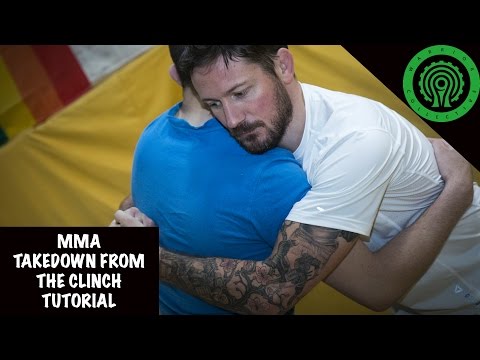
MMA Takedown from the Clinch Tutorial
0
Standard Dirty Boxing Takedown·Stuart Tomlinson
John Kavanagh, BJJ Black Belt and renowned Head coach of SBG Ireland in Dublin is here filmed by the Warrior Collective …
Translation: standard dirty boxing takedown
The Standard Dirty Boxing Takedown subfamily represents the fundamental takedown sequence from a dirty boxing clinch, where the attacker uses collar tie and head control to off-balance the opponent before executing a drag, snap-down, or inside trip. [1] The attacker typically establishes a collar tie or double collar tie, delivers short strikes to occupy the opponent's attention, then uses the head control to pull the opponent forward and downward while stepping the hips to one side. [1],[2] The combination of striking and grappling in the dirty boxing context makes these takedowns difficult to anticipate and defend. [2],[3]
The standard dirty boxing takedown uses a collar tie or underhook combined with short strikes to set up an inside trip or body lock drive. [1]
This is the foundational dirty boxing takedown taught in MMA gyms, derived from Randy Couture's clinch system. [1]
The standard dirty boxing takedown is a common technique in UFC competition. [1]
No images yet for this technique.
Sign in to suggest an image.
John Kavanagh, BJJ Black Belt and renowned Head coach of SBG Ireland in Dublin is here filmed by the Warrior Collective …
No instructional courses yet for this technique.
Sign in to suggest a course.
Risk of injury to the person this technique is applied to
Takedowns from striking range; combines strikes with wrestling
Skill level needed to execute this technique reliably
Whether this technique is allowed under major competition rule sets
Japanese MMA standard terminology
Japanese MMA standard terminology
Standard katakana transliteration of Western martial arts terminology (外来語) — used in Japanese MMA, boxing, and BJJ communities
Katakana transliteration used in Japanese MMA/Shooto
timing, balance, upper body control for push-pull
good coordination and sense of opponent's weight distribution
core stabilisers, hip adductors/abductors, calves
Every move, in any martial art, shares a few universal traits. Mix and match below to pinpoint the right tool — or compare equivalents across styles.
Stepping out at an angle prevents your opponent from using their shoulder to block your leg grab, making it easier to secure the takedown. Stuart Tomlinson demonstrates that this angle combined with an underhook pull creates the space you need to grab the leg effectively.
Grab the leg with your elbow, then lift upward to complete the takedown. This method, shown by Stuart Tomlinson, keeps your grip tight and allows you to drive through the lift.
The Standard Dirty Boxing Takedown subfamily represents the fundamental takedown sequence from a dirty boxing clinch, where the attacker uses collar tie and head control to off-balance the opponent before executing a drag, snap-down, or inside trip. The attacker typically establishes a collar tie or double collar tie, delivers short strikes to occupy the opponent's attention, then uses the head control to pull the opponent forward and downward while stepping the hips to one side.
The dirty boxing takedown was developed in MMA training camps during the late 1990s and 2000s as fighters sought to integrate striking and wrestling seamlessly. Randy Couture's 'Clinch Fighting' instructional system formalised many of these techniques for broader adoption.
IJF: legal — Legal takedown technique; IBJJF: legal — Legal at all belt levels, scored as takedown (2 points); UWW: legal — Legal in freestyle, may be restricted in Greco-Roman depending on technique; Unified MMA: legal — Legal takedown technique; ADCC: legal — Legal, scored 2-4 points in second half of match; FIAS Sport Sambo: legal — Legal — all takedowns permitted; FIAS Combat Sambo: legal — Legal; NCAA Folkstyle: legal — Legal, scored as takedown (2 points)
Danger rating 5/10. High — takedowns from striking range; combines strikes with wrestling
The standard setup chain: Establish Contact → Create Off-Balance → Execute the Takedown → Follow to Ground.
Standard counters include: Sprawl — drop hips back and drive weight down to stuff the takedown attempt / Underhook — establish inside position to control distance and prevent the takedown entry / Post and Circle — post on the attacker's head and circle away to break their angle / Level Change Defence — recognize the shot early and react with appropriate hip defence.
Common variants: Standard trip (blocking or sweeping the support leg while driving the up…); Combination trip (chaining an inside trip with an outside trip when the opp…); Counter trip (using the trip as a counter when the opponent attacks); Clinch trip (executing the trip from a tight clinch position).
The standard dirty boxing takedown is a common technique in UFC competition.
Top errors to watch for: Snapping the head without following up with a takedown — you've broken their posture for nothing / Over-committing to the snap and getting your head pushed down when they resist / Shooting from too far away after the snap — you need to close distance as you change levels / Letting go of the collar tie before establishing leg control.
The Standard Dirty Boxing Takedown is also known as Dātī Bokushingu Teikudaun, In-Fighting Takedown, Clinch Punch Takedown, Plum Takedown.