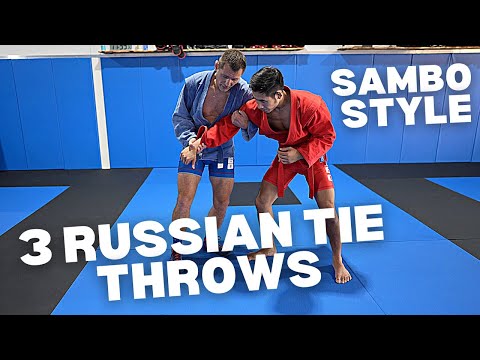
3 Russian Tie Throws (SAMBO Techniques)
0
Standard Side Body Lock TD·Jeff Chan MMAShredded ·Added by Admin
In this video, @sambofusion9486 teaches 3 throws using the Russian tie! Train like a fighter & get access to my new p…
Translation: standard side body lock takedown
The Standard Side Body Lock TD is the genus-level execution where the attacker, locked onto the opponent's side, uses a hip bump and rotational drive to topple the opponent laterally to the mat. [1] The attacker plants the inside hip against the opponent's near hip, locks the grip tight, then simultaneously bumps the hip upward and drives the upper body downward in a rotational arc. [1],[2] The finish places the attacker in side control or a scramble position depending on the angle of the takedown. [2] Timing the hip bump with the opponent's movement greatly increases the technique's effectiveness. [2],[3]
The standard side body lock takedown variant is a core Greco-Roman and freestyle technique. [1]
Commonly seen in international wrestling competition at all levels. [1]
No images yet for this technique.
Sign in to suggest an image.
In this video, @sambofusion9486 teaches 3 throws using the Russian tie! Train like a fighter & get access to my new p…
This video I teach my morning class a basic series I like from the pummel position. Check out the details and you are s…
Your body is unique—your training should be too. Take our survey to get a FREE 14-day Jiu-Jitsu plan custom-tailored to …
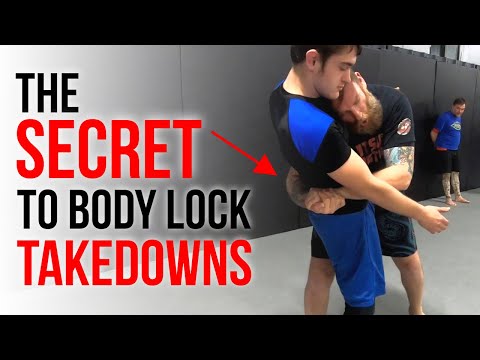
The standard side body lock takedown is executed by establishing a body lock from a clinch position, typically after pummeling to achieve control. Instructors agree on the fundamental mechanics: the practitioner drops their level through the opponent's chest and secures the body lock at the kink of the hips—the space between the floating ribs and hip socket—rather than around the center of the back where stronger musculature provides better defense. TRITAC Martial Arts emphasizes this anatomical target as the critical control point where minimal strength achieves maximum leverage. Jeff Chan MMAShredded details the oblique grip establishment and the importance of leg placement, specifically hooking the inner thigh rather than the leg itself to neutralize flexibility-based defenses, combined with a powerful arm pull that transforms the attacker into an obstacle the opponent trips over. TeachMeGrappling Coach Brian focuses on clinch-based entry through pummeling sequences, maintaining high posture to prevent headlock counters, and adapting the takedown method based on opponent resistance—using either a lifting action or a knee trip depending on defensive positioning. All three instructors agree that maintaining connection and controlling the opponent's hip is essential, though they emphasize different aspects: Jeff Chan stresses the grip mechanics and leg hook placement, TRITAC highlights the anatomical targeting and chest-driven pressure, and Coach Brian prioritizes clinch position management and adaptive finishing options.
Synthesized from 3 instructors
No instructional courses yet for this technique.
Sign in to suggest a course.
Risk of injury to the person this technique is applied to
Lateral body lock takedown; shoulder/hip impact
Skill level needed to execute this technique reliably
Whether this technique is allowed under major competition rule sets
Japanese amateur wrestling terminology
Japanese amateur wrestling terminology
Mixed Japanese-Western terminology — combines traditional Japanese terms with katakana loanwords
Standard katakana transliteration used in Japanese wrestling (レスリング)
upper body squeeze strength, lifting power, hip drive
thick chest and arms for tight lock, strong lower back for lifts
pectorals, biceps, erector spinae, glutes
Work on pommeling to get underneath your opponent, then establish your grip by 'kinking' at the point where their arm is protecting their body. TRITAC Martial Arts emphasizes that you should be adding movement and trying different approaches in conjunction with each other.
Don't worry—if you maintain your body lock grip and adjust with a level change and duck, you can seamlessly transition to taking the back without losing your position. TRITAC Martial Arts notes that these options work together naturally once you have the body lock.
When you come into a double under clinch position, stand up with a solid base so that if your opponent tries to headlock you, you're in a strong defensive posture. Coach Brian emphasizes not being in a compromised position where you're vulnerable to headlocks.
The Standard Side Body Lock TD is the genus-level execution where the attacker, locked onto the opponent's side, uses a hip bump and rotational drive to topple the opponent laterally to the mat. The attacker plants the inside hip against the opponent's near hip, locks the grip tight, then simultaneously bumps the hip upward and drives the upper body downward in a rotational arc.
This fundamental side body lock technique has been practised across wrestling disciplines as a reliable clinch takedown option. It gained visibility in MMA through fighters who used the lateral angle to bypass front-facing takedown defences.
IJF: legal — Legal takedown technique; IBJJF: legal — Legal at all belt levels, scored as takedown (2 points); UWW: legal — Legal in both freestyle and Greco-Roman; Unified MMA: legal — Legal takedown technique; ADCC: legal — Legal, scored 2-4 points in second half of match; FIAS Sport Sambo: legal — Legal — all takedowns permitted; FIAS Combat Sambo: legal — Legal; NCAA Folkstyle: legal — Legal, scored as takedown (2 points)
Danger rating 5/10. High — lateral body lock takedown; shoulder/hip impact
The standard setup chain: Close Distance → Establish the Lock → Hip Pressure → Lift or Trip.
Standard counters include: Sprawl — drop hips back and drive weight down to stuff the takedown attempt / Underhook Pummeling — fight for inside position to neutralize the lock / Hip Switch — rotate hips to break the grip angle and create separation / Knee Tap — redirect opponent's momentum with a quick leg attack.
Common variants: Front body lock (securing the lock face-to-face and driving laterally or b…); Rear body lock (securing from behind for mat returns or lifts); Side body lock (angled body lock for trips and throws); Body lock to trip (combining the lock with a foot trip for the finish).
Commonly seen in international wrestling competition at all levels.
Top errors to watch for: Trying to trip without the hip bump — the bump loads their weight onto the blocking foot / Not stepping behind the far foot, so they simply step out and recover / Letting the chest separate from their body during the rotation, losing all pressure / Rotating too slowly, giving them time to pummel or re-square.
The Standard Side Body Lock TD is also known as Yoko Bodi Rokku, Side Bear Hug TD, Lateral Waist Lock Takedown, Bochny Zakhvat.