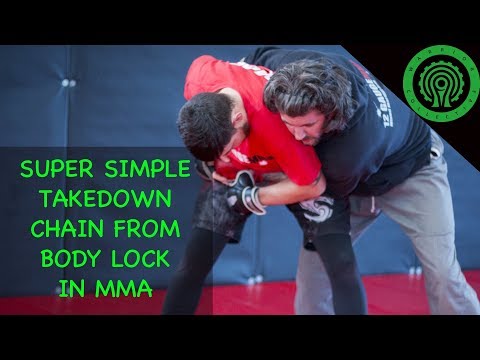
Simple Takedown Chain from the Body Lock for MMA with Matt Thorpe
0
Standard Side Body Lock Takedown·Stuart Tomlinson
Takedowns are a much needed aspect of MMA. Keeping them simple is often the key to consistent success whilst under pres…
Translation: standard side body lock
The Standard Side Body Lock Takedown subfamily executes the classical lateral body lock takedown where the attacker uses hip-to-hip contact and rotational force from the side position to bring the opponent to the mat. [1] The attacker typically locks the grip around the opponent's waist from the side, positions the near hip against the opponent's hip as a fulcrum, and uses a twisting lift-and-turn motion to topple them. [1],[2] The side angle makes this technique difficult to defend because the opponent cannot effectively brace against the lateral rotational force. [2],[3]
The standard side body lock takedown is the fundamental lateral body lock drive, using hip pressure and rotational force to take the opponent down from an angle. [1]
This is a core technique in Greco-Roman and freestyle wrestling curricula. [1]
The standard side body lock is a regular technique in international wrestling competition. [1]
No images yet for this technique.
Sign in to suggest an image.
Takedowns are a much needed aspect of MMA. Keeping them simple is often the key to consistent success whilst under pres…
No instructional courses yet for this technique.
Sign in to suggest a course.
Risk of injury to the person this technique is applied to
Lateral body lock takedown; shoulder/hip impact
Skill level needed to execute this technique reliably
Whether this technique is allowed under major competition rule sets
Japanese amateur wrestling terminology
Japanese amateur wrestling terminology
Mixed Japanese-Western terminology — combines traditional Japanese terms with katakana loanwords
Standard katakana transliteration used in Japanese wrestling (レスリング)
upper body squeeze strength, lifting power, hip drive
thick chest and arms for tight lock, strong lower back for lifts
pectorals, biceps, erector spinae, glutes
Every move, in any martial art, shares a few universal traits. Mix and match below to pinpoint the right tool — or compare equivalents across styles.
Your head should be on your opponent's shoulder, and you should look down at what they're doing rather than across their back. This positioning helps you read their movements and maintain control.
As soon as you feel them building their base back up, immediately rejoin your hands and return to control their waist. Stuart Tomlinson emphasizes that if you don't rejoin your grip, they can escape because you'll only have one-handed control.
Step your leg in and drive your hips up—it's the bump of your hips that kicks their post out and brings them down to their knees and elbows, where you can maintain control and continue striking.
If they're fighting your grip and pushing their hips to escape in the original direction, hook your foot to their heel, sit on your butt while keeping the grip strong, and turn them in a different direction.
The Standard Side Body Lock Takedown subfamily executes the classical lateral body lock takedown where the attacker uses hip-to-hip contact and rotational force from the side position to bring the opponent to the mat. The attacker typically locks the grip around the opponent's waist from the side, positions the near hip against the opponent's hip as a fulcrum, and uses a twisting lift-and-turn motion to topple them.
Side body lock takedowns have been part of wrestling curricula across multiple styles, evolving from the natural transitions that occur when front or rear body locks are partially defended. The technique is taught as a standard clinch takedown in modern MMA and wrestling programmes.
IJF: legal — Legal takedown technique; IBJJF: legal — Legal at all belt levels, scored as takedown (2 points); UWW: legal — Legal in both freestyle and Greco-Roman; Unified MMA: legal — Legal takedown technique; ADCC: legal — Legal, scored 2-4 points in second half of match; FIAS Sport Sambo: legal — Legal — all takedowns permitted; FIAS Combat Sambo: legal — Legal; NCAA Folkstyle: legal — Legal, scored as takedown (2 points)
Danger rating 5/10. High — lateral body lock takedown; shoulder/hip impact
The standard setup chain: Close Distance → Establish the Lock → Hip Pressure → Lift or Trip.
Standard counters include: Sprawl — drop hips back and drive weight down to stuff the takedown attempt / Underhook Pummeling — fight for inside position to neutralize the lock / Hip Switch — rotate hips to break the grip angle and create separation / Knee Tap — redirect opponent's momentum with a quick leg attack.
Common variants: Front body lock (securing the lock face-to-face and driving laterally or b…); Rear body lock (securing from behind for mat returns or lifts); Side body lock (angled body lock for trips and throws); Body lock to trip (combining the lock with a foot trip for the finish).
The standard side body lock is a regular technique in international wrestling competition.
Top errors to watch for: Hip bump without rotation — just pushing sideways rarely works against a braced opponent / Head position too high, allowing them to crossface and turn / Not blocking the far foot, letting them step out of the rotation / Grip breaking because you didn't squeeze tight before initiating.
The Standard Side Body Lock Takedown is also known as Yoko Bodi Rokku, Lateral Bear Hug, Side Clinch Takedown, Yoko Body Lock.