Establishing the Body Lock Foundation
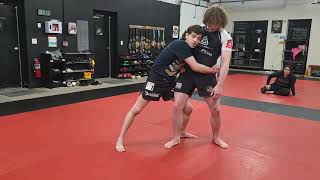
The body lock begins from pummeling exchanges. As the opponent pummel, the instructor adds another pummeling action to establish position. The goal is to drop level through the opponent's chest and secure the body lock at the hip crease—a vulnerable anatomical point between the floating ribs and hip socket.
Targeting the Kinetic Point
The body lock targets the 'kink' at the hip—a specific anatomical weak point distinct from the strong erector muscles of the mid-back. This location allows effective control with minimal strength by using chest pressure and hand positioning rather than muscular force alone. Proper hand placement in this spot enables controlled folding and submission mechanics.
Entry Technique: The Re-Underhook
From pummeling position, the instructor re-underhooks after the opponent's pummeling action to secure the body lock. This is achieved by dropping level while driving through the opponent's chest. Once established, the grip should feel connected at the hip crease with the hands working in conjunction with core pressure.
Walking the Grip and Initiating Takedown
After establishing the body lock, the instructor takes deliberate steps to feel the opponent's weight distribution. The right knee then drives while pulling downward, using a ripping motion to bring the opponent to the ground. This movement creates the initial strong positional advantage needed for the takedown.
Leg Trip Variation and Backstep Defense
If the opponent backsteps over the initial takedown attempt, the instructor transitions to a leg trip while maintaining the body lock. This second option works in conjunction with the primary takedown, allowing the grappler to adapt based on the opponent's defensive response. Both techniques share the same body lock foundation.
Transitioning to Back Control
If the takedown doesn't materialize, a small level change and duck can shift the position toward back control without losing the body lock grip. This option provides continuity in positional flow. The instructor maintains the same grip and positioning, simply adjusting the point of attack.
Seatbelt Grip Transition
From the body lock, the instructor transitions to a seatbelt grip while keeping the opponent controlled with the head and chest. One arm releases while the other maintains control as the grip shifts from body lock to seatbelt configuration. This maintains control while preparing for submission entries.
Kimura Grip Setup and Finish
From the seatbelt grip, the instructor establishes a Kimura grip by moving around the opponent's head and punching their hand to the ground. Once the Kimura is fully established, the instructor uses leg positioning and backpressure to complete the submission. Leg scissors intensify the finish when needed.
Choke Submission from Back Control
If the opponent escapes toward back control, the instructor can transition to a rear-naked choke by catching underneath the chin with one arm and crossing the top leg over. From this position, crushing foot pressure finalizes the submission. This chain maintains control throughout the sequence.
The 'Secret' To Body Lock Takedowns + 2 Submissions (Kimura + Choke)
Key Takeaways
- •Establishing the Body Lock Foundation
- •Targeting the Kinetic Point
- •Entry Technique: The Re-Underhook
- •Walking the Grip and Initiating Takedown
Your body is unique—your training should be too. Take our survey to get a FREE 14-day Jiu-Jitsu plan custom-tailored to you: https://tritacmartialarts.com/survey?utm_source=youtube&utm_medium=desc&utm_campaign=ttj The real secret to the body lock takedowns is all in the clinch and how you attack the hip socket with your body lock... In this TRITAC-Jitsu lesson, you will learn how to pummel and them establish the body lock control to 2 takedowns from Kobukai Jujitsu (Japanese Jujitsu) and 2 submission finishes - a kimura and leg scissor choke. This TRITAC Flow is a great way to develop confidence in how to attack a body lock takedown and have the submissions skills to finish your opponent. Learn the major skills in this lesson and more with a FREE CUSTOM TRITAC Intro Course here: https://tritacmartialarts.com/course The body lock is one of the most powerful controls in all of the grappling arts. You see it all in applications of grappling from Jiu-Jitsu, Judo, Sambo and all wrestling variations. It is also one of the most powerful takedown controls in MMA as well. Wrestlers have been dominating in the UFC with the body lock (especially against the cage) since the days or Mark Coleman, Dan Severn and other MMA wrestling / takedown legends. It provides supreme control and gives you many opportunities to take your opponent down and then dominate on the ground. If you are interested learning more about the body lock, jiu jitsu takedowns and other TRITAC Martial Arts Skills, start off with our survey https://tritacmartialarts.com/survey?utm_source=youtube&utm_medium=desc&utm_campaign=ttj
Frequently Asked Questions
What does this video teach about standard side body lock td?
This video covers establishing the body lock foundation, targeting the kinetic point, entry technique: the re-underhook. It provides detailed instruction from TRITAC Martial Arts.
How long does it take to learn standard side body lock td?
The basic mechanics can be understood in a single session, but developing reliable execution requires consistent drilling over weeks of practice. This 9-part breakdown helps structure your training by isolating each phase of the technique.
What are the key details for finishing standard side body lock td?
From the seatbelt grip, the instructor establishes a Kimura grip by moving around the opponent's head and punching their hand to the ground. Once the Kimura is fully established, the instructor uses leg positioning and backpressure to complete the submission. Leg scissors intensify the finish when needed.
Related videos
Basic CLINCH Bodylock Takedowns for EVERYONE!
TeachMeGrappling Coach Brian
3 Russian Tie Throws (SAMBO Techniques)
Jeff Chan MMAShredded
Simple Takedown Chain from the Body Lock for MMA with Matt Thorpe
Stuart Tomlinson
Rear body lock | Learn how to THROW and SLAM
Energia Martial Arts
Front Body Lock Takedowns. Mat Return, Throw By, and more.
Pica Pau Jiu Jitsu & Grappling