How to do a PERFECT Twister
0
Twister From Back Ride·Brandon Quick
I’ve been doing the Twister since the 90’s. This is a great path for the fundamentals and any rank can catch on easily. …
Translation: Twister (katakana loanword)
The twister from back ride is applied when the attacker has a back ride position with one hook controlling the opponent's far leg (the 'truck' entry) and threads an arm under the opponent's chin from behind, then uses the trapped leg and upper body grip to rotate the spine in opposite directions. [1],[2] The attacker's legs control the lower body while the arms rotate the upper body in the opposite direction, creating severe rotational stress on the entire spinal column. [1] The back ride provides the base from which the twister's counter-rotational forces are generated. [1],[2]
The twister was popularized by Eddie Bravo and is a central technique in his 10th Planet Jiu-Jitsu system. [1],[2] Bravo adapted the guillotine ride from amateur wrestling into a submission by adding the cervical rotation component. [1] The technique gained mainstream attention when Chan Sung Jung finished Leonard Garcia with a twister in the UFC in 2011, the first twister finish in UFC history. [1],[2] The back ride entry is the most common path to the twister position. [1]
The twister from back ride creates devastating rotational spinal lock — one of the most painful submissions in grappling. The back ride position provides the control needed to execute the rotation [1]
Eddie Bravo's adaptation of the wrestler's guillotine to submission grappling; the back ride (or 'truck') position is the primary platform for the twister. Chan Sung Jung's UFC twister finish (2011) brought global attention [1]
Chan Sung Jung (Korean Zombie) finished Leonard Garcia with a twister at UFC Fight Night 24 — the first twister in UFC history. Regular finish at 10th Planet invitationals [1]
No images yet for this technique.
Sign in to suggest an image.
I’ve been doing the Twister since the 90’s. This is a great path for the fundamentals and any rank can catch on easily. …
This video I demo a backward roll escape to a takedown when someone gets you in the double unders pass, as well as a bac…
The twister is a great submission from the back especially when your opponents hips are elevated. Today's video will sho…
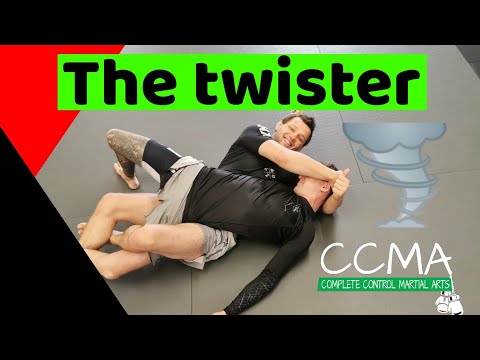
The twister from back ride is a cervical rotation submission executed from the back control position, particularly effective when the opponent is in turtle or elevated hip position. CCMA Complete Control Martial Arts emphasizes initiating the technique when the opponent's hips rise during defensive movement—specifically removing the underhook hook, elevating the hips with the knee, locking down the far leg, and then securing a baseball bat grip on the opponent's arm before threading the elbow and shoulder through to apply neck torque. TeachMeGrappling Coach Brian presents the twister as a transition from the truck position (achieved via double underhook pass), stressing the critical distinction between lockdown and triangle leg configuration—a triangle must be maintained to prevent the opponent from slipping their foot inside the lock. Brandon Quick provides detailed hand-fighting and positional refinements, emphasizing a shallow arm hook gripped baseball-bat style, the importance of keeping the opponent's leg pinned to the ground via calf stomp, scooting laterally to achieve proper elbow positioning outside the armpit, and targeting the temple rather than the neck during the final rotation. All three instructors agree on the baseball bat grip and the requirement to keep hips elevated and controlled. Where they differ slightly: CCMA focuses on the seat-belt transition and hand placement variations; TeachMeGrappling distinguishes this from banana split and other truck attacks; Brandon Quick provides the most technical detail on leg positioning and the shallow-grip hook mechanic.
Synthesized from 3 instructors
No instructional courses yet for this technique.
Sign in to suggest a course.
Risk of injury to the person this technique is applied to
Rotation cranks twist the cervical spine; among the highest-risk submission categories
Skill level needed to execute this technique reliably
Whether this technique is allowed under major competition rule sets
note.com BJJ articles; Eddie Bravo 'Grappling Technique' Japanese edition (trans. 中井祐樹); JBJJF rules
Official Japanese BJJ federation — competition rules and terminology
Translated by 中井祐樹 (Nakai Yūki, 2007)
Japanese BJJ community writing platform
Standard katakana transliteration of Western martial arts terminology (外来語) — used in Japanese MMA, boxing, and BJJ communities
Japanese terminology sourced from note.com BJJ articles; Eddie Bravo 'Grappling Technique' Japanese edition (trans. 中井祐樹); JBJJF rules
grip or squeeze strength, positional control
strong upper body for sustained compression
forearms, biceps, pectorals, core stabilisers
Every move, in any martial art, shares a few universal traits. Mix and match below to pinpoint the right tool — or compare equivalents across styles.
Use a shallow grip when hooking the arm—if you stick your arm through deeply, your opponent can pull your wrist and tap you. Keep the grip over the ribs with a shallow angle to prevent this escape. Brandon Quick emphasizes keeping your elbows tight and your arms connected strongly.
Keep your opponent's leg on the ground throughout the technique rather than letting it come up in the air, and maintain a triangle leg position. Coach Brian notes to always use a triangle grip on twisters rather than a lockdown, because a lockdown allows the foot to slip inside and escape.
After hooking the arm with a shallow grip, separate and transition to a baseball bat grip. Then scoot closer to your opponent by digging your heels and butt in, keeping your elbow high out of the armpit while pulling the arm away—not just holding it. Pull at the temple rather than the neck to twist them effectively.
Position yourself over your opponent's back with a seatbelt grip, keeping their hips elevated on your knee so they can't fall away. Drive your knee inside and step on their ankle before their butt can sit down, then insert your hand to start building the seatbelt grip for the twister entry.
The twister from back ride is applied when the attacker has a back ride position with one hook controlling the opponent's far leg (the 'truck' entry) and threads an arm under the opponent's chin from behind, then uses the trapped leg and upper body grip to rotate the spine in opposite directions. The attacker's legs control the lower body while the arms rotate the upper body in the opposite direction, creating severe rotational stress on the entire spinal column.
The twister was popularized by Eddie Bravo and is a central technique in his 10th Planet Jiu-Jitsu system. Bravo adapted the guillotine ride from amateur wrestling into a submission by adding the cervical rotation component.
IBJJF: legal — Legal at all belt levels, gi and no-gi — chokes are the safest submission cat…; IJF: legal — Legal (shime-waza) — strangulation techniques are one of three permitted subm…; ADCC: legal — Legal; Unified MMA: legal — Legal — choke submissions are among the most common finishes in MMA; FIAS Sport Sambo: banned — All chokes prohibited in Sport Sambo; FIAS Combat Sambo: legal — Legal
Danger rating 9/10. Rotation cranks twist the cervical spine; among the highest-risk submission categories
The standard setup chain: Establish Position → Create the Threat → Secure the Hold → Finish.
Standard counters include: Early Recognition — identify the submission attempt early and begin defence immediately / Posture and Base — maintain strong posture and base to prevent submission setups / Grip Fight — deny the attacker their preferred gripping configuration.
Common variants: Standard grip variation (primary hand configuration for maximum choking pressure); Gi variation (uses the lapel or collar as an anchor for additional fric…); No-gi variation (adapted grip and positioning for submission grappling wit…); Transition finish (applied during a positional change to catch the opponent …).
Chan Sung Jung (Korean Zombie) finished Leonard Garcia with a twister at UFC Fight Night 24 — the first twister in UFC history.
Top errors to watch for: Not maintaining the back ride during the transition — keep chest weight on the opponent while hooking the leg and rea… / Hooking the wrong leg — hook the near-side leg (same side as the reaching arm); hooking the far leg creates incorrect… / Applying the rotation before both controls are established — the leg must be hooked AND the head controlled before ro… / Using explosive rotation — the spinal lock is dangerous; progressive application is essential.
The Twister From Back Ride is also known as Tsuisutā, Back Ride Twister, Wrestling Ride Twister.