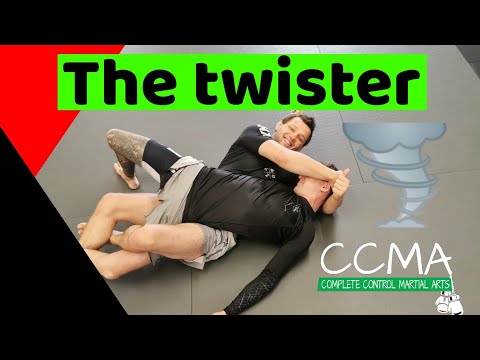
The twister submission
0
Wrestling Entry Twister·CCMA Complete Control Martial Arts
The twister is a great submission from the back especially when your opponents hips are elevated. Today's video will sho…
Translation: Twister (katakana loanword)
The wrestling-entry twister accesses the twister submission through a traditional wrestling back ride transition rather than the truck position commonly associated with 10th Planet Jiu-Jitsu. [1] The attacker establishes a back ride — chest on the opponent's back with the legs hooking the hips — then threads one arm behind the opponent's head while the other arm captures the far knee, creating the spinal rotation and lateral flexion characteristic of the twister. [1],[2] The wrestling entry is more familiar to wrestlers transitioning to submission grappling, as the back ride is a fundamental wrestling control position. [2] This entry pathway demonstrates how traditional wrestling positions can be repurposed for submission attacks when competing under submission-permitting rulesets. [2],[3]
The wrestling-entry pathway to the twister was documented as an alternative to the truck entry by practitioners who came from wrestling backgrounds. [1] This entry recognised the natural overlap between wrestling back rides and the twister position, facilitating cross-training between wrestling and submission grappling. [2],[3]
The wrestling entry provides a high-percentage path to the twister through traditional back ride and leg riding control; effective for wrestlers transitioning to submission grappling [1]
Eddie Bravo adapted the twister from the wrestler's guillotine (a traditional wrestling pinning combination) and developed the wrestling entry as part of his 10th Planet system [1]
Seen in 10th Planet invitational events and occasionally in MMA; the wrestling entry is considered the most reliable path to twister position [1]
No images yet for this technique.
Sign in to suggest an image.
The twister is a great submission from the back especially when your opponents hips are elevated. Today's video will sho…
No instructional courses yet for this technique.
Sign in to suggest a course.
Risk of injury to the person this technique is applied to
Rotation cranks twist the cervical spine; among the highest-risk submission categories
Skill level needed to execute this technique reliably
Whether this technique is allowed under major competition rule sets
note.com BJJ articles; Eddie Bravo 'Grappling Technique' Japanese edition (trans. 中井祐樹); JBJJF rules
Official Japanese BJJ federation — competition rules and terminology
Translated by 中井祐樹 (Nakai Yūki, 2007)
Japanese BJJ community writing platform
Standard katakana transliteration of Western martial arts terminology (外来語) — used in Japanese MMA, boxing, and BJJ communities
Japanese terminology sourced from note.com BJJ articles; Eddie Bravo 'Grappling Technique' Japanese edition (trans. 中井祐樹); JBJJF rules
grip or squeeze strength, positional control
strong upper body for sustained compression
forearms, biceps, pectorals, core stabilisers
According to CCMA Complete Control Martial Arts, the twister is best attempted when your opponent's hips are elevated, such as when they start to drive up into you from a position like side control or similar.
CCMA Complete Control Martial Arts emphasizes keeping your opponent's hips elevated and their leg stretched out throughout the setup—don't let their hips get far away from you. Start by taking one hook out from a seat belt position, then elevate their hips and lock them down before tipping them to the side.
Use your bottom hand to bring the head towards you, then have your overhand hug the head. Get your hands together, lift the hips up, and finish the twist with pressure through the neck.
The wrestling-entry twister accesses the twister submission through a traditional wrestling back ride transition rather than the truck position commonly associated with 10th Planet Jiu-Jitsu. The attacker establishes a back ride — chest on the opponent's back with the legs hooking the hips — then threads one arm behind the opponent's head while the other arm captures the far knee, creating the spinal rotation and lateral flexion characteristic of the twister.
The wrestling-entry pathway to the twister was documented as an alternative to the truck entry by practitioners who came from wrestling backgrounds. This entry recognised the natural overlap between wrestling back rides and the twister position, facilitating cross-training between wrestling and submission grappling.
IBJJF: legal — Legal at all belt levels, gi and no-gi — chokes are the safest submission cat…; IJF: legal — Legal (shime-waza) — strangulation techniques are one of three permitted subm…; ADCC: legal — Legal; Unified MMA: legal — Legal — choke submissions are among the most common finishes in MMA; FIAS Sport Sambo: banned — All chokes prohibited in Sport Sambo; FIAS Combat Sambo: legal — Legal
Danger rating 9/10. Rotation cranks twist the cervical spine; among the highest-risk submission categories
The standard setup chain: Establish Position → Create the Threat → Secure the Hold → Finish.
Standard counters include: Early Recognition — identify the submission attempt early and begin defence immediately / Posture and Base — maintain strong posture and base to prevent submission setups / Grip Fight — deny the attacker their preferred gripping configuration.
Common variants: Standard grip variation (primary hand configuration for maximum choking pressure); Gi variation (uses the lapel or collar as an anchor for additional fric…); No-gi variation (adapted grip and positioning for submission grappling wit…); Transition finish (applied during a positional change to catch the opponent …).
Seen in 10th Planet invitational events and occasionally in MMA; the wrestling entry is considered the most reliable path to twister position
Top errors to watch for: Not hooking the leg before reaching for the head — the leg hook anchors the lower body; without it, the opponent can … / Using a shallow leg hook — the hook must be deep enough to prevent the opponent from extracting the leg; shallow hook… / Reaching for the head without the chest on the back — maintain back-ride pressure throughout; lifting up to reach all… / Applying explosive rotation — the spinal rotation is extremely dangerous; progressive application is critical.
The Wrestling Entry Twister is also known as Tsuisutā, Guillotine Ride Twister, Wrestling Crossbody Twister.