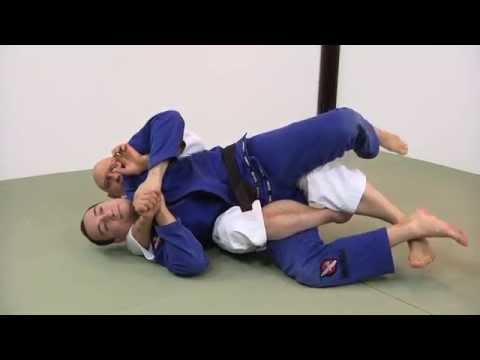
The Easiest Way to do the Twister
0
Twister·Stephan Kesting·Added by Admin
How to do the Twister Submission the easiest way. By Stephan Kesting from http://www.grapplearts.com
Translation: Twister
The twister is a cervical rotation crank that applies extreme lateral rotation and flexion to the spine by trapping the opponent's legs (via a lockdown or leg entanglement) while cranking the head in the opposite direction with a chin-strap grip. [1],[2] The attacker controls the lower body with leg hooks and the upper body with the head grip, then torques the spine by pulling the head one way while the legs anchor the hips in the other direction. [1],[3] The twister creates simultaneous rotational and lateral stress on the entire spinal column, making it one of the most dangerous cranks in grappling. [1],[4]
The twister was popularized by Eddie Bravo, who derived it from the wrestling 'guillotine' (a wrestling pin, not the choke) and integrated it into his 10th Planet Jiu-Jitsu system. [1],[2] The Korean Zombie (Chan Sung Jung) famously finished the first twister in UFC history in 2011. [1],[3] While spinal rotation attacks existed in wrestling, Bravo's systematization made the twister a recognized named submission in BJJ and MMA. [1],[4]
No images yet for this technique.
Sign in to suggest an image.
How to do the Twister Submission the easiest way. By Stephan Kesting from http://www.grapplearts.com
No instructional courses yet for this technique.
Sign in to suggest a course.
Risk of injury to the person this technique is applied to
The twister simultaneously rotates the cervical and thoracic spine; extreme risk of spinal injury
Skill level needed to execute this technique reliably
Whether this technique is allowed under major competition rule sets
Japanese BJJ — universal loanword; underlying concept: 脊椎捻り (Sekitsui Hineri) in Fusen-ryu
Japanese terminology sourced from Japanese BJJ — universal loanword; underlying concept: 脊椎捻り (Sekitsui Hineri) in Fusen-ryu
Classical ground-fighting jujutsu school
Standard katakana transliteration of Western martial arts terminology (外来語) — used in Japanese MMA, boxing, and BJJ communities
Japanese terminology sourced from Japanese BJJ — universal loanword; underlying concept: 脊椎捻り (Sekitsui Hineri) in Fusen-ryu
grip or squeeze strength, positional control
strong upper body for sustained compression
forearms, biceps, pectorals, core stabilisers
Every move, in any martial art, shares a few universal traits. Mix and match below to pinpoint the right tool — or compare equivalents across styles.
The twister from back ride is applied when the attacker has a back ride position with one hook controlling the opponent's far leg (the 'truck' entry) and threads an arm under the opponent's chin from behind, then uses the trapped leg and upper body grip to rotate the spine in opposite directions. [1,2] The attacker's legs control the lower body while the arms rotate the upper body in the opposite direction, creating severe rotational stress on the entire spinal column. [1] The back ride provides the base from which the twister's counter-rotational forces are generated. [1,2]
The twister from truck is applied from the 'truck' position, where the attacker controls the opponent's far leg by threading their own legs through in a lockdown-style configuration while positioned behind the opponent. [1,2] From the truck, the attacker threads one arm under the opponent's chin and grabs the wrist of the other arm, then rotates the upper body away from the trapped lower body to produce a severe rotational spinal crank. [1] The truck provides the leg control that anchors the lower body while the arms rotate the spine. [1,2]
The Twister appears in 595 passages across 16 books — the single most referenced submission in the 10th Planet system. Originally the wrestler's guillotine pin, adapted by Eddie Bravo as a spinal lock. Bravo's Mastering the Twister is entirely dedicated to the technique and its associated positions. (Bravo, Mastering the Twister; 16 books in corpus)
According to Stephan Kesting, if your opponent begins to escape or removes a hook, transition from full rear mount to half back mount rather than lose the position entirely, then work to set up the leg triangle from there.
Stephan Kesting emphasizes that the Twister can cause paralysis, so be especially careful when training with higher-level partners who might not tap early enough.
The twister is a cervical rotation crank that applies extreme lateral rotation and flexion to the spine by trapping the opponent's legs (via a lockdown or leg entanglement) while cranking the head in the opposite direction with a chin-strap grip. The attacker controls the lower body with leg hooks and the upper body with the head grip, then torques the spine by pulling the head one way while the legs anchor the hips in the other direction.
The twister was popularized by Eddie Bravo, who derived it from the wrestling 'guillotine' (a wrestling pin, not the choke) and integrated it into his 10th Planet Jiu-Jitsu system. The Korean Zombie (Chan Sung Jung) famously finished the first twister in UFC history in 2011.
IBJJF: banned — Neck cranks and spinal locks prohibited at all belt levels; IJF: banned — Neck cranks prohibited; ADCC: legal — Legal; Unified MMA: legal — Legal — choke submissions are among the most common finishes in MMA; FIAS Sport Sambo: banned — All chokes prohibited in Sport Sambo; FIAS Combat Sambo: legal — Legal
Danger rating 10/10. The twister simultaneously rotates the cervical and thoracic spine; extreme risk of spinal injury
The standard setup chain: Establish Position → Create the Threat → Secure the Hold → Finish.
Standard counters include: Early Recognition — identify the submission attempt early and begin defence immediately / Posture and Base — maintain strong posture and base to prevent submission setups / Grip Fight — deny the attacker their preferred gripping configuration.
Common variants: Standard grip variation (primary hand configuration for maximum choking pressure); Gi variation (uses the lapel or collar as an anchor for additional fric…); No-gi variation (adapted grip and positioning for submission grappling wit…); Transition finish (applied during a positional change to catch the opponent …).
The Korean Zombie (Chan Sung Jung) finished Leonard Garcia with a twister at UFC Fight Night 24 (2011), the first twister finish in UFC history. Eddie Bravo submitted Royler Gracie's student Gustavo Machado with a twister, demonstrating the technique's viability.
Top errors to watch for: Applying the twist without controlling the lower body — the legs must anchor the opponent's hips; without the leg hoo… / Twisting explosively — the spinal rotation is dangerous; apply the twist progressively to allow the opponent to tap / Not establishing the truck position before attempting the twist — the truck (leg entanglement + half back control) is… / Pulling only the head — the head pull creates the rotation, but the anchored legs are equally important; both must be….
The Twister is also known as Tsuisutaa, Wrestler's Guillotine, Spinal Crank, Eddie Bravo Twister.