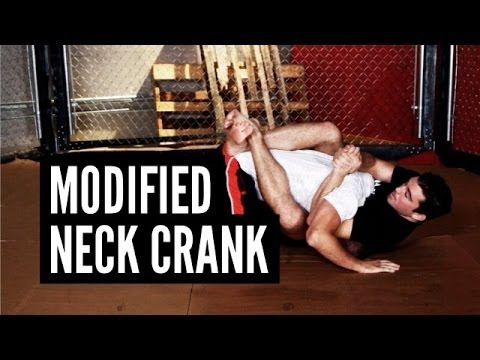
Modified Neck Crank
0
Cervical Rotation Crank·mahalodotcom
Top 10 MMA Knockouts of 2012: http://bit.ly/VLMFtM Benson Henderson's Axe Kick: http://bit.ly/VIRyBE Armbar Defense: ht…
頸椎回旋捻り(Keitsui Kaisen Hineri)
TraditionalTranslation: Cervical Spine Rotation Twist
Cervical rotation cranks twist the head laterally, applying torsional force to the cervical vertebrae. [1],[2] The twister is the most well-known example: from back control, the attacker traps a leg, controls the head, and rotates the opponent's upper body against the trapped lower body, creating extreme rotational stress on the thoracic and cervical spine. Cervical rotation cranks carry the highest injury risk of all neck crank variants. [3],[4]
Cervical rotation cranks force the neck into extreme rotation, targeting the cervical vertebrae, intervertebral discs, and surrounding ligaments. [1] They produce immediate intense pain and carry significant injury risk, which is why many rulesets classify them as illegal or grey-area techniques. [1],[2]
Cervical rotation cranks twist the head and neck, appearing in catch wrestling (twister), jūjutsu, and MMA. Eddie Bravo popularised the twister variation. [1]
The twister (a cervical rotation crank) was popularised by Eddie Bravo and has been finished in MMA, notably by Korean Zombie at UFC. [1]
No images yet for this technique.
Sign in to suggest an image.
Top 10 MMA Knockouts of 2012: http://bit.ly/VLMFtM Benson Henderson's Axe Kick: http://bit.ly/VIRyBE Armbar Defense: ht…
No instructional courses yet for this technique.
Sign in to suggest a course.
Risk of injury to the person this technique is applied to
Cervical rotation cranks twist the neck; the twister is among the most dangerous submissions in grappling
Skill level needed to execute this technique reliably
Whether this technique is allowed under major competition rule sets
Shooto Official Rules — anatomical terminology
Japanese MMA pioneer organization — technique classification
Standard Japanese martial arts terminology (kanji/hiragana)
Established Japanese martial arts naming convention — native Japanese term (和語/漢語)
Japanese terminology sourced from Shooto Official Rules — anatomical terminology
grip or squeeze strength, positional control
strong upper body for sustained compression
forearms, biceps, pectorals, core stabilisers
The ideal position is when your opponent has guard on you. From there, you slap their hands off and get your hand around their neck to set up the crank.
Use a thumbs-up grip, lock your feet together, and roll their head under while pulling back and squeezing. The instructor emphasizes sitting forward to make everything tight before applying pressure.
This technique causes significant pain and should be applied carefully. Proper communication is essential—the person being submitted should tap loudly or verbally say 'I quit' to ensure safety.
Cervical rotation cranks twist the head laterally, applying torsional force to the cervical vertebrae. The twister is the most well-known example: from back control, the attacker traps a leg, controls the head, and rotates the opponent's upper body against the trapped lower body, creating extreme rotational stress on the thoracic and cervical spine.
Rotational neck attacks were standard in catch wrestling finishing sequences. The twister was modernized by Eddie Bravo, adapted from wrestling's guillotine ride position, and incorporated into the 10th Planet Jiu-Jitsu curriculum.
IBJJF: banned — Neck cranks and spinal locks prohibited at all belt levels; IJF: banned — Neck cranks prohibited; ADCC: legal — Legal; Unified MMA: legal — Legal — choke submissions are among the most common finishes in MMA; FIAS Sport Sambo: banned — All chokes prohibited in Sport Sambo; FIAS Combat Sambo: legal — Legal
Danger rating 9/10. Cervical rotation cranks twist the neck; the twister is among the most dangerous submissions in grappling
The standard setup chain: Establish Position → Create the Threat → Secure the Hold → Finish.
Standard counters include: Early Recognition — identify the submission attempt early and begin defence immediately / Posture and Base — maintain strong posture and base to prevent submission setups / Grip Fight — deny the attacker their preferred gripping configuration.
Common variants: Standard grip variation (primary hand configuration for maximum choking pressure); Gi variation (uses the lapel or collar as an anchor for additional fric…); No-gi variation (adapted grip and positioning for submission grappling wit…); Transition finish (applied during a positional change to catch the opponent …).
The twister (a cervical rotation crank) was popularised by Eddie Bravo and has been finished in MMA, notably by Korean Zombie at UFC.
Top errors to watch for: Twisting the neck explosively — cervical rotation cranks can damage vertebral arteries, facet joints, and ligaments; … / Using rotation cranks in casual training — these are advanced submissions that should only be practised with experien… / Not controlling the body — rotation cranks require the torso to be fixed; without body control, the entire body rotat… / Ignoring the risk of vertebral artery injury — forced rotation can cause stroke-inducing arterial damage; treat this ….
The Cervical Rotation Crank is also known as Keitsui Kaisen Hineri, Spinal Twist, Rotational Neck Crank, Twister Family.