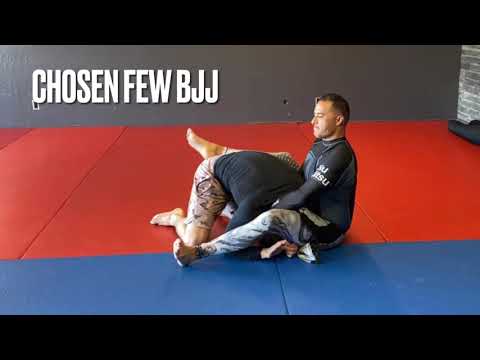
Peruvian Neck Tie
0
Peruvian Necktie·Chosen Few BJJ·Added by Admin
Peruvian neck tie from top turtle This is a great alternative to the Darce when you can’t get your arm through or knock …
Translation: Peruvian Necktie (katakana loanword)
The Peruvian necktie is a front headlock choke where the attacker wraps one arm around the opponent's neck, locks a grip, and throws a leg over the opponent's back to create downward leverage that tightens the strangle. [1],[2] The leg draped across the back acts as a lever — the weight of the leg plus hip extension creates significantly more compression than arms alone can generate. [1],[3] The technique is entered from a front headlock when the opponent is turtled or on all fours, and finished by sitting back while the leg drives the opponent's head downward. [1],[4]
The Peruvian necktie was developed and popularized by Tony DeSouza, an American MMA fighter of Peruvian descent, in the mid-2000s. [1],[2] DeSouza used the technique successfully in professional MMA competition, and it quickly spread through BJJ and submission grappling as a high-leverage front headlock finish. [1],[3] The leg-over mechanic was a novel addition to the traditional front headlock arsenal. [1],[4]
The Peruvian necktie uses a front headlock grip combined with a sprawled leg over the back to create a powerful choking mechanism. [1]
The Peruvian necktie was created by Tony DeSouza, a Peruvian-American BJJ and MMA competitor. [1]
The Peruvian necktie has been finished in UFC and other MMA promotions, notably by Tony DeSouza and CB Dollaway. [1]
No images yet for this technique.
Sign in to suggest an image.
Peruvian neck tie from top turtle This is a great alternative to the Darce when you can’t get your arm through or knock …
No instructional courses yet for this technique.
Sign in to suggest a course.
Risk of injury to the person this technique is applied to
The Peruvian necktie uses leg pressure over the back to amplify front headlock compression
Skill level needed to execute this technique reliably
Whether this technique is allowed under major competition rule sets
Yahoo知恵袋 BJJ community threads; Acai Cafe (cafe.quietwarriors.com) necktie choke comparison
Japanese Q&A community — BJJ technique name verification
Japanese BJJ community forum
Standard katakana transliteration of Western martial arts terminology (外来語) — used in Japanese MMA, boxing, and BJJ communities
Japanese terminology sourced from Yahoo知恵袋 BJJ community threads; Acai Cafe (cafe.quietwarriors.com) necktie choke comparison
grip or squeeze strength, positional control
strong upper body for sustained compression
forearms, biceps, pectorals, core stabilisers
Every move, in any martial art, shares a few universal traits. Mix and match below to pinpoint the right tool — or compare equivalents across styles.
The Peruvian necktie from closed guard is applied by the bottom player who secures a front headlock grip, then throws one leg over the opponent's back to create a lever that drives the head downward into the choking arm. [1,2] From closed guard, the attacker wraps the neck and threads the leg over the opponent's shoulder line, using hip extension and leg pressure to generate the downward force that tightens the strangle. [1] The closed guard initially controls distance before the leg is elevated to create the characteristic necktie lever. [1,2]
The Peruvian necktie from front headlock is the primary application of this technique, where the attacker secures a front headlock and then throws one or both legs over the opponent's back while sitting through to create a powerful downward lever on the trapped head. [1,2] The legs act as a lever arm that drives the opponent's head deeper into the choking arm, creating simultaneous carotid compression (the choking arm bicep against one side of the neck) and cervical flexion (head driven into the chest). [1] The attacker sits back and extends the hips to maximize the downward force, producing a fast and powerful finish that blends choking with cranking mechanics. [1,2]
The Peruvian necktie appears in 3 passages in our corpus. A front headlock choke where the attacker threads one arm around the neck, grips their own leg, and drops weight to create a choking pressure. Named for its popularization by Tony DeSouza, who has Peruvian heritage. (BJJ competition records)
Keep your body hugged tightly into your opponent and maintain pressure on their back throughout the technique. Chosen Few BJJ emphasizes staying super tight and bringing them into your elbows to maximize control.
You need to be in a deadlift position with your chest up and back slightly curved, keeping yourself tall rather than collapsing forward. This position allows you to squeeze effectively while maintaining leverage.
With a Peruvian Necktie, you must crunch into your opponent and bring their neck or chin down to their chest to achieve the choke, rather than being able to choke however you want as with a full guillotine grip.
Your outside leg goes over your opponent's head with your hamstring positioned along their neck, while you continue squeezing them into your body.
The Peruvian necktie is a front headlock choke where the attacker wraps one arm around the opponent's neck, locks a grip, and throws a leg over the opponent's back to create downward leverage that tightens the strangle. The leg draped across the back acts as a lever — the weight of the leg plus hip extension creates significantly more compression than arms alone can generate.
The Peruvian necktie was developed and popularized by Tony DeSouza, an American MMA fighter of Peruvian descent, in the mid-2000s. DeSouza used the technique successfully in professional MMA competition, and it quickly spread through BJJ and submission grappling as a high-leverage front headlock finish.
IBJJF: legal — Legal at all belt levels, gi and no-gi — chokes are the safest submission cat…; IJF: legal — Legal (shime-waza) — strangulation techniques are one of three permitted subm…; ADCC: legal — Legal; Unified MMA: legal — Legal — choke submissions are among the most common finishes in MMA; FIAS Sport Sambo: banned — All chokes prohibited in Sport Sambo; FIAS Combat Sambo: legal — Legal
Danger rating 9/10. The Peruvian necktie uses leg pressure over the back to amplify front headlock compression
The standard setup chain: Achieve Controlling Position → Isolate the Neck → Set the Grip → Apply Pressure.
Standard counters include: Tuck Chin — protect the neck by lowering the chin to prevent the choke from sinking / Two-on-One Grip Fight — use both hands to strip the choking grip before it locks / Turn Into — rotate toward the choking arm to relieve carotid pressure / Posture Up — straighten the spine and create distance to break the choking angle.
Common variants: Standard grip variation (primary hand configuration for maximum choking pressure); Gi variation (uses the lapel or collar as an anchor for additional fric…); No-gi variation (adapted grip and positioning for submission grappling wit…); Transition finish (applied during a positional change to catch the opponent …).
The Peruvian necktie has been finished in UFC and other MMA promotions, notably by Tony DeSouza and CB Dollaway.
Top errors to watch for: Not getting the leg fully over the back — the leg must pass over and press down on the opponent's back; a leg that do… / Throwing the wrong leg — throw the leg on the same side as the choking arm; the opposite leg doesn't create the corre… / Not maintaining the headlock grip during the leg transition — the grip must stay tight as the leg swings over; moment… / Attempting against an opponent who is posturing up — the Peruvian necktie requires the opponent's head to be low; aga….
The Peruvian Necktie is also known as Peruvian Nekutai, Peruvian Tie, Leg-Over Necktie, Peruvian Choke.