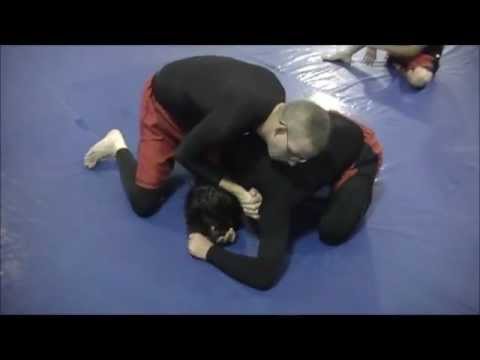
Front Head lock to Peruvian Necktie and Multiple Submission Options
0
Peruvian Necktie From Front Headlock·Donny Blue
This technique is from a Front Headlock to Peruvian NeckTie to Multiple Submission Options.Come in to Tri-City Martial a…
Translation: Peruvian Necktie (katakana loanword)
The Peruvian necktie from front headlock is the primary application of this technique, where the attacker secures a front headlock and then throws one or both legs over the opponent's back while sitting through to create a powerful downward lever on the trapped head. [1],[2] The legs act as a lever arm that drives the opponent's head deeper into the choking arm, creating simultaneous carotid compression (the choking arm bicep against one side of the neck) and cervical flexion (head driven into the chest). [1] The attacker sits back and extends the hips to maximize the downward force, producing a fast and powerful finish that blends choking with cranking mechanics. [1],[2]
Created and popularized by Tony DeSouza in MMA competition, the Peruvian necktie from front headlock became known as one of the most devastating front headlock submissions in no-gi grappling. [1],[2] DeSouza developed the technique by adding the leg-lever concept to the standard front headlock, creating significantly more force than arm strength alone could generate. [1] The technique was further refined by subsequent MMA and grappling competitors who systematized entries from common front headlock positions. [1],[2]
One of the most effective front headlock submissions in no-gi grappling — combines head-and-arm compression with leg pressure across the neck for a quick finish [1]
Created by Tony DeSouza, a Peruvian-American grappler training under Ralph Gracie. First demonstrated at major events in the early-to-mid 2000s; popularized through ADCC and 10th Planet Jiu-Jitsu [1]
Regular finish at ADCC, no-gi worlds, and in MMA. Tony DeSouza, Dustin Hazelett, and numerous 10th Planet competitors have scored notable wins with this technique [1]
No images yet for this technique.
Sign in to suggest an image.
This technique is from a Front Headlock to Peruvian NeckTie to Multiple Submission Options.Come in to Tri-City Martial a…
No instructional courses yet for this technique.
Sign in to suggest a course.
Risk of injury to the person this technique is applied to
Necktie chokes use leg pressure over the back combined with front headlock grip for extreme compression
Skill level needed to execute this technique reliably
Whether this technique is allowed under major competition rule sets
Yahoo知恵袋 BJJ community; Acai Cafe (cafe.quietwarriors.com)
Japanese Q&A community — BJJ technique name verification
Japanese BJJ community forum
Standard katakana transliteration of Western martial arts terminology (外来語) — used in Japanese MMA, boxing, and BJJ communities
Japanese terminology sourced from Yahoo知恵袋 BJJ community; Acai Cafe (cafe.quietwarriors.com)
grip or squeeze strength, positional control
strong upper body for sustained compression
forearms, biceps, pectorals, core stabilisers
Every move, in any martial art, shares a few universal traits. Mix and match below to pinpoint the right tool — or compare equivalents across styles.
The Peruvian necktie from front headlock with shin across the neck is the standard application of this technique, where the attacker holds a front headlock and swings one leg over the opponent's head, placing the shin across the back of the neck. [1] From the front headlock, the attacker sits to the hip on the side of the choking arm, then threads the near leg over the opponent's head so the shin presses against the cervical spine. [1,2] The leg acts as a powerful lever — pulling the hands while pressing the shin creates a three-point compression system that attacks the neck from multiple angles simultaneously. [2] This is the most commonly taught and highest-percentage Peruvian necktie variant. [2,3]
The shoulder-post Peruvian necktie variant modifies the standard entry by using the shoulder as a posting point against the opponent's back while applying the shin-across-neck compression. [1] Instead of sitting fully to the hip, the attacker posts the shoulder against the opponent's upper back, creating an additional pressure point that prevents the opponent from rolling or posturing out. [1,2] The shoulder post acts as a third contact point — combined with the shin on the neck and the hands on the head, it creates a triangulated pressure system that controls the opponent's entire upper body. [2] This variant is preferred when the opponent is actively resisting by trying to lift or roll through the standard finish. [2,3]
According to Donny Blue, rest your shoulder in the middle of the opponent's shoulder blades while getting up on your toes. Place the hand underneath with the back of your hand in their armpit using a thumbless grip, then scoop low with your elbow.
Donny Blue emphasizes staying tight with no space between you and your opponent—if you can see their neck, the choke is ineffective. Start squeezing your knees immediately and perform an oblique crunch by pushing off the hip while trying to touch your ear with the back of your hands.
Donny Blue stresses that the opponent's shoulder (not their arm) should be positioned in your crotch, and your shoulder should be lower than theirs, with the bone of your shoulder pressing into their neck.
If the neck choke isn't working, Donny Blue recommends digging deep with your hand and squeezing your knees together tightly, which can force a tap even when the primary submission is defended.
The Peruvian necktie from front headlock is the primary application of this technique, where the attacker secures a front headlock and then throws one or both legs over the opponent's back while sitting through to create a powerful downward lever on the trapped head. The legs act as a lever arm that drives the opponent's head deeper into the choking arm, creating simultaneous carotid compression (the choking arm bicep against one side of the neck) and cervical flexion (head driven into the chest).
Created and popularized by Tony DeSouza in MMA competition, the Peruvian necktie from front headlock became known as one of the most devastating front headlock submissions in no-gi grappling. DeSouza developed the technique by adding the leg-lever concept to the standard front headlock, creating significantly more force than arm strength alone could generate.
IBJJF: legal — Legal at all belt levels, gi and no-gi — chokes are the safest submission cat…; IJF: legal — Legal (shime-waza) — strangulation techniques are one of three permitted subm…; ADCC: legal — Legal; Unified MMA: legal — Legal — choke submissions are among the most common finishes in MMA; FIAS Sport Sambo: banned — All chokes prohibited in Sport Sambo; FIAS Combat Sambo: legal — Legal
Danger rating 9/10. Necktie chokes use leg pressure over the back combined with front headlock grip for extreme compression
The standard setup chain: Establish Position → Create the Threat → Secure the Hold → Finish.
Standard counters include: Early Recognition — identify the submission attempt early and begin defence immediately / Posture and Base — maintain strong posture and base to prevent submission setups / Grip Fight — deny the attacker their preferred gripping configuration.
Common variants: Standard grip variation (primary hand configuration for maximum choking pressure); Gi variation (uses the lapel or collar as an anchor for additional fric…); No-gi variation (adapted grip and positioning for submission grappling wit…); Transition finish (applied during a positional change to catch the opponent …).
Regular finish at ADCC, no-gi worlds, and in MMA.
Top errors to watch for: Attempting the necktie without establishing front headlock control — the headlock must be secure before adding the le… / Not connecting the hands before adding the lever — the grip must be locked; the lever adds force to an established st… / Choosing the wrong lever for the situation — if the leg can reach, use the shin variant (more force); if not, use the… / Not transitioning to other headlock attacks when the necktie is defended — guillotine, D'Arce, anaconda, and go-behin….
The Peruvian Necktie From Front Headlock is also known as Peruvian Nekutai, Front Headlock Peruvian Necktie, Peruvian Tie from Sprawl.