Learn The Peruvian Necktie Submission for Jiu Jitsu!
0
Peruvian Necktie From Closed Guard·Daisy Fresh
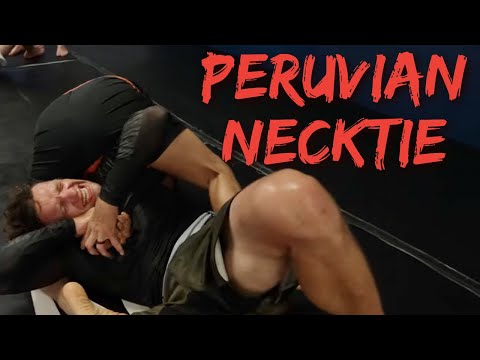
Franco Yucra teaches the Peruvian Necktie, learned directly from his first coach Tony DeSouza back in Peru! Anyone who …
Translation: Peruvian Necktie (katakana loanword)
The Peruvian necktie from closed guard is applied by the bottom player who secures a front headlock grip, then throws one leg over the opponent's back to create a lever that drives the head downward into the choking arm. [1],[2] From closed guard, the attacker wraps the neck and threads the leg over the opponent's shoulder line, using hip extension and leg pressure to generate the downward force that tightens the strangle. [1] The closed guard initially controls distance before the leg is elevated to create the characteristic necktie lever. [1],[2]
The Peruvian necktie is attributed to Tony DeSouza, a Peruvian-American MMA fighter who used the technique in competition in the mid-2000s. [1],[2] The closed guard variant represents an adaptation of the original front headlock application, where practitioners found that the guard position offered an alternative platform for establishing the leg-over-back lever. [1] The technique combines front headlock choking mechanics with the guard player's ability to use legs as force amplifiers. [1],[2]
Low-percentage from closed guard compared to the front headlock version; the guard player lacks the gravitational and hip-pressure advantages that make the standard Peruvian Necktie effective [1]
An adaptation of Tony DeSouza's Peruvian Necktie (2000s) to closed guard, explored primarily in no-gi training environments [1]
Rarely finished in competition; the front headlock version accounts for nearly all competitive Peruvian Necktie finishes [1]
No images yet for this technique.
Sign in to suggest an image.
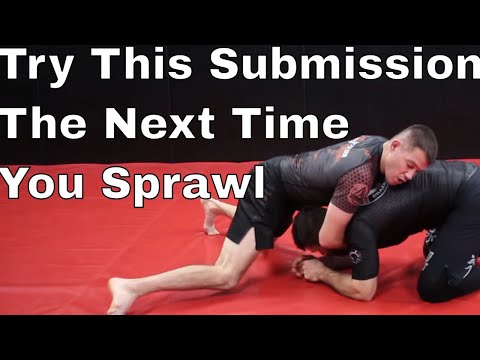
Franco Yucra teaches the Peruvian Necktie, learned directly from his first coach Tony DeSouza back in Peru! Anyone who …
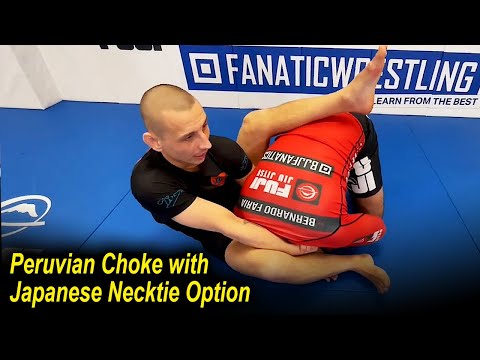
Peruvian Choke with Japanese Necktie Option - Click Here To Check Out Alex Humen's Instructional Videos - https://bjjfan…
In today's technique video my Black Belt buddy James Clingerman shows a sneaky Peruvian Necktie setup and finish from th…
The Peruvian Necktie from closed guard is executed from a side control or front headlock position, with instructors agreeing on core mechanics while offering complementary details. All three sources emphasize maintaining tight rib-cage-to-rib-cage contact to prevent opponent escape and control. Bernardo Faria BJJ Fanatics and Daisy Fresh both detail the gable grip setup, where the choking hand's fingers point skyward before meeting the other hand at the back of the opponent's head with the forearm blade tight against the neck—positioned at the hairline rather than high on the head to prevent slipping. Chewjitsu introduces an S-grip variant as an alternative to the gable, offering mobility advantages. The leg positioning diverges slightly: Faria emphasizes placing the heel to pass the opponent's elbow, sitting back on the thigh and buttock rather than flat on the spine; Daisy Fresh stresses a 90-degree angle with legs for maximum stretching leverage; Chewjitsu details the IT band placement across the back of the neck with the rear knee positioned behind to prevent rolling. All three agree on the finish mechanics: pulling with the arms while extending the legs, creating compression and spinal extension. Chewjitsu uniquely provides fallback submissions—armbar and reverse triangle—if the initial choke fails, demonstrating position versatility. The technique is presented as effective against wrestlers exploiting front headlock control.
Synthesized from 3 instructors
No instructional courses yet for this technique.
Sign in to suggest a course.
Risk of injury to the person this technique is applied to
Necktie chokes use leg pressure over the back combined with front headlock grip for extreme compression
Skill level needed to execute this technique reliably
Whether this technique is allowed under major competition rule sets
Yahoo知恵袋 BJJ community; Acai Cafe (cafe.quietwarriors.com)
Japanese Q&A community — BJJ technique name verification
Japanese BJJ community forum
Standard katakana transliteration of Western martial arts terminology (外来語) — used in Japanese MMA, boxing, and BJJ communities
Japanese terminology sourced from Yahoo知恵袋 BJJ community; Acai Cafe (cafe.quietwarriors.com)
grip or squeeze strength, positional control
strong upper body for sustained compression
forearms, biceps, pectorals, core stabilisers
Every move, in any martial art, shares a few universal traits. Mix and match below to pinpoint the right tool — or compare equivalents across styles.
According to Chewjitsu, you want your IT band and outer leg to lay on the back of the opponent's neck. Make sure your knee goes behind them so they can't immediately roll out, and keep that leg elevated—don't let it touch the mat again during the finish.
Bernardo Faria emphasizes not wrapping your partner's body with your arms, as they might trap your arm and roll you over. Instead, connect your rib cage to theirs, use one hand to control their hip, and keep your other hand on the back of their head to control head position.
Bernardo Faria teaches that when you extend your arm to create the grip, your fingers should point up toward the sky, forming a V-shape with your arm. Once you have the gable grip, ensure the blade of your forearm continues to press against your opponent's neck, placing it where the hair starts rather than too high on the head.
According to Bernardo Faria, hooking the leg prevents your opponent from rolling or escaping over the hook, making the submission significantly more secure and difficult to defend.
The Peruvian necktie from closed guard is applied by the bottom player who secures a front headlock grip, then throws one leg over the opponent's back to create a lever that drives the head downward into the choking arm. From closed guard, the attacker wraps the neck and threads the leg over the opponent's shoulder line, using hip extension and leg pressure to generate the downward force that tightens the strangle.
The Peruvian necktie is attributed to Tony DeSouza, a Peruvian-American MMA fighter who used the technique in competition in the mid-2000s. The closed guard variant represents an adaptation of the original front headlock application, where practitioners found that the guard position offered an alternative platform for establishing the leg-over-back lever.
IBJJF: legal — Legal at all belt levels, gi and no-gi — chokes are the safest submission cat…; IJF: legal — Legal (shime-waza) — strangulation techniques are one of three permitted subm…; ADCC: legal — Legal; Unified MMA: legal — Legal — choke submissions are among the most common finishes in MMA; FIAS Sport Sambo: banned — All chokes prohibited in Sport Sambo; FIAS Combat Sambo: legal — Legal
Danger rating 9/10. Necktie chokes use leg pressure over the back combined with front headlock grip for extreme compression
The standard setup chain: Achieve Controlling Position → Isolate the Neck → Set the Grip → Apply Pressure.
Standard counters include: Tuck Chin — protect the neck by lowering the chin to prevent the choke from sinking / Two-on-One Grip Fight — use both hands to strip the choking grip before it locks / Turn Into — rotate toward the choking arm to relieve carotid pressure / Posture Up — straighten the spine and create distance to break the choking angle.
Common variants: Standard grip variation (primary hand configuration for maximum choking pressure); Gi variation (uses the lapel or collar as an anchor for additional fric…); No-gi variation (adapted grip and positioning for submission grappling wit…); Transition finish (applied during a positional change to catch the opponent …).
Rarely finished in competition; the front headlock version accounts for nearly all competitive Peruvian Necktie finishes
Top errors to watch for: Pulling guard without the necktie grip secured — the grip must be locked before sitting back; pulling guard with a lo… / Not closing the guard — open guard allows the opponent to pass; the closed guard is essential for maintaining the choke / Relying only on the arm grip without using the legs — from guard, the legs must contribute to the compression; the ar… / Not transitioning when the necktie is defended — switch to guillotine or triangle if the necktie isn't finishing; all….
The Peruvian Necktie From Closed Guard is also known as Peruvian Nekutai, Guard Peruvian Necktie, Bottom Peruvian Tie.