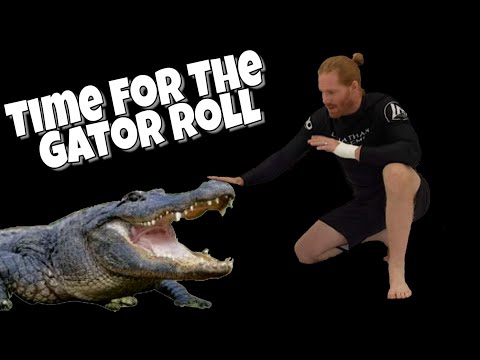
Gator Roll to Anaconda Choke
0
Anaconda Choke From Turtle Gator Roll·Still Rolling
Attacking from the front head position with the Gator Roll then transitioning to the Anaconda Choke. Also transitioning …
Translation: Anaconda Choke (katakana loanword)
The anaconda choke from turtle with gator roll uses the signature rolling transition to attack an opponent in the turtle position. [1] The attacker positions to the side of the turtled opponent, threads the near arm under the chin and around the far arm in the anaconda wrap, locks the grip, then executes the gator roll to pull the opponent from turtle onto their side. [1],[2] The turtle position is ideal for the anaconda entry because the opponent's elbows are on the mat, creating the neck-and-arm gap that the anaconda thread requires. [2] The gator roll is particularly effective against turtle because it eliminates the opponent's base entirely, rolling them into a position where escape is extremely difficult. [2],[3]
The turtle-to-anaconda with gator roll became one of the most common anti-turtle attacks in competition grappling, developed during the 2000s as turtle defence became increasingly prevalent. [1] This combination exemplifies the evolution of front headlock attacks into a systematic anti-turtle toolkit. [2],[3]
Dual-purpose technique — the gator roll simultaneously breaks the defensive turtle position and finishes the strangle. Highly effective because the turtle's rounded posture creates the ideal anaconda geometry. [1]
Combines the wrestling turtle attack with the BJJ anaconda and gator roll finish. The turtle is a common defensive position in both wrestling and BJJ, making this an important cross-discipline technique. [1]
Used in competition when opponents turtle to prevent guard passes or back takes. The gator roll from turtle is a primary method for attacking the turtle position in no-gi events. [1]
No images yet for this technique.
Sign in to suggest an image.
Attacking from the front head position with the Gator Roll then transitioning to the Anaconda Choke. Also transitioning …
No instructional courses yet for this technique.
Sign in to suggest a course.
Risk of injury to the person this technique is applied to
Anaconda/gator-roll chokes use a rolling motion to tighten the arm-in head-and-arm strangle
Skill level needed to execute this technique reliably
Whether this technique is allowed under major competition rule sets
Tri-force BJJ Academy (triforce-bjj.com); Tri-force Shiki BJJ (tfshiki-bjj.com); Aoki Shinya (note.com/a_ok_i)
Japan's largest BJJ academy chain — Japanese technique terminology
Japanese BJJ technique naming conventions article (2019)
Top Japanese MMA fighter — BJJ technique terminology
Standard katakana transliteration of Western martial arts terminology (外来語) — used in Japanese MMA, boxing, and BJJ communities
Japanese terminology sourced from Tri-force BJJ Academy (triforce-bjj.com); Tri-force Shiki BJJ (tfshiki-bjj.com); Aoki Shinya (note.com/a_ok_i)
long arms for head-and-arm wrap, core strength for gator roll
longer limbs, athletic build
biceps, deltoids, core rotators, hip flexors
Still Rolling emphasizes preferring to lock your hand over top and pull in tight, as hooking it up underneath gives opponents a known defense to escape.
Instead of just tucking your head and attempting the choke, pull back and extend your opponent's arm—this pulls their arm out and makes the roll much easier, especially against experienced wrestlers in nogi.
Still Rolling stresses getting tight under your opponent's head with a strong gable grip and elbows in, then pulling them to you so you can shoot your grip across—this positioning is where you'll really be able to finish the choke.
Try to hook a leg if you can to stop the escape, but the main focus should be getting tight and getting under their head, which is where the finish comes from.
The anaconda choke from turtle with gator roll uses the signature rolling transition to attack an opponent in the turtle position. The attacker positions to the side of the turtled opponent, threads the near arm under the chin and around the far arm in the anaconda wrap, locks the grip, then executes the gator roll to pull the opponent from turtle onto their side.
The turtle-to-anaconda with gator roll became one of the most common anti-turtle attacks in competition grappling, developed during the 2000s as turtle defence became increasingly prevalent. This combination exemplifies the evolution of front headlock attacks into a systematic anti-turtle toolkit.
IBJJF: legal — Legal at all belt levels, gi and no-gi — chokes are the safest submission cat…; IJF: legal — Legal (shime-waza) — strangulation techniques are one of three permitted subm…; ADCC: legal — Legal; Unified MMA: legal — Legal — choke submissions are among the most common finishes in MMA; FIAS Sport Sambo: banned — All chokes prohibited in Sport Sambo; FIAS Combat Sambo: legal — Legal
Danger rating 9/10. Anaconda/gator-roll chokes use a rolling motion to tighten the arm-in head-and-arm strangle
The standard setup chain: Achieve Controlling Position → Isolate the Neck → Set the Grip → Apply Pressure.
Standard counters include: Tuck Chin — protect the neck by lowering the chin to prevent the choke from sinking / Two-on-One Grip Fight — use both hands to strip the choking grip before it locks / Turn Into — rotate toward the choking arm to relieve carotid pressure / Posture Up — straighten the spine and create distance to break the choking angle.
Common variants: Standard anaconda (arm threaded under the neck and over the far arm, finishe…); No-roll anaconda (finished in place without the gator roll by sprawling and…); Anaconda from guard (applied from bottom position when the opponent's head is low).
Used in competition when opponents turtle to prevent guard passes or back takes. The gator roll from turtle is a primary method for attacking the turtle position in no-gi events.
Top errors to watch for: Threading from directly behind — approach from the side to access the neck-arm gap; directly behind limits access / Not connecting hands before rolling — the grip must be locked; rolling with an open grip loses the position / Rolling in the wrong direction — always toward the trapped arm; opposite direction opens the loop / Not committing to the roll — the gator roll requires momentum; tentative rolling allows the opponent to base and resist.
The Anaconda Choke From Turtle Gator Roll is also known as Anakonda Chōku, Turtle Gator Roll Anaconda, Rolling Anaconda from Turtle.