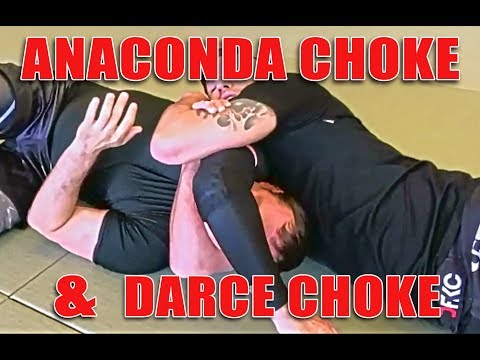
BJJ Chokes - How To Do The Anaconda Choke & The Darce Choke
0
Anaconda Choke·Knight Jiu-Jitsu
This video will show how to apply two of the most valuable and popular chokes from BJJ: The Anaconda Choke and The Darce…
Translation: Anaconda Choke (katakana loanword)
The anaconda choke is a front headlock arm triangle where the attacker threads one arm around the opponent's neck, under the far armpit, and locks a figure-four grip to create bilateral carotid compression. [1],[2] The finishing mechanic involves a gator roll — the attacker rolls to the trapping-arm side, which tightens the squeeze as body rotation cinches the figure-four configuration. [1],[3] The anaconda is the mirror of the D'Arce: here the arm goes around the neck first and under the armpit second. [1],[4] It is commonly entered from front headlock when the opponent is turtled or shoots for a takedown. [1],[5]
The anaconda choke was popularized by Milton Vieira and other Brazilian Jiu-Jitsu practitioners in the early 2000s. [1],[2] The gator roll finishing mechanic was adapted from wrestling's barrel roll and similar rotational techniques. [1],[3] The technique gained widespread visibility through MMA, where fighters used it to finish opponents from the front headlock sprawl position. [1],[4],[5]
The anaconda is one of the most reliable arm-triangle strangles — the over-neck-under-arm threading creates consistent bilateral compression using the opponent's shoulder. High finishing rate with gator roll or hip walk. [1]
Named for the constricting snake. Popularised by Milton Vieira in BJJ competition. The threading principle exists in catch wrestling arm-in headlocks and was systematised by Danaher's front headlock system. [1]
A top-tier front headlock submission at ADCC, no-gi worlds, and professional MMA. Milton Vieira, Rafael Mendes, and others have finished world-class opponents with the anaconda. [1]
No images yet for this technique.
Sign in to suggest an image.
This video will show how to apply two of the most valuable and popular chokes from BJJ: The Anaconda Choke and The Darce…
Welcome to my channel! Short, clear, and concise BJJ techniques that include footage of the technique every time. Like…
Like Our Videos or Subscribe to Our Channel to See New Demonstrations and Techniques. 3 Part Technique — Marcelo Garcia…
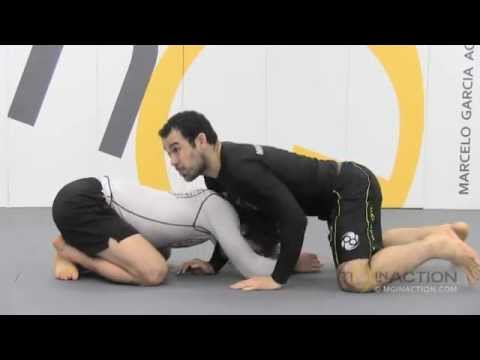
The anaconda choke is a front-headlock submission that enters via the neck and exits the armpit, executed from turtle or front-headlock positions. All three instructors emphasize precise elbow positioning as fundamental: the attacking arm's forearm must contact the soft tissue of the neck (where blood flow to the brain occurs) rather than hard muscle, requiring the elbow to remain completely in-line with the opponent's neck to avoid ineffective shoulder pressure. Jordan Teaches Jiujitsu stresses using a gable grip before rolling, tucking the head, and planting the foot to generate squeeze pressure while protecting against elbow-flaring defenses by transitioning to leg elevation. MGInActionVideos (Marcelo Garcia) demonstrates extensive hand-depth management, advising the top hand go as deep as possible on the shoulder while the bottom hand reaches for the opponent's arm before rotating; he details hip control during the roll to prevent escape and offers variations including alternative arm positioning when opponent arms resist closure. Knight Jiu-Jitsu provides turtle-position setup details and emphasizes using a gable grip squeeze to close arm-to-neck spacing before locking the bicep grip, plus the critical cue of looking underneath the opponent before rolling to avoid pulling them atop the attacker's face. All instructors agree on gable-grip setup, elbow alignment, and rotational mechanics, though Garcia provides the most technical variation detail regarding hand positioning and defensive counters.
Synthesized from 3 instructors
No instructional courses yet for this technique.
Sign in to suggest a course.
Risk of injury to the person this technique is applied to
Anaconda/gator-roll chokes use a rolling motion to tighten the arm-in head-and-arm strangle
Skill level needed to execute this technique reliably
Whether this technique is allowed under major competition rule sets
Tri-force BJJ Academy (triforce-bjj.com); Tri-force Shiki BJJ (tfshiki-bjj.com); Aoki Shinya (note.com/a_ok_i)
Japan's largest BJJ academy chain — Japanese technique terminology
Japanese BJJ technique naming conventions article (2019)
Top Japanese MMA fighter — BJJ technique terminology
Standard katakana transliteration of Western martial arts terminology (外来語) — used in Japanese MMA, boxing, and BJJ communities
Japanese terminology sourced from Tri-force BJJ Academy (triforce-bjj.com); Tri-force Shiki BJJ (tfshiki-bjj.com); Aoki Shinya (note.com/a_ok_i)
hip flexibility, long legs relative to torso
longer limbs for easier figure-four lock around head and arm
hip adductors, hamstrings, quadriceps
Every move, in any martial art, shares a few universal traits. Mix and match below to pinpoint the right tool — or compare equivalents across styles.
The anaconda choke from front headlock is applied by threading the attacking arm under the opponent's far-side arm and across the near side of the neck, then locking a figure-four grip and performing a gator roll to tighten the strangle. [1,2] From the front headlock, the attacker reaches across to encircle both the head and one arm, creating the arm-in compression structure. [1] The gator roll — a lateral rolling motion — is used to flatten the opponent and eliminate their base, pulling the choke tight as the bodies rotate. [1,2]
The anaconda choke from sprawl is initiated after the attacker sprawls to defend a takedown, trapping the opponent's head and threading the choking arm under the far-side arm and across the neck. [1,2] The sprawl creates the downward pressure and head-trapping angle that facilitate the arm thread, and the attacker transitions from the sprawled position into the gator roll to finish the strangle. [1] The sprawl-to-anaconda sequence is a natural counter-wrestling chain that punishes failed takedown attempts. [1,2]
The anaconda choke from turtle targets an opponent in the turtle position by the attacker threading the choking arm around the neck and under the far-side arm from a front-facing or side-facing angle, then locking the figure-four and executing a gator roll. [1,2] The turtle position exposes the head for the neck-wrap and arms for the arm thread, and the gator roll dismantles the opponent's base by rolling them onto their back or side. [1] The attacker ends in a controlling position with the choke locked, using chest pressure and the roll's momentum to complete the submission. [1,2]
You need one arm between the opponent's shoulder and neck, with that arm able to grab your bicep. According to Knight Jiu-Jitsu, if the space is too tight, you need to close it up to secure the grip properly.
Jordan Teaches Jiujitsu emphasizes that your elbow position is critical—you must be completely in line with the neck with no weird angles. Use a gable grip, shoot your arm across the body, tuck your head, and roll through for an effective choke without cranking.
If your opponent flares their elbow to defend, bring your legs up and then down to complete the choke, as explained by Jordan Teaches Jiujitsu.
Marcelo Garcia teaches that you should rotate your hips to move them toward the opponent's head, rather than staying underneath—this rotation helps tighten the choke and improves control.
The anaconda choke is a front headlock arm triangle where the attacker threads one arm around the opponent's neck, under the far armpit, and locks a figure-four grip to create bilateral carotid compression. The finishing mechanic involves a gator roll — the attacker rolls to the trapping-arm side, which tightens the squeeze as body rotation cinches the figure-four configuration.
The anaconda choke was popularized by Milton Vieira and other Brazilian Jiu-Jitsu practitioners in the early 2000s. The gator roll finishing mechanic was adapted from wrestling's barrel roll and similar rotational techniques.
IBJJF: legal — Legal at all belt levels, gi and no-gi — chokes are the safest submission cat…; IJF: legal — Legal (shime-waza) — strangulation techniques are one of three permitted subm…; ADCC: legal — Legal; Unified MMA: legal — Legal — choke submissions are among the most common finishes in MMA; FIAS Sport Sambo: banned — All chokes prohibited in Sport Sambo; FIAS Combat Sambo: legal — Legal
Danger rating 9/10. Anaconda/gator-roll chokes use a rolling motion to tighten the arm-in head-and-arm strangle
The standard setup chain: Achieve Controlling Position → Isolate the Neck → Set the Grip → Apply Pressure.
Standard counters include: Tuck Chin — protect the neck by lowering the chin to prevent the choke from sinking / Two-on-One Grip Fight — use both hands to strip the choking grip before it locks / Turn Into — rotate toward the choking arm to relieve carotid pressure / Posture Up — straighten the spine and create distance to break the choking angle.
Common variants: Standard triangle (classic figure-four leg lock around the head and one arm …); Reverse triangle (legs locked from behind or inverted angle for different a…); Mounted triangle (applied from mount position with gravity assisting the sq…); No-arm triangle (both arms excluded, legs-only compression on the neck).
A top-tier front headlock submission at ADCC, no-gi worlds, and professional MMA. Milton Vieira, Rafael Mendes, and others have finished world-class opponents with the anaconda.
Top errors to watch for: Confusing the anaconda threading with the D'Arce threading — anaconda goes over-neck-under-arm; D'Arce goes under-nec… / Not threading deep enough — the arm must pass far enough to connect the hands; shallow threading cannot be finished / Trapping the near arm instead of the far arm — the far arm's shoulder creates the correct compression angle / Not choosing between gator roll and hip walk — both are valid finishes; pick one and commit.
The Anaconda Choke is also known as Anakonda Chōku, Anaconda, Arm-Triangle Front Headlock, Gator Choke.