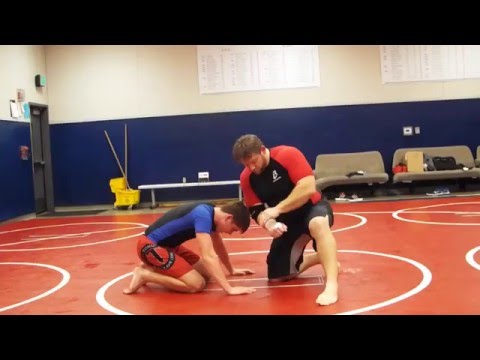
M.G.C. #415: Anaconda Choke/Darce Choke from Sprawl Control
0
Anaconda Choke From Sprawl·Modesto Judo Club
M.G.C. #415: Anaconda Choke/Darce Choke from Sprawl Control
Translation: Anaconda Choke (katakana loanword)
The anaconda choke from sprawl is initiated after the attacker sprawls to defend a takedown, trapping the opponent's head and threading the choking arm under the far-side arm and across the neck. [1],[2] The sprawl creates the downward pressure and head-trapping angle that facilitate the arm thread, and the attacker transitions from the sprawled position into the gator roll to finish the strangle. [1] The sprawl-to-anaconda sequence is a natural counter-wrestling chain that punishes failed takedown attempts. [1],[2]
The sprawl entry for the anaconda choke developed in MMA and no-gi grappling as wrestlers and grapplers sought submission options from the sprawled front headlock position. [1],[2] When traditional go-behind and spin attacks from the sprawl were too slow, the anaconda provided an immediate submission threat. [1] This counter-wrestling application gained popularity in the 2000s alongside the broader development of front headlock attack systems in submission grappling. [1],[2]
The anaconda from sprawl is a fundamental counter-wrestling submission — it punishes failed takedown attempts with an arm-triangle strangle. The sprawl provides weight advantage for the compression. [1]
Evolved from the wrestling sprawl defence combined with BJJ arm-triangle submissions. A standard counter-wrestling technique in modern MMA and submission grappling. [1]
Common in MMA as a takedown counter. Appears regularly when wrestlers over-commit to shots and are caught in the post-sprawl front headlock. [1]
No images yet for this technique.
Sign in to suggest an image.
M.G.C. #415: Anaconda Choke/Darce Choke from Sprawl Control
No instructional courses yet for this technique.
Sign in to suggest a course.
Risk of injury to the person this technique is applied to
Anaconda/gator-roll chokes use a rolling motion to tighten the arm-in head-and-arm strangle
Skill level needed to execute this technique reliably
Whether this technique is allowed under major competition rule sets
Tri-force BJJ Academy (triforce-bjj.com); Tri-force Shiki BJJ (tfshiki-bjj.com); Aoki Shinya (note.com/a_ok_i)
Japan's largest BJJ academy chain — Japanese technique terminology
Japanese BJJ technique naming conventions article (2019)
Top Japanese MMA fighter — BJJ technique terminology
Standard katakana transliteration of Western martial arts terminology (外来語) — used in Japanese MMA, boxing, and BJJ communities
Japanese terminology sourced from Tri-force BJJ Academy (triforce-bjj.com); Tri-force Shiki BJJ (tfshiki-bjj.com); Aoki Shinya (note.com/a_ok_i)
long arms for head-and-arm wrap, core strength for gator roll
longer limbs, athletic build
biceps, deltoids, core rotators, hip flexors
Every move, in any martial art, shares a few universal traits. Mix and match below to pinpoint the right tool — or compare equivalents across styles.
You need to get an arm inside the position first. Once you have sprawl control with an arm threaded in, you can place your other arm in the back of the neck to set up the choke.
Roll to your opposite side (typically to your left), then use a bicycle motion with your legs to hook and create leverage. Once you have the hook locked in, arch your back to tighten and finish the choke.
Yes, according to Modesto Judo Club instruction, you can finish this choke while down on your knees by using the bicycle hook technique rather than needing to roll through.
The anaconda choke from sprawl is initiated after the attacker sprawls to defend a takedown, trapping the opponent's head and threading the choking arm under the far-side arm and across the neck. The sprawl creates the downward pressure and head-trapping angle that facilitate the arm thread, and the attacker transitions from the sprawled position into the gator roll to finish the strangle.
The sprawl entry for the anaconda choke developed in MMA and no-gi grappling as wrestlers and grapplers sought submission options from the sprawled front headlock position. When traditional go-behind and spin attacks from the sprawl were too slow, the anaconda provided an immediate submission threat.
IBJJF: legal — Legal at all belt levels, gi and no-gi — chokes are the safest submission cat…; IJF: legal — Legal (shime-waza) — strangulation techniques are one of three permitted subm…; ADCC: legal — Legal; Unified MMA: legal — Legal — choke submissions are among the most common finishes in MMA; FIAS Sport Sambo: banned — All chokes prohibited in Sport Sambo; FIAS Combat Sambo: legal — Legal
Danger rating 9/10. Anaconda/gator-roll chokes use a rolling motion to tighten the arm-in head-and-arm strangle
The standard setup chain: Achieve Controlling Position → Isolate the Neck → Set the Grip → Apply Pressure.
Standard counters include: Tuck Chin — protect the neck by lowering the chin to prevent the choke from sinking / Two-on-One Grip Fight — use both hands to strip the choking grip before it locks / Turn Into — rotate toward the choking arm to relieve carotid pressure / Posture Up — straighten the spine and create distance to break the choking angle.
Common variants: Standard anaconda (arm threaded under the neck and over the far arm, finishe…); No-roll anaconda (finished in place without the gator roll by sprawling and…); Anaconda from guard (applied from bottom position when the opponent's head is low).
Common in MMA as a takedown counter. Appears regularly when wrestlers over-commit to shots and are caught in the post-sprawl front headlock.
Top errors to watch for: Threading before the sprawl is complete — finish the sprawl first (hips down, weight on the opponent) before attempti… / Not controlling the opponent's head during the threading — the head must be trapped; if it slips out during the threa… / Attempting against an opponent who has already retreated — the anaconda from sprawl works on the committed shot; once… / Not choosing between gator roll and hip walk — have a plan for the finish before threading.
The Anaconda Choke From Sprawl is also known as Anakonda Chōku, Sprawl Anaconda, Standing Anaconda Choke.