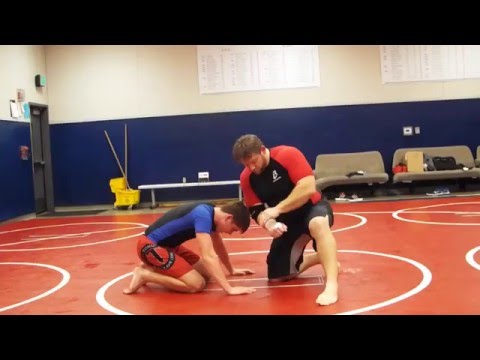
M.G.C. #415: Anaconda Choke/Darce Choke from Sprawl Control
0
Anaconda Choke From Sprawl Hip-Walk Finish·Modesto Judo Club
M.G.C. #415: Anaconda Choke/Darce Choke from Sprawl Control
Translation: Anaconda Choke (katakana loanword)
The anaconda choke from sprawl with hip-walk finish applies the head-and-arm strangle after sprawling on a takedown attempt, then uses the hip-walk method to progressively tighten the compression. [1] The sprawl provides the initial positional advantage — the opponent's head is driven to the mat and one arm is naturally exposed for the anaconda thread. [1],[2] From the sprawl, the attacker threads the choking arm, locks the grip, then walks the hips incrementally toward the opponent's head to ratchet the choke tighter. [2] This variant is valued in MMA for its ability to counter takedowns directly into a fight-ending submission without pulling guard. [2],[3]
Sprawl-to-anaconda transitions became a signature MMA counter-wrestling technique in the mid-2000s as the sport's grappling sophistication increased. [1] The hip-walk finish added a controlled, methodical alternative to the gator roll for fighters who preferred maintaining top position pressure. [2],[3]
Effective wrestling-to-submission transition — the sprawl defends the takedown while the hip-walk provides a controlled, top-position finish without needing to pull guard. [1]
Combines wrestling sprawl defence with the anaconda arm-triangle and hip-walk finishing method. Represents the wrestling-to-submission grappling evolution. [1]
Seen in MMA and submission wrestling when wrestlers defend takedowns and convert to anaconda attacks. The hip-walk finish is preferred by competitors who want to maintain top position. [1]
No images yet for this technique.
Sign in to suggest an image.
M.G.C. #415: Anaconda Choke/Darce Choke from Sprawl Control
No instructional courses yet for this technique.
Sign in to suggest a course.
Risk of injury to the person this technique is applied to
Anaconda/gator-roll chokes use a rolling motion to tighten the arm-in head-and-arm strangle
Skill level needed to execute this technique reliably
Whether this technique is allowed under major competition rule sets
Tri-force BJJ Academy (triforce-bjj.com); Tri-force Shiki BJJ (tfshiki-bjj.com); Aoki Shinya (note.com/a_ok_i)
Japan's largest BJJ academy chain — Japanese technique terminology
Japanese BJJ technique naming conventions article (2019)
Top Japanese MMA fighter — BJJ technique terminology
Standard katakana transliteration of Western martial arts terminology (外来語) — used in Japanese MMA, boxing, and BJJ communities
Japanese terminology sourced from Tri-force BJJ Academy (triforce-bjj.com); Tri-force Shiki BJJ (tfshiki-bjj.com); Aoki Shinya (note.com/a_ok_i)
long arms for head-and-arm wrap, core strength for gator roll
longer limbs, athletic build
biceps, deltoids, core rotators, hip flexors
You need to start in sprawl control with an arm threaded through your opponent's guard. According to Modesto Judo Club's M.G.C. #415, this arm placement is essential before you can execute the choke effectively.
Roll to your left, then use a bicycle motion with your legs to hook your opponent's body while arching your back to apply pressure. Modesto Judo Club emphasizes that this arching motion combined with the hook creates a very tight finish.
Try the bicycle leg motion to find a better hook point on your opponent's body—this mechanical adjustment helps lock in the choke more securely than attempting to muscle it, according to Modesto Judo Club's instructional approach.
The anaconda choke from sprawl with hip-walk finish applies the head-and-arm strangle after sprawling on a takedown attempt, then uses the hip-walk method to progressively tighten the compression. The sprawl provides the initial positional advantage — the opponent's head is driven to the mat and one arm is naturally exposed for the anaconda thread.
Sprawl-to-anaconda transitions became a signature MMA counter-wrestling technique in the mid-2000s as the sport's grappling sophistication increased. The hip-walk finish added a controlled, methodical alternative to the gator roll for fighters who preferred maintaining top position pressure.
IBJJF: legal — Legal at all belt levels, gi and no-gi — chokes are the safest submission cat…; IJF: legal — Legal (shime-waza) — strangulation techniques are one of three permitted subm…; ADCC: legal — Legal; Unified MMA: legal — Legal — choke submissions are among the most common finishes in MMA; FIAS Sport Sambo: banned — All chokes prohibited in Sport Sambo; FIAS Combat Sambo: legal — Legal
Danger rating 9/10. Anaconda/gator-roll chokes use a rolling motion to tighten the arm-in head-and-arm strangle
The standard setup chain: Achieve Controlling Position → Isolate the Neck → Set the Grip → Apply Pressure.
Standard counters include: Tuck Chin — protect the neck by lowering the chin to prevent the choke from sinking / Two-on-One Grip Fight — use both hands to strip the choking grip before it locks / Turn Into — rotate toward the choking arm to relieve carotid pressure / Posture Up — straighten the spine and create distance to break the choking angle.
Common variants: Standard anaconda (arm threaded under the neck and over the far arm, finishe…); No-roll anaconda (finished in place without the gator roll by sprawling and…); Anaconda from guard (applied from bottom position when the opponent's head is low).
Seen in MMA and submission wrestling when wrestlers defend takedowns and convert to anaconda attacks. The hip-walk finish is preferred by competitors who want to maintain top position.
Top errors to watch for: Not sprawling low enough before threading — the sprawl must be heavy; threading from a high sprawl gives the opponent… / Walking hips in the wrong direction — toward the choking arm side always; opposite direction loosens / Taking too large steps — small, controlled steps create incremental tightening; large steps risk losing the grip / Not maintaining chest pressure — stay heavy on the opponent while walking; lifting up creates escape space.
The Anaconda Choke From Sprawl Hip-Walk Finish is also known as Anakonda Chōku, Sprawl Hip-Walk Anaconda, Walk-Around Anaconda from Sprawl.