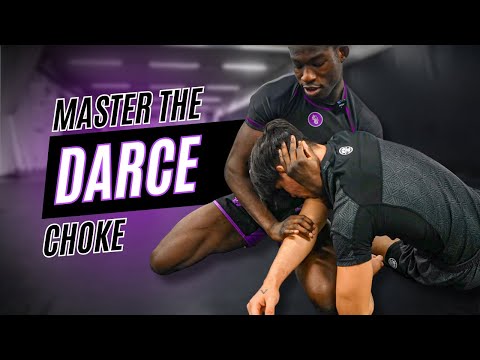
UFC BJJ Star Davis Asare Teaches World Class Darce
0
D’Arce Choke From Top Half-Guard·JonThomasBJJ
Make Hydration Easier With Kumite! Get 20% off your order with code: JONTHOMASBJJ https://kumite.energy/?utm_source=jont…
Not yet documented
The D'Arce choke applied from the top half-guard position, where the attacker threads the arm under the bottom player's neck while they attempt to underhook or recover guard. This entry capitalises on the bottom player's exposed neck when they turn to their side to initiate a sweep or underhook. It is one of the highest-percentage D'Arce entries in competition.
Named after Joe D'Arce; closely related to the Brabo choke from Brazil. [1]
The D'Arce choke is commonly finished in MMA and no-gi competition. [1]
No images yet for this technique.
Sign in to suggest an image.
Make Hydration Easier With Kumite! Get 20% off your order with code: JONTHOMASBJJ https://kumite.energy/?utm_source=jont…
In this video I explain how to apply the Darce choke. This is a very common choke with a large variety of setups. During…
How to Do the D'Arce (aka No Gi Brabo) choke in BJJ, no gi submission grappling, and MMA by Denis Kang and Stephan Kesti…
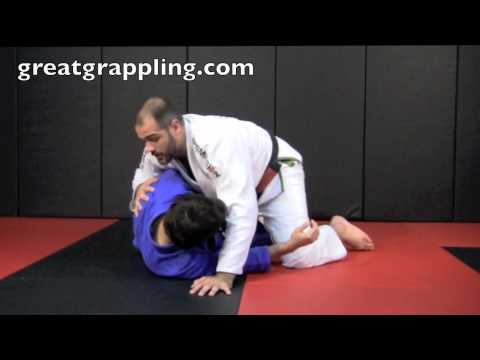
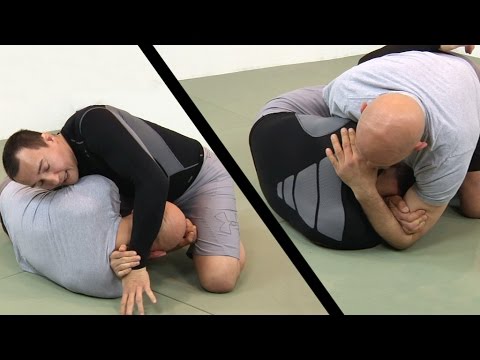
The D'Arce choke from top half-guard is a front-headlock-based arm-triangle submission that capitalizes on the opponent's underhook attempt. According to Stephan Kesting and Great Grappling, the technique is triggered when the bottom player seeks an underhook in half-guard, prompting the top player to thread their arm under the opponent's head and neck. The setup requires feeding the hand deep underneath the opponent's arm and manipulating the neck to break down posture and access the back of the neck. Davis Asare, featured by JonThomasBJJ, emphasizes that the finishing mechanics depend on hand placement—the top hand should walk as high as possible toward the far shoulder rather than remaining low. All three instructors stress the importance of achieving a chest-to-chest position for optimal finishing, with Asare noting that opponents will attempt to escape by facing belly-down or belly-up to prevent this alignment. Great Grappling and Kesting both detail the figure-four grip variation, with Kesting presenting an alternative forearm-to-forearm grip for shorter-armed practitioners or larger opponents. Asare uniquely highlights using the top player's knee, thigh, or hip to drive the opponent's elbow past the centerline, and emphasizes rotating the elbow inward (rather than squeezing blindly) as the primary finishing mechanism. Great Grappling adds that lifting the setup-side elbow toward the ceiling provides superior leverage compared to pure compression. All instructors agree the position is fluid, requiring continuous positional adjustment to maintain chest-to-chest orientation as opponents counter-rotate.
Synthesized from 3 instructors
No instructional courses yet for this technique.
Sign in to suggest a course.
Risk of injury to the person this technique is applied to
The D'Arce choke compresses the carotid arteries and can cause unconsciousness in 6-10 seconds; the trapped arm adds additional compression
Skill level needed to execute this technique reliably
Whether this technique is allowed under major competition rule sets
Jiu-Jitsu University (Saulo Ribeiro, 2008)
Description sources — [1] Joe D'Arce technique lineage [2] Competition analysis
Standard katakana transliteration of Western martial arts terminology (外来語) — used in Japanese MMA, boxing, and BJJ communities
Description sources — [1] Joe D'Arce technique lineage [2] Competition analysis
arm length (threading under the armpit), squeeze strength, chest pressure
long arms
biceps, forearms, chest
Every move, in any martial art, shares a few universal traits. Mix and match below to pinpoint the right tool — or compare equivalents across styles.
Stephan Kesting emphasizes that while you can finish by squeezing hard if you're very strong, using biomechanics is more effective: drive forward while pushing your arm up into the neck and driving down with the other hand to create a tight choke.
According to Stephan Kesting, when you place your arm on the forearm instead of the bicep and drop your chest for pressure, it becomes more of a neck crank than a choke, with your wrist acting as the fulcrum and your chest providing counterweight pressure on the neck.
Great Grappling instructor explains that how deep you get your setup hand underneath is critical—it dictates whether or not you'll finish the choke, so getting maximum depth is important before cinching the grip.
Great Grappling emphasizes using the bony part of your wrist on the outside of the neck, avoiding the flat, bendy, or back parts of the wrist that bend, as this creates more effective pressure.
Great Grappling demonstrates lifting your inside elbow toward the ceiling after sitting on your opponent's hip and securing the grip—this finish works even when your opponent has a solid underhook.
The D'Arce choke applied from the top half-guard position, where the attacker threads the arm under the bottom player's neck while they attempt to underhook or recover guard. This entry capitalises on the bottom player's exposed neck when they turn to their side to initiate a sweep or underhook.
The D'Arce choke was named after Joe D'Arce who popularised the technique in the early 2000s. It is closely related to the Brabo choke.
IBJJF: legal — Legal at all belt levels, gi and no-gi — chokes are the safest submission cat…; IJF: legal — Legal (shime-waza) — strangulation techniques are one of three permitted subm…; ADCC: legal — Legal; Unified MMA: legal — Legal — choke submissions are among the most common finishes in MMA; FIAS Sport Sambo: banned — All chokes prohibited in Sport Sambo; FIAS Combat Sambo: legal — Legal
Danger rating 8/10. High — the D'Arce choke compresses the carotid arteries and can cause unconsciousness in 6-10 seconds; the trapped arm adds additional compression
The standard setup chain: Establish front headlock/half guard top → Thread choking arm under armpit → Wrap around neck → Clasp hands → Apply chest pressure and squeeze.
Standard counters include: Posture up before the arm is threaded / Lock the hands together to prevent arm isolation / Turn into the choke to relieve angle.
Common variants: Short D'Arce (partial arm thread for shorter arms); Long D'Arce (deep arm thread for maximum compression); Gable grip finish; RNC-style figure-four finish.
The D'Arce choke is commonly finished in MMA and no-gi competition.
Top errors to watch for: Not threading deep enough / Squeezing with arms only (use chest pressure) / Not controlling the opponent's hip to prevent escape / Applying from too far away.
The D’Arce Choke From Top Half-Guard is also known as D'Arce From Half Guard Top, Brabo From Half Guard, Half Guard D'Arce.