Introduction and Setup
Stefan Kasting demonstrates the D'Arce choke, also known as the No-Gi Brabo choke, with training partner Dennis Kang. While this technique can be applied from multiple positions including bottom half-guard, turtle, and side mount, Kasting typically executes it from the top half-guard position when his opponent has an underhook.
Arm Positioning and Initial Control
From half-guard with the opponent controlling one leg and establishing an underhook, Kasting comes over the opponent's arm and slides his hand under the head. Tight positioning on the arm is critical to prevent the opponent from escaping or using a limp-arm defense.
Preventing the Escape
Kasting secures both hands on the opponent's head to prevent them from arching back and extracting their neck or limp-arming out of the submission. This two-hand control is essential before transitioning to the final grip.
The Grip Configuration
Kasting slides his forearm down against the back of the opponent's head until his elbow contacts the ground, then configures his arms by bringing his hand up to complete the grip. This arm arrangement sets up the choking mechanism using both pressure and leverage.
Finishing with Proper Mechanics
Rather than relying on strength alone, Kasting drives forward using biomechanics to apply pressure. The choke is executed by driving the upper arm up into the neck while simultaneously driving downward, creating a vise-like effect that forces the tap.
The Forearm Variation for Different Body Types
Dennis Kang demonstrates an alternative grip configuration for practitioners with shorter arms or when facing larger opponents. Instead of clasping the grip on the bicep, the hand is placed on the forearm, reducing the distance required to complete the submission.
Chest-Driven Pressure Application
In the forearm variation, Kang drops his chest to create downward pressure on the neck rather than relying on arm strength. The wrist acts as the fulcrum while the chest provides the counterweight, creating a neck crank effect that is highly effective regardless of arm length.
Maintaining Elbow Pressure
Both instructors emphasize keeping the elbows squeezed tightly throughout the technique to maintain a compact package and maximize pressure. Combined with downward chest weight, this elbow engagement ensures submission efficiency and prevents the opponent from creating escape space.
Alternative Names and Historical Context
The forearm variation is sometimes referred to as the Japanese Necktie and represents an evolution of techniques that originated years earlier without a formal name. These variations demonstrate jiu-jitsu's cyclical nature, where old techniques are continuously rediscovered and refined for modern application.
How to Do the D'Arce Choke (aka the No Gi Brabo Choke)
Key Takeaways
- •Introduction and Setup
- •Arm Positioning and Initial Control
- •Preventing the Escape
- •The Grip Configuration
How to Do the D'Arce (aka No Gi Brabo) choke in BJJ, no gi submission grappling, and MMA by Denis Kang and Stephan Kesting. Download Stephan's free guide to learning BJJ fast at http://www.grapplearts.com/book
Related Techniques
Frequently Asked Questions
What does this video teach about d’arce choke from top half-guard?
This video covers introduction and setup, arm positioning and initial control, preventing the escape. It provides detailed instruction from Stephan Kesting.
How long does it take to learn d’arce choke from top half-guard?
The basic mechanics can be understood in a single session, but developing reliable execution requires consistent drilling over weeks of practice. This 9-part breakdown helps structure your training by isolating each phase of the technique.
What are the key details for finishing d’arce choke from top half-guard?
Both instructors emphasize keeping the elbows squeezed tightly throughout the technique to maintain a compact package and maximize pressure. Combined with downward chest weight, this elbow engagement ensures submission efficiency and prevents the opponent from creating escape space.
Related videos
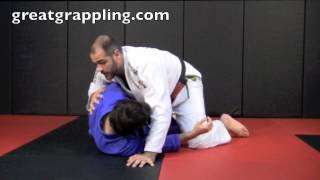
Half Guard Submission- The Darce
Great Grappling
UFC BJJ Star Davis Asare Teaches World Class Darce
JonThomasBJJ
All About the Darce Choke - Pathways & Back-Up Plans
Knight Jiu-Jitsu
UFC BJJ Star Davis Asare Teaches World Class Darce
JonThomasBJJ

Front Headlock: Submission Chain for MMA (D'Arce to Guillotine)
fightTIPS