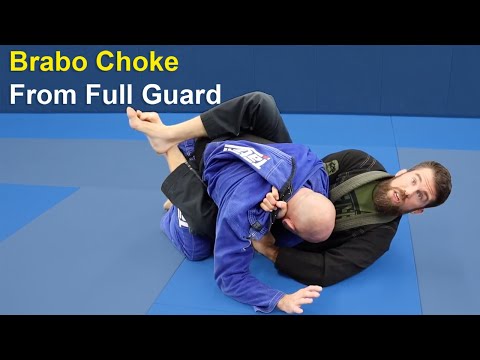
Lapel Grip in Full Guard for Breaking Posture and Setting Up Submissions
0
Loop From Guard·Chewjitsu
Today's BJJ technique video will show you a nasty, but simple, lapel grip you can use to break someone's posture and set…
Translation: Loop Choke (katakana loanword)
The loop choke from guard is applied when the bottom player threads one hand behind the opponent's neck and grips their own collar or the opponent's collar, creating a loop of fabric around the neck that compresses the carotid arteries. [1],[2] As the opponent attempts to pass or posture, the guard player tightens the loop by pulling the collar hand toward their own chest while using the legs to control distance and hip angle. [1] The choke tightens progressively as the opponent moves forward, making it an effective counter to guard passing attempts. [1],[2]
The loop choke from guard emerged in competitive BJJ as a counter to aggressive guard passing, with practitioners discovering that collar grips threaded behind the head could be converted into strangles during transitions. [1],[2] The technique gained prominence in the 2000s through competitors who used it as a surprise submission during scrambles. [1] Its self-tightening nature — the opponent's own forward movement increases the choke's pressure — makes it a unique positional trap within the guard choke arsenal. [1],[2]
The loop choke from guard catches opponents who drive forward during guard passing with a sudden collar strangle. [1]
Guard loop chokes were developed in BJJ as counter-submissions against guard passing. [1]
Loop chokes from guard are commonly finished at IBJJF competition. [1]
No images yet for this technique.
Sign in to suggest an image.
Today's BJJ technique video will show you a nasty, but simple, lapel grip you can use to break someone's posture and set…
This video I go through a simple system to create offense vs a strong stalling opponent. The key to attacking a stalling…
LOOP CHOKE BY THOMAS LISBOA - BJJ Techniques // In this BJJ Techniques video, Thomas Lisboa demonstrates hot to do the…
The loop choke from guard is a collar-based stranglehold executed primarily from closed guard, where the attacker wraps their forearm across the opponent's neck using a lapel grip to create a loop that compresses the carotid artery. All three instructors—Chewjitsu, JonThomasBJJ, and BJJ Fanatics—emphasize that the technique requires a loose rather than deep collar grip, distinguishing it from traditional cross-collar chokes. Chewjitsu demonstrates the choke following posture-breaking with the Bravo grip in full guard, establishing control before attacking an X choke to force the opponent's defensive posture upward, then transitioning by pulling the sleeve across and scooping the head to secure the position. JonThomasBJJ presents the loop choke as a response when opponents defend against omoplata and triangle threats by pulling their elbow tight, showing how the attacker dips their wrist to create a pocket for the neck and threads their top arm over and under the forearm. BJJ Fanatics (Thomas Lisboa) emphasizes that closed guard is superior to open guard for the loop choke since leg position prevents the opponent from escaping via lateral rotation—the primary defense—and stresses the importance of proper hip angle and consistent pressure rather than explosive force. All instructors agree that the technique requires practice to find the optimal collar grip point and that finishing relies on removing space through body positioning and wrist flexion rather than raw strength.
Synthesized from 3 instructors
No instructional courses yet for this technique.
Sign in to suggest a course.
Risk of injury to the person this technique is applied to
Loop choke from guard catches passers who posture low with one lapel grip
Skill level needed to execute this technique reliably
Whether this technique is allowed under major competition rule sets
柔術B (jiujitsu-b.com) choke technique summary
Major Japanese BJJ publication — comprehensive technique lists
Standard katakana transliteration of Western martial arts terminology (外来語) — used in Japanese MMA, boxing, and BJJ communities
Japanese terminology sourced from 柔術B (jiujitsu-b.com) choke technique summary
grip or squeeze strength, positional control
strong upper body for sustained compression
forearms, biceps, pectorals, core stabilisers
Every move, in any martial art, shares a few universal traits. Mix and match below to pinpoint the right tool — or compare equivalents across styles.
According to Thomas Lisboa at BJJ Fanatics, a deep grip on the collar will prevent you from applying the loop choke effectively—you need a looser grip to make the technique work. The grip should be positioned more to the side of the neck rather than directly over the shoulder.
Thomas Lisboa explains that in the open guard, your opponent can spin to the side to escape the loop choke, but in the closed guard, your legs prevent them from turning, making the choke far more difficult to escape.
Jon Thomas notes that when opponents pull their elbow tight to defend, they lower their posture, which makes the loop choke much easier to execute. You dip your wrist forward to create a pocket for the neck to go under.
Thomas Lisboa emphasizes that you cannot squeeze to tap immediately—instead you must stay tight, bring your wrist in with your other hand, and angle your body properly in order to make your opponent tap.
The loop choke from guard is applied when the bottom player threads one hand behind the opponent's neck and grips their own collar or the opponent's collar, creating a loop of fabric around the neck that compresses the carotid arteries. As the opponent attempts to pass or posture, the guard player tightens the loop by pulling the collar hand toward their own chest while using the legs to control distance and hip angle.
The loop choke from guard emerged in competitive BJJ as a counter to aggressive guard passing, with practitioners discovering that collar grips threaded behind the head could be converted into strangles during transitions. The technique gained prominence in the 2000s through competitors who used it as a surprise submission during scrambles.
IBJJF: legal — Legal at all belt levels, gi and no-gi — chokes are the safest submission cat…; IJF: legal — Legal (shime-waza) — strangulation techniques are one of three permitted subm…; ADCC: legal — Legal; Unified MMA: legal — Legal — choke submissions are among the most common finishes in MMA; FIAS Sport Sambo: banned — All chokes prohibited in Sport Sambo; FIAS Combat Sambo: legal — Legal
Danger rating 8/10. Loop choke from guard catches passers who posture low with one lapel grip
The standard setup chain: Achieve Controlling Position → Isolate the Neck → Set the Grip → Apply Pressure.
Standard counters include: Tuck Chin — protect the neck by lowering the chin to prevent the choke from sinking / Two-on-One Grip Fight — use both hands to strip the choking grip before it locks / Turn Into — rotate toward the choking arm to relieve carotid pressure / Posture Up — straighten the spine and create distance to break the choking angle.
Common variants: Standard grip variation (primary hand configuration for maximum choking pressure); Gi variation (uses the lapel or collar as an anchor for additional fric…); No-gi variation (adapted grip and positioning for submission grappling wit…); Transition finish (applied during a positional change to catch the opponent …).
Loop chokes from guard are commonly finished at IBJJF competition.
Top errors to watch for: Opening the guard before the loop is secured — keep the guard closed until the forearm is around the head; premature … / Not maintaining the collar grip throughout guard play — the grip must be established early and maintained; scrambling… / Attempting against an opponent who is leaning back — the guard loop requires forward commitment; against a posturing … / Falling backward instead of to the side — the loop tightens laterally, not vertically; falling straight back creates ….
The Loop From Guard is also known as Rūpu Chōku, Guard Loop Choke, Closed Guard Loop.