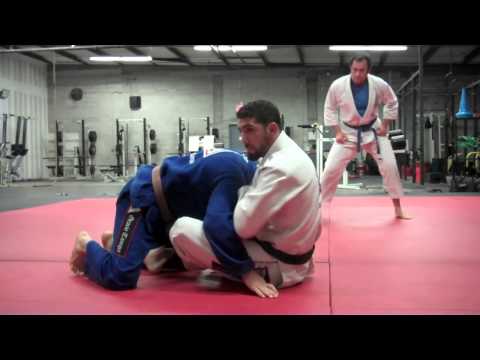
Best Loop Choke Technique (top and bottom)
0
Head Loop Lapel Noose Choke·Matt Arroyo Jiu Jitsu
http://www.MattArroyo.com Matt Arroyo teaches the loop choke from top and from bottom at Gracie Tampa South MMA. These…
Translation: Head Loop Lapel Noose Choke (katakana loanword)
Head-loop lapel noose chokes use the opponent's collar looped over and around the head to create a noose-like constriction around the neck. [1] The loop choke — the primary technique — is applied by feeding the collar around the opponent's neck from bottom position (typically half guard or butterfly guard), then closing the loop and tightening. Loop chokes are effective because the collar creates a broad compression surface and the attacker can use both hands. [2],[3]
The head loop lapel choke uses the lapel fed around the opponent's head to create a noose-like strangle. [1]
Lapel noose chokes were developed in modern BJJ as part of the expanding lapel guard/worm guard system. [1]
Lapel choke innovations appear at high-level IBJJF competition, particularly from competitors known for lapel guard systems. [1]
No images yet for this technique.
Sign in to suggest an image.
http://www.MattArroyo.com Matt Arroyo teaches the loop choke from top and from bottom at Gracie Tampa South MMA. These…
No instructional courses yet for this technique.
Sign in to suggest a course.
Risk of injury to the person this technique is applied to
Loop chokes create a self-tightening noose around the neck using the opponent's lapel
Skill level needed to execute this technique reliably
Whether this technique is allowed under major competition rule sets
Japanese BJJ community; related to ループチョーク
Japanese BJJ community; related to ループチョーク
Standard katakana transliteration of Western martial arts terminology (外来語) — used in Japanese MMA, boxing, and BJJ communities
Japanese terminology sourced from Japanese BJJ community; related to ループチョーク
grip or squeeze strength, positional control
strong upper body for sustained compression
forearms, biceps, pectorals, core stabilisers
Every move, in any martial art, shares a few universal traits. Mix and match below to pinpoint the right tool — or compare equivalents across styles.
According to Matt Arroyo Jiu Jitsu, you want to curl your wrist so that when you do, it touches the opponent's neck—positioning your knuckle rather than your thumb against the neck is ideal.
Matt Arroyo Jiu Jitsu emphasizes dropping your shoulder under the opponent's shoulder and pushing into it to finish; make sure your shoulder goes over their arm and head to avoid them escaping, and keep the grip tight throughout.
Matt Arroyo Jiu Jitsu advises making it look like you want to wrestle rather than choke—push into them to get them to come back, then smack their head down and lift your body high to get their head under your armpit.
According to Matt Arroyo Jiu Jitsu, if your opponent pops the grip, you can simply regrip and continue working the technique.
Head-loop lapel noose chokes use the opponent's collar looped over and around the head to create a noose-like constriction around the neck. The loop choke — the primary technique — is applied by feeding the collar around the opponent's neck from bottom position (typically half guard or butterfly guard), then closing the loop and tightening.
Loop chokes were developed primarily within the BJJ competition context as creative collar attacks from bottom positions. They represent the innovative use of the gi that distinguishes BJJ's ground game from judo's traditional approach.
IBJJF: legal — Legal at all belt levels, gi and no-gi — chokes are the safest submission cat…; IJF: legal — Legal (shime-waza) — strangulation techniques are one of three permitted subm…; ADCC: restricted — N/A (no-gi competition only — technique requires gi); Unified MMA: restricted — N/A (technique requires gi — not applicable in MMA); FIAS Sport Sambo: banned — All chokes prohibited in Sport Sambo; FIAS Combat Sambo: legal — Legal
Danger rating 8/10. Loop chokes create a self-tightening noose around the neck using the opponent's lapel
The standard setup chain: Achieve Controlling Position → Isolate the Neck → Set the Grip → Apply Pressure.
Standard counters include: Tuck Chin — protect the neck by lowering the chin to prevent the choke from sinking / Two-on-One Grip Fight — use both hands to strip the choking grip before it locks / Turn Into — rotate toward the choking arm to relieve carotid pressure / Posture Up — straighten the spine and create distance to break the choking angle.
Common variants: Standard grip variation (primary hand configuration for maximum choking pressure); Gi variation (uses the lapel or collar as an anchor for additional fric…); No-gi variation (adapted grip and positioning for submission grappling wit…); Transition finish (applied during a positional change to catch the opponent …).
Lapel choke innovations appear at high-level IBJJF competition, particularly from competitors known for lapel guard systems.
Top errors to watch for: Attempting to feed the lapel over the head of an upright opponent — the head must be low for the lapel to pass over; … / Not securing the lapel on the far side — the lapel must be caught after passing over the head; if it falls loose, the… / Using a stiff, short lapel — the lapel must have enough length and flexibility to pass over the head and be gripped o… / Pulling the noose before it's fully seated around the neck — ensure the lapel is behind the head and around both side….
The Head Loop Lapel Noose Choke is also known as Heddo Rūpu Raperu Chōku, Loop Choke Family, Head-Loop Strangle, Lapel Noose.