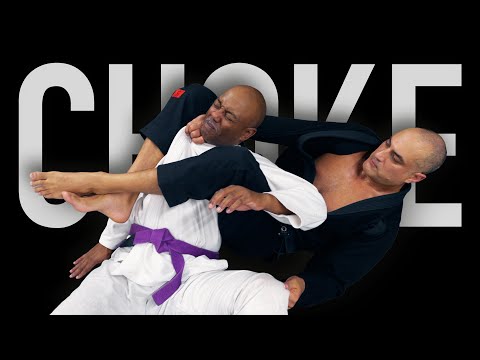
Collar Choke Mechanics: White Belt vs Black Belt
0
Forarm And Collar Choke·ROYDEAN
➡️ Get It Here 👉: https://courses.roydeanacademy.com/the-hidden-mechanics-of-brazilian-jiu-jitsu Study the Art of Jiu J…
フォアアームアンドカラーチョーク(Foaāmu Ando Karā Chōku)
TransliterationTranslation: Forearm and Collar Choke (katakana loanword)
Forearm and collar chokes are submission techniques that use the gi lapel, collar, or the bare forearm pressed against the front or side of the neck to restrict blood flow or airflow. [1] This family includes cross-collar chokes (juji-jime variations), loop chokes, Ezekiel chokes (sode-guruma-jime), and thrust chokes that drive the lapel or forearm into the throat. The cross-collar choke from mount and guard is one of the most fundamental gi submissions in Brazilian Jiu-Jitsu, requiring deep collar grips and proper wrist rotation to create the shearing force across both carotids. The Ezekiel choke uses the sleeve of the gi as a fulcrum, allowing application from mount, side control, and even inside an opponent's closed guard. [2] Forearm and collar chokes are primarily gi-dependent, though no-gi adaptations exist using wrist-on-wrist grips.
The cross-collar choke (juji-jime) is one of the foundational Kodokan Judo shime-waza, with three classical variants: nami-juji-jime (normal cross), kata-juji-jime (half cross), and gyaku-juji-jime (reverse cross). [1] The Ezekiel choke is named after Brazilian judoka Ezequiel Paraguassú, who famously used the technique (sode-guruma-jime in judo terminology) to submit multiple opponents while training at the Carlson Gracie academy in the 1990s. [2] Loop chokes were developed primarily within the BJJ competition context, using creative collar grips to attack from bottom positions.
Forearm and collar chokes use a combination of the attacker's forearm and the opponent's gi collar to create strangling pressure. [1] This category includes some of the most powerful gi chokes, as the collar fabric provides a strong grip point and the forearm blade creates direct pressure on the carotid. [1],[2]
The forearm-and-collar choke combines a forearm across the throat with a collar grip to create a hybrid choking mechanism. [1]
Forearm-and-collar chokes are used in gi BJJ competition from various top positions. [1]
No images yet for this technique.
Sign in to suggest an image.
➡️ Get It Here 👉: https://courses.roydeanacademy.com/the-hidden-mechanics-of-brazilian-jiu-jitsu Study the Art of Jiu J…
No instructional courses yet for this technique.
Sign in to suggest a course.
Risk of injury to the person this technique is applied to
Forearm and collar chokes combine bone pressure with gi material for strong vascular compression
Skill level needed to execute this technique reliably
Whether this technique is allowed under major competition rule sets
Japanese BJJ community standard katakana transliteration
Japanese BJJ community standard katakana transliteration
Standard katakana transliteration of Western martial arts terminology (外来語) — used in Japanese MMA, boxing, and BJJ communities
Japanese terminology sourced from Japanese BJJ community standard katakana transliteration
forearm strength, wrist control, top position stability
thick forearms for pressure across the throat
forearm flexors, wrist extensors, core
Cross lapel cross chokes are front-facing strangles where both hands grip the opponent's collar in a crossed configuration — each hand on the opposite side of the neck — and pull inward to compress both carotid arteries. [1,2] This is the classical jūji-jime (十字絞め, cross strangle) configuration from Kodokan Judo, applied from guard, mount, or other front-facing positions. [1,2] The cross-collar cross choke is mechanically powerful because the crossed forearms create a scissoring action where each wrist blade presses into one carotid artery simultaneously. [1,3] Variations include palm-up/palm-down grip combinations (gyaku-jūji-jime vs. nami-jūji-jime) that alter the angle and depth of the strangle. [1,4]
Head-loop lapel noose chokes use the opponent's collar looped over and around the head to create a noose-like constriction around the neck. [1] The loop choke — the primary technique — is applied by feeding the collar around the opponent's neck from bottom position (typically half guard or butterfly guard), then closing the loop and tightening. Loop chokes are effective because the collar creates a broad compression surface and the attacker can use both hands. [2,3]
Sleeve-assisted forearm strangles use the attacker's own gi sleeve as a fulcrum against the throat while the opposite arm provides compression from behind the head. [1,2] The Ezekiel choke (sode-guruma-jime) is the defining technique: the attacker threads one arm behind the opponent's head, feeds the sleeve of that arm across the throat, and squeezes with the opposite forearm. [3,4] The Ezekiel can be applied from mount, side control, and even inside the opponent's closed guard. [5]
Thrust lapel chokes involve driving the fist or forearm into the opponent's throat using the collar as a grip anchor. [1,2] The attacker grips the collar with one or both hands and thrusts forward, pressing the knuckles or wrist into the trachea or carotid arteries. These are primarily air chokes (tracheal compression) rather than blood chokes, creating immediate discomfort and gagging reflex. [3,4,5]
Forearm and collar chokes use the gi collar as a choking surface — the attacker grips the collar and uses the forearm across the throat. Cross collar chokes are the most fundamental gi chokes, applicable from mount, guard, and side control. Appears in 71 passages across 15 books under 'collar choke.' (15 books; Ribeiro, Jiu-Jitsu University; Kano, Kodokan Judo)
For beginners, avoid settling for a shallow grip—that's a classic white belt mistake. Once you reach blue belt level, focus on getting your second hand deep as well, not just the first hand. ROYDEAN emphasizes this progression in 'Collar Choke Mechanics: White Belt vs Black Belt.'
You want to get your second hand close to the center line of the neck for better angle and mechanics. Don't grab the shoulder or go over the face—both placements are too shallow and ineffective. ROYDEAN stresses being as technical as possible rather than settling for a poor choke.
The collar choke doesn't always have to be a submission—it can be a pathway to your next opportunity, like setting up a sweep when your opponent defends. At higher levels, it becomes a versatile tool you can use as you see fit depending on the situation.
Forearm and collar chokes are submission techniques that use the gi lapel, collar, or the bare forearm pressed against the front or side of the neck to restrict blood flow or airflow. This family includes cross-collar chokes (juji-jime variations), loop chokes, Ezekiel chokes (sode-guruma-jime), and thrust chokes that drive the lapel or forearm into the throat.
The cross-collar choke (juji-jime) is one of the foundational Kodokan Judo shime-waza, with three classical variants: nami-juji-jime (normal cross), kata-juji-jime (half cross), and gyaku-juji-jime (reverse cross). The Ezekiel choke is named after Brazilian judoka Ezequiel Paraguassú, who famously used the technique (sode-guruma-jime in judo terminology) to submit multiple opponents while training at the Carlson Gracie academy in the 1990s.
IBJJF: legal — Legal at all belt levels, gi and no-gi — chokes are the safest submission cat…; IJF: legal — Legal (shime-waza) — strangulation techniques are one of three permitted subm…; ADCC: restricted — N/A (no-gi competition only — technique requires gi); Unified MMA: restricted — N/A (technique requires gi — not applicable in MMA); FIAS Sport Sambo: banned — All chokes prohibited in Sport Sambo; FIAS Combat Sambo: legal — Legal
Danger rating 8/10. Forearm and collar chokes combine bone pressure with gi material for strong vascular compression
The standard setup chain: Achieve Controlling Position → Isolate the Neck → Set the Grip → Apply Pressure.
Standard counters include: Tuck Chin — protect the neck by lowering the chin to prevent the choke from sinking / Two-on-One Grip Fight — use both hands to strip the choking grip before it locks / Turn Into — rotate toward the choking arm to relieve carotid pressure / Posture Up — straighten the spine and create distance to break the choking angle.
Common variants: Gi Ezekiel (uses the sleeve for the choking grip, traditional technique); No-gi Ezekiel (uses the fist or forearm across the throat without sleeve…); Reverse Ezekiel (applied from the bottom position when opponent is in your…).
Forearm-and-collar chokes are used in gi BJJ competition from various top positions.
Top errors to watch for: Applying both pressures from the same angle — the collar grip and forearm must attack opposite sides of the neck; sam… / Using a shallow collar grip — the four fingers must pass the neck's centre line for the collar to compress the artery / Pressing the forearm into the trachea — target the lateral neck with the forearm; tracheal pressure causes pain but n… / Not using body weight behind the forearm — from mount, drive weight through the forearm; from side control, lean ches….
The Forarm And Collar Choke is also known as Foaāmu Ando Karā Chōku, Eri-jime, Collar Choke, Lapel Choke.