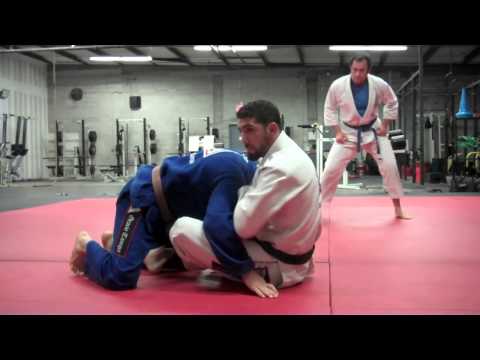
Best Loop Choke Technique (top and bottom)
0
Standard Loop Choke·Matt Arroyo Jiu Jitsu
http://www.MattArroyo.com Matt Arroyo teaches the loop choke from top and from bottom at Gracie Tampa South MMA. These…
Translation: Loop Choke (katakana loanword)
The standard loop choke from guard is a gi strangulation where the attacker feeds one hand deep into the opponent's collar, loops it around the back of the neck, and uses the closed guard to trap the opponent's posture while the lapel tightens around the throat. [1] The 'loop' refers to the circular path the gi collar travels — starting at the far collar, wrapping behind the neck, and returning to create a noose-like compression. [1],[2] The attacker typically initiates the choke when the opponent drops their head while attempting to pass, allowing the collar hand to swoop around the neck in a single fluid motion. [2] The closed guard ensures the opponent cannot posture away from the tightening loop. [2],[3]
The standard loop choke is the fundamental collar-loop strangle, executed with a quick grab-and-pull motion. [1]
The standard loop choke was codified as a competition technique in modern gi BJJ. [1]
The standard loop choke is one of the more commonly finished collar chokes at IBJJF competition. [1]
No images yet for this technique.
Sign in to suggest an image.
http://www.MattArroyo.com Matt Arroyo teaches the loop choke from top and from bottom at Gracie Tampa South MMA. These…
No instructional courses yet for this technique.
Sign in to suggest a course.
Risk of injury to the person this technique is applied to
The standard loop choke is the most common variant, typically applied during guard passing
Skill level needed to execute this technique reliably
Whether this technique is allowed under major competition rule sets
柔術B (jiujitsu-b.com) choke technique summary
Major Japanese BJJ publication — comprehensive technique lists
Standard katakana transliteration of Western martial arts terminology (外来語) — used in Japanese MMA, boxing, and BJJ communities
Japanese terminology sourced from 柔術B (jiujitsu-b.com) choke technique summary
grip or squeeze strength, positional control
strong upper body for sustained compression
forearms, biceps, pectorals, core stabilisers
According to Matt Arroyo, you want to curl your wrist so it touches the neck, with your knuckle (rather than your thumb) making contact at the throat—this positioning is critical for proper setup.
Matt Arroyo explains that you keep your grip on the leg, position your shoulder on their head, then drop your shoulder under theirs while pushing into their shoulder to complete the choke.
Matt Arroyo emphasizes making it look like you want to wrestle rather than choke—push into your opponent so they naturally come back, then smack their head down and lift your body high to get their head under your armpit.
Matt Arroyo stresses that your shoulder must hit over the opponent's arm and over their head—if you leave their face, they will pop their head out and escape.
The standard loop choke from guard is a gi strangulation where the attacker feeds one hand deep into the opponent's collar, loops it around the back of the neck, and uses the closed guard to trap the opponent's posture while the lapel tightens around the throat. The 'loop' refers to the circular path the gi collar travels — starting at the far collar, wrapping behind the neck, and returning to create a noose-like compression.
The loop choke was popularised by BJJ competitor Leo Vieira in the early 2000s, who demonstrated its effectiveness at the highest levels of international competition. The technique quickly spread through the BJJ community and became a staple attack from guard and half guard positions.
IBJJF: legal — Legal at all belt levels, gi and no-gi — chokes are the safest submission cat…; IJF: legal — Legal (shime-waza) — strangulation techniques are one of three permitted subm…; ADCC: restricted — N/A (no-gi competition only — technique requires gi); Unified MMA: restricted — N/A (technique requires gi — not applicable in MMA); FIAS Sport Sambo: banned — All chokes prohibited in Sport Sambo; FIAS Combat Sambo: legal — Legal
Danger rating 8/10. The standard loop choke is the most common variant, typically applied during guard passing
The standard setup chain: Achieve Controlling Position → Isolate the Neck → Set the Grip → Apply Pressure.
Standard counters include: Tuck Chin — protect the neck by lowering the chin to prevent the choke from sinking / Two-on-One Grip Fight — use both hands to strip the choking grip before it locks / Turn Into — rotate toward the choking arm to relieve carotid pressure / Posture Up — straighten the spine and create distance to break the choking angle.
Common variants: Standard grip variation (primary hand configuration for maximum choking pressure); Gi variation (uses the lapel or collar as an anchor for additional fric…); No-gi variation (adapted grip and positioning for submission grappling wit…); Transition finish (applied during a positional change to catch the opponent …).
The standard loop choke is one of the more commonly finished collar chokes at IBJJF competition.
Top errors to watch for: Initiating the loop while the opponent is sitting back — the standard loop requires forward pressure; against a retre… / Falling to the wrong side — fall to the collar-grip side; falling opposite opens the loop / Keeping the legs closed in guard during the finish — open the guard and fall to the side; closed guard restricts the … / Not pulling the head down with the looping arm — the forearm must actively pull the head into the loop; a passive arm….
The Standard Loop Choke is also known as Rūpu Chōku, Classic Loop Choke, Standard Lapel Loop.