Strike & defenceLocksClose rangeFighting multiple people
Distance
CloseMiddleLong
Body target
Upper bodyMiddle bodyLower body
Overview
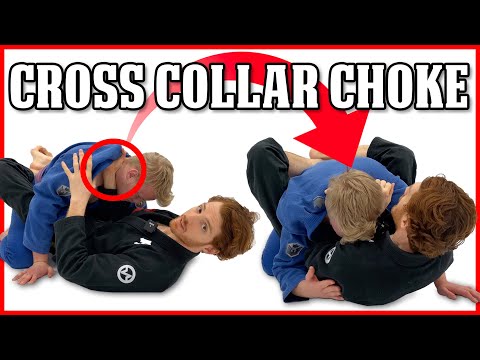
The cross collar choke from guard (jūji-jime) is a fundamental gi strangle executed from closed guard by feeding both hands deep into the opponent's collar with crossed grips. [1],[2] The attacker pulls the opponent's head down while rotating the wrists inward to create bilateral compression on the carotid arteries using the collar edges. [1] It is one of the first submissions taught in BJJ and judo, prized for its simplicity and effectiveness when the opponent's posture is broken. [2],[3]
Also known as
Guard Cross ChokeBoxing[1]Juji-jime from GuardJP[2]Guard Collar Choke[3]
The cross collar choke from closed guard is among the most foundational submissions in Brazilian Jiu-Jitsu. The underlying grip — juji-jime (十字絞, 'cross strangle') — was systematised by Jigoro Kano in the Kodokan judo shime-waza curriculum in the late nineteenth century, though it was primarily applied from top position in judo. [1] Helio Gracie and his students adapted the cross collar grip for use from the guard (bottom position), making it a centrepiece of the Gracie self-defence system where the guard was reframed as an offensive position rather than a disadvantage. [2] Renzo Gracie and Royler Gracie describe the cross collar choke from guard as 'the first submission every BJJ student should learn,' as it teaches fundamental principles of grip fighting, posture breaking, and guard retention simultaneously. [3] The technique became a signature weapon of competition BJJ in the 1990s and remains one of the highest-percentage gi submissions at all belt levels. [2],[3]
Country of origin· shown in random order
🇧🇷BrazilBJJ, Submission Grappling, MMA
🇯🇵Japan十字絞(ガードから)(Juji-jime — From Guard)BJJ, Judo, Submission Grappling
🇺🇸USASubmission Grappling, MMA
🇷🇺RussiaSambo
Effectiveness
The cross collar choke from guard is one of the most fundamental gi submissions, using deep collar grips to strangle the opponent from closed guard. [1]
Lineage
This was one of the first submissions taught in the Gracie BJJ curriculum and remains a fundamental technique. [1]
Competition Record
The cross collar choke from guard is one of the most commonly attempted submissions in IBJJF gi competition at all belt levels. [1]
Images
No images yet for this technique.
Sign in to suggest an image.
Biomechanical Mechanism
Primary Action — Bilateral compression of the carotid arteries — restricts blood flow to the brain, causing unconsciousness within seconds
Joints Involved — Cervical spine (lateral flexion), glenohumeral joint of the trapped arm (if arm-in), nuchal region
Force Vector — Lateral squeeze creates inward pressure on both sides of the neck simultaneously
Choking Mechanism — Vascular strangle — occludes carotid arteries and jugular veins, distinct from airway (tracheal) chokes
Position & Entry
From closed guard (gi) — Secure deep cross-collar grip, feed second hand to the opposite collar, close elbows and squeeze
From closed guard (no-gi) — Break posture, wrap neck with arm, secure the choking configuration using head and arm control
From open guard — Use spider or collar-sleeve grips to break posture, transition to the choking position
Variants
Palm-up palm-down cross collar — standard gi choke with opposing hand rotations
Deep collar cross choke — fingers inserted deep past the label for maximum leverage
Loop choke variant — one collar grip feeds the loop for a tighter neck compression
How to Actually FINISH The Cross Collar Choke from Guard
0
Cross Collar Choke From Guard·Stephan Kesting
How to actually successfully choke someone out with the cross collar choke from closed guard. Excerpt from https://www.g…
2 videos
What Instructors Say
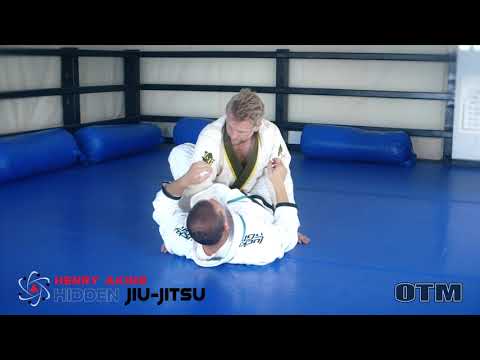
The cross collar choke from guard is executed by securing two grips on the opponent's collar lapels while in closed guard, then applying pressure via wrist rotation and arm connection to the neck. Both Henry Akins' Hidden Jiu-Jitsu and Stephan Kesting emphasize that arm-to-neck connection is more critical than grip strength alone. Akins stresses obtaining the first grip despite opponent resistance by turning shoulders to deflect defensive hands, then slapping the second grip behind the neck before finishing with wrist curling—a technique requiring minimal strength. Kesting similarly prioritizes a very tight first collar grip while allowing looser secondary grip positioning, and emphasizes finding the sharp bone of the wrist rather than a flat surface to cut the carotid. Where Akins demonstrates both underhand and overhand grip variations and teaches wrist rotation as the primary finishing mechanic, Kesting focuses on a single preferred variation with tight chest-to-chest positioning and uses the collar choke as a base control to set up arm bars and triangles. Both instructors recommend incorporating leg and arm pulls for efficiency once the choke is established, though Akins highlights that proper technique should work with wrist movement alone. Kesting additionally warns against overexertion and emphasizes timing when the opponent leaves gaps in defense.
Synthesized from 2 instructors
Henry Akins' Hidden Jiu-Jitsu — Closed Guard Cross Collar Choke Secrets I learned from Rickson Gracie: Detailed grip acquisition against posture control, demonstrated underhand and overhand grip variations, emphasized wrist curling as primary finishing mechanic with minimal strength, explained elbow movement and arm connection as force multipliers
Stephan Kesting — How to Actually FINISH The Cross Collar Choke from Guard: Emphasized tight first collar grip with specific wrist bone positioning (sharp vs. flat), demonstrated chest-to-chest finishing posture, showed integration with triangle and armbar threats as setups, discussed timing gaps and energy efficiency
Learn This Technique
No instructional courses yet for this technique.
Sign in to suggest a course.
Ratings
Danger Rating
Risk of injury to the person this technique is applied to
8
Very High8/10
Cross choke from closed guard is a fundamental attack; Helio Gracie considered it essential
Difficulty
Skill level needed to execute this technique reliably
Beginner
Competition Legality
Whether this technique is allowed under major competition rule sets
Illegal
— FIAS Sport Sambo — All chokes prohibited in Sport Sambo
✓The cross-collar choke from closed guard is one of the most fundamental gi submissions — it attacks the opponent from the bottom position using deep collar grips (Gracie & Gracie, Brazilian Jiu-Jitsu: Theory and Technique, 2001)
✓From closed guard, the first hand feeds deep into the collar — the palm-up grip (thumb inside) slides the hand as deep as possible past the opponent's centre line
✓The second hand crosses over the first and grips the opposite collar — the forearms now cross against both carotid arteries
✓The closed guard prevents the opponent from posturing away — the legs pull the opponent's torso forward, keeping them in range of the choke
✓The finish: pull both elbows toward your chest while expanding the chest — the forearms scissor across the neck
✓The cross-collar from guard is the original BJJ technique: it was the first guard submission taught in Gracie Jiu-Jitsu
✓The choke is most effective when the opponent's posture is broken: use the legs to pull them forward, then feed the grips while they're close
✓This choke creates a dilemma: if the opponent stays low to avoid the choke, they're vulnerable to sweeps; if they posture to escape, the choke tightens
Common Mistakes
!Not getting the first grip deep enough — the first hand must be inside the collar past the centre line; shallow grips don't create enough forearm compression
!Opening the guard to chase the choke — maintain closed guard for posture control; opening allows the opponent to posture and escape
!Pulling outward instead of toward the chest — the elbows contract toward the body; outward pulling crushes the trachea instead of compressing the carotids
!Not breaking the opponent's posture first — if they're fully postured, the collar grips can't reach deep enough; use the legs to pull them down
!Stacking on the choke attempt — if the opponent drives forward, adjust by pulling their head down or angling to the side
!Giving up after the first grip is stripped — re-establish the grip; the guard allows multiple attempts
!Not combining with other guard attacks — the cross-collar should be part of a system with armbars, triangles, and sweeps
Standard Japanese martial arts terminology (kanji/hiragana)
4OtherJapanese Martial Arts Standard Terminology (武道用語)
Established Japanese martial arts naming convention — native Japanese term (和語/漢語)
5CitationKodokan Judo — Juji-jime
Japanese terminology sourced from Kodokan Judo — Juji-jime
Community
Athletics
Requires
grip or squeeze strength, positional control
Favours
strong upper body for sustained compression
Key muscles
forearms, biceps, pectorals, core stabilisers
Frequently Asked Questions
What's more important when setting up a cross collar choke from guard—getting a perfect grip or arm placement?
According to Henry Akins, the connection of your arm to the opponent's neck is far more important than the grip itself. Once your arm is touching the neck, you can grab whatever cloth is available, and small wrist movements will immediately affect the choke.
How do I prevent my opponent from defending the cross collar choke grip?
Henry Akins emphasizes not letting your opponent prevent you from getting the deep grip behind the neck—don't sit up, turn your shoulders, and deflect their arm to get your hand behind their neck. If they successfully keep you from establishing this grip, they've defended the choke.
What's the correct wrist angle when finishing the cross collar choke?
Stephan Kesting stresses that you want the sharp part of your wrist to cut into the opponent's neck rather than being flat. You should also finish by coming up with your posture, pulling your elbows tight while expanding your chest open.
Should I use only arm strength to finish the cross collar choke?
Henry Akins teaches that you should incorporate your whole body—using arms and legs together rather than relying on arm strength alone. The technique works best with small wrist movements combined with pulling in with both arms and legs.
How does the Cross Collar Choke From Guard work?
The cross collar choke from guard (jūji-jime) is a fundamental gi strangle executed from closed guard by feeding both hands deep into the opponent's collar with crossed grips. The attacker pulls the opponent's head down while rotating the wrists inward to create bilateral compression on the carotid arteries using the collar edges.
Where does the Cross Collar Choke From Guard come from?
The cross collar choke from closed guard is among the most foundational submissions in Brazilian Jiu-Jitsu. The underlying grip — juji-jime (十字絞, 'cross strangle') — was systematised by Jigoro Kano in the Kodokan judo shime-waza curriculum in the late nineteenth century, though it was primarily applied from top position in judo.
Is the Cross Collar Choke From Guard legal in competition?
IBJJF: legal — Legal at all belt levels, gi and no-gi — chokes are the safest submission cat…; IJF: legal — Legal (shime-waza) — strangulation techniques are one of three permitted subm…; ADCC: restricted — N/A (no-gi competition only — technique requires gi); Unified MMA: restricted — N/A (technique requires gi — not applicable in MMA); FIAS Sport Sambo: banned — All chokes prohibited in Sport Sambo; FIAS Combat Sambo: legal — Legal
How dangerous is the Cross Collar Choke From Guard?
Danger rating 8/10. Cross choke from closed guard is a fundamental attack; Helio Gracie considered it essential
How do I set up the Cross Collar Choke From Guard?
The standard setup chain: Achieve Controlling Position → Isolate the Neck → Set the Grip → Apply Pressure.
How do I defend against the Cross Collar Choke From Guard?
Standard counters include: Tuck Chin — protect the neck by lowering the chin to prevent the choke from sinking / Two-on-One Grip Fight — use both hands to strip the choking grip before it locks / Turn Into — rotate toward the choking arm to relieve carotid pressure / Posture Up — straighten the spine and create distance to break the choking angle.
What are the variants of the Cross Collar Choke From Guard?
Common variants: Palm-up palm-down cross collar (standard gi choke with opposing hand rotations); Deep collar cross choke (fingers inserted deep past the label for maximum leverage); Loop choke variant (one collar grip feeds the loop for a tighter neck compres…).
How effective is the Cross Collar Choke From Guard in competition?
The cross collar choke from guard is one of the most commonly attempted submissions in IBJJF gi competition at all belt levels.
What are common mistakes when doing the Cross Collar Choke From Guard?
Top errors to watch for: Not getting the first grip deep enough — the first hand must be inside the collar past the centre line; shallow grips… / Opening the guard to chase the choke — maintain closed guard for posture control; opening allows the opponent to post… / Pulling outward instead of toward the chest — the elbows contract toward the body; outward pulling crushes the trache… / Not breaking the opponent's posture first — if they're fully postured, the collar grips can't reach deep enough; use ….
What are other names for the Cross Collar Choke From Guard?
The Cross Collar Choke From Guard is also known as Juji-jime — From Guard, Guard Cross Choke, Juji-jime from Guard, Guard Collar Choke.