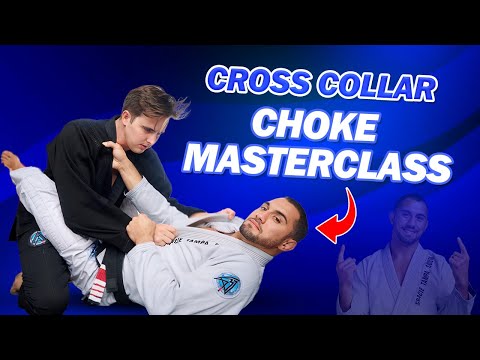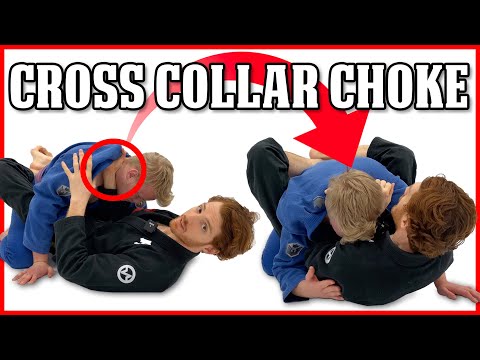
How to Actually FINISH The Cross Collar Choke from Guard
0
Cross Collar Choke·Stephan Kesting
How to actually successfully choke someone out with the cross collar choke from closed guard. Excerpt from https://www.g…
Translation: cross strangle
The cross collar choke from front-facing positions uses both hands gripping opposite sides of the collar in a crossed configuration to compress both carotid arteries simultaneously. [1],[2] From guard, mount, or other front-facing positions, the attacker inserts each hand into the opposite collar with the wrist blades rotated toward the carotid arteries, then draws both elbows together while pulling the opponent's head into the chest to close the compression. [1],[2] The technique can be executed with palm-down (nami-jūji-jime — normal cross strangle), palm-up (gyaku-jūji-jime — reverse cross strangle), or mixed grip with one palm up and one palm down (kata-jūji-jime — half cross strangle) configurations, per the Kodokan classification. [1],[3]
The cross collar choke is one of the foundational techniques of Kodokan Judo's jūji-jime (十字絞め) family, codified by Jigoro Kano as a core shime-waza. [1],[2] Three variations were established: nami, gyaku, and kata, each with different palm orientations. [1],[3] In Brazilian Jiu-Jitsu, the cross choke from closed guard became one of the first submissions taught to beginners and was a signature technique of Helio Gracie. [4]
The cross collar choke (juji-jime) is the fundamental gi choke, applied by gripping both lapels in a cross pattern and pulling the forearms into the sides of the neck. [1] Roger Gracie demonstrated that this basic technique, when executed with perfect timing and grip depth, can defeat the highest-level competitors despite being fully anticipated. [2]
Juji-jime (十字絞め) is one of the original Kodokan Judo shime-waza techniques codified by Jigoro Kano. [1] The Gracie family, particularly Hélio Gracie, made cross collar chokes from guard and mount fundamental to BJJ. [2] Roger Gracie's dominance with the cross collar choke from mount at IBJJF Worlds (2004–2009) cemented its status as the quintessential BJJ technique. [3]
No images yet for this technique.
Sign in to suggest an image.
How to actually successfully choke someone out with the cross collar choke from closed guard. Excerpt from https://www.g…
Join My Online Academy to Improve Your Jiu Jitsu FAST!!! http://academy.mattarroyo.com/home Welcome to your ultimate g…
✅ BJJ Beginner Course: https://bjjbeginnercourse.com ✅ Jiu-Jitsu Theory Course: https://jiujitsutheorycourse.com 📩 Ne…
The cross collar choke is a fundamental Brazilian jiu-jitsu submission that requires precise hand placement and wrist positioning to be effective against skilled opponents. All three instructors—Matt Arroyo Jiu Jitsu, Jordan Teaches Jiujitsu, and Stephan Kesting—emphasize that beginners commonly execute this technique incorrectly by failing to achieve sufficient depth and proper blade angle. The choke functions by using the wrist bones (blades) to compress the carotid arteries, not the gi itself; the lapel serves merely as a leverage point. The first grip must be inserted as deeply as possible with four fingers, ideally positioning the wrist behind or level with the ear. Both Arroyo and Kesting stress the critical importance of rotating the wrist to angle the bone edge into the neck rather than applying pressure with the flat wrist. For the second grip, all instructors note less depth is required and it can be placed either under the arm (palm up) or over the arm (palm down). The finishing mechanics diverge slightly: Arroyo emphasizes a four-step sequence (deep grip, turn blades, hammer the lapel, pull head to chest with elbows driven downward), while Jordan and Kesting prioritize bringing elbows inward rather than opening them. Kesting uniquely highlights the technique's power when used as a base control alongside threat of arm bars and triangles, allowing the opponent to leave the shoulder opening available for the second grip. All instructors note versatility across guard, mount, side control, and other positions.
Synthesized from 3 instructors
No instructional courses yet for this technique.
Sign in to suggest a course.
Risk of injury to the person this technique is applied to
Cross collar choke is a foundational gi strangle using bilateral wrist-blade pressure
Skill level needed to execute this technique reliably
Whether this technique is allowed under major competition rule sets
Kodokan Judo — Official Katame-waza Classification
Kodokan — Jūji-jime (十字絞め) official classification
Standard Japanese martial arts terminology (kanji/hiragana)
Established Japanese martial arts naming convention — native Japanese term (和語/漢語)
Kodokan — Jūji-jime (十字絞め) official classification
grip or squeeze strength, positional control
strong upper body for sustained compression
forearms, biceps, pectorals, core stabilisers
Every move, in any martial art, shares a few universal traits. Mix and match below to pinpoint the right tool — or compare equivalents across styles.
The cross collar choke from guard (jūji-jime) is a fundamental gi strangle executed from closed guard by feeding both hands deep into the opponent's collar with crossed grips. [1,2] The attacker pulls the opponent's head down while rotating the wrists inward to create bilateral compression on the carotid arteries using the collar edges. [1] It is one of the first submissions taught in BJJ and judo, prized for its simplicity and effectiveness when the opponent's posture is broken. [2,3]
The cross collar choke from mount uses the dominant mount position to apply a crossed-grip lapel strangle with gravity-assisted pressure. [1,2] From mount, the attacker feeds both hands deep into the collar, crosses the forearms, and drops weight forward while squeezing to compress both carotid arteries. [1] The mount position limits the defender's hip escape options, making this one of the highest-percentage gi submissions from top position. [2]
Cross collar choke appears in 28 passages across 10 books. The fundamental gi choke — both hands grip deep into the opponent's collar, forearms crossing at the wrists. Applied from mount, guard, and side control. The first gi choke taught in most BJJ schools. (10 books; Ribeiro, Jiu-Jitsu University; Kano, Kodokan Judo)
Matt Arroyo emphasizes that beginners often place their hand in the wrong position—most fail to grip deep enough and position the thumb behind the ear as it should be. Additionally, a common misconception is that you're choking the neck with the gi itself, when proper technique requires a deep grip on the collar.
Jordan Teaches Jiujitsu stresses that you need to go much deeper than most people think—you want to wrap around as deep as possible so the hard part of your wrist contacts the soft part of the neck, not the trachea. The difference between an optimal and suboptimal grip depth is shocking.
Bring your elbows underneath the chin, not over it, and keep them tight together as you finish. Jordan Teaches Jiujitsu notes that a common mistake is opening the elbows during the finish—instead, pull your elbows in toward you, either by placing your head on the mat for base or by pulling your opponent up.
Stephan Kesting explains that you want the sharp part of your wrist to cut into the neck at an angle, not flat. A flat wrist position lacks the cutting pressure needed for an effective finish.
The cross collar choke from front-facing positions uses both hands gripping opposite sides of the collar in a crossed configuration to compress both carotid arteries simultaneously. From guard, mount, or other front-facing positions, the attacker inserts each hand into the opposite collar with the wrist blades rotated toward the carotid arteries, then draws both elbows together while pulling the opponent's head into the chest to close the compression.
The cross collar choke is one of the foundational techniques of Kodokan Judo's jūji-jime (十字絞め) family, codified by Jigoro Kano as a core shime-waza. Three variations were established: nami, gyaku, and kata, each with different palm orientations.
IBJJF: legal — Legal at all belt levels, gi and no-gi — chokes are the safest submission cat…; IJF: legal — Legal (shime-waza) — strangulation techniques are one of three permitted subm…; ADCC: restricted — N/A (no-gi competition only — technique requires gi); Unified MMA: restricted — N/A (technique requires gi — not applicable in MMA); FIAS Sport Sambo: banned — All chokes prohibited in Sport Sambo; FIAS Combat Sambo: legal — Legal
Danger rating 8/10. Cross collar choke is a foundational gi strangle using bilateral wrist-blade pressure
The standard setup chain: Achieve Controlling Position → Isolate the Neck → Set the Grip → Apply Pressure.
Standard counters include: Tuck Chin — protect the neck by lowering the chin to prevent the choke from sinking / Two-on-One Grip Fight — use both hands to strip the choking grip before it locks / Turn Into — rotate toward the choking arm to relieve carotid pressure / Posture Up — straighten the spine and create distance to break the choking angle.
Common variants: Palm-up palm-down cross collar (standard gi choke with opposing hand rotations); Deep collar cross choke (fingers inserted deep past the label for maximum leverage); Loop choke variant (one collar grip feeds the loop for a tighter neck compres…).
Roger Gracie won 10 IBJJF World Championship gold medals (2004–2009), with the cross collar choke from mount being his signature finish, submitting most of his opponents at the highest level. The technique is statistically the most common gi choke finish in IBJJF competition.
Top errors to watch for: Gripping too shallow — the first hand must be deep inside the collar, past the opponent's centre line; shallow grips … / Pulling the arms outward — the elbows pull toward the attacker's own chest, not outward; outward pulling creates a tr… / Not staggering the grips — one hand goes deep first, then the second crosses over; trying to insert both simultaneous… / Ignoring the opponent's grip defence — the opponent will fight the first hand; persist through grip fighting or use f….
The Cross Collar Choke is also known as Jūji-jime, Juji-jime, Cross Collar Choke, Cross Lapel Choke.