Introduction to the Cross Collar Choke
The cross collar choke is one of the most reliable attacks from closed guard, offering minimal defense options for the opponent. Once properly executed, any defensive attempt forces the opponent to sacrifice significant positioning. Understanding grip acquisition and hand placement is fundamental to mastering this technique.
Initial Grip Acquisition
The first step involves securing a grip inside the opponent's lapel without requiring a deep or tight connection. While the opponent typically maintains chest pressure to prevent sit-up, this initial grip placement creates the foundation for the full choke setup.
Shoulder Turn and Grip Deepening
By rotating the shoulders, the practitioner can deflect the opponent's defensive arm and advance the hand behind the neck. This shoulder rotation is impossible for the opponent to stop, immediately placing them in a compromised position. Even without a fully secured second grip, the deep arm position behind the neck creates significant danger.
Posture Break and Second Grip Placement
Breaking the opponent's posture requires throwing the body backward while simultaneously pulling with both arms and legs. The second hand slaps the back of the neck rather than seeking a precise grip, with arm-to-neck contact being more critical than grip quality. Both elbows then drive downward to complete the choke.
Double Underhook Grip Finish
With hands gripped inside both lapels, the practitioner must first eliminate space by pushing into the opponent's neck rather than deepening the grip. Once arm connection is established, a subtle wrist curl using only the wrist bones—not arm strength—applies immediate pressure. This technique demonstrates that proper body mechanics eliminate the need for strength.
Wrist Mechanics and Efficient Pressure Application
The effectiveness of the choke depends entirely on wrist rotation after establishing arm-to-neck contact. With straight arms, the practitioner curls the wrists to apply pressure, producing an immediate choking response without muscular effort. This demonstrates how technical precision creates efficiency regardless of grip quality.
Overhook Grip Finish Mechanics
The overhook variation employs the same wrist-curling principle, with one hand controlling pressure through wrist rotation. The arm-to-neck connection remains paramount, as the flat surface of the forearm must maintain contact with the opponent's neck. When the elbow turns downward, the forearm transitions from narrow to wide, increasing choke pressure.
Closed Guard Cross Collar Choke Secrets I learned from Rickson Gracie
Key Takeaways
- •Introduction to the Cross Collar Choke
- •Initial Grip Acquisition
- •Shoulder Turn and Grip Deepening
- •Posture Break and Second Grip Placement
Henry Akins Hidden Jiu Jitsu Closed Guard Attack System. Rickson was know for his cross choke from inside the guard and also mounted. In tournaments once Rickson got one grip in the crowd would start chanting down from 10 and his opponent always tapped before the count ended. https://member.hiddenjiujitsu.com/a/33888/GRc8mW6F
Related Techniques
Frequently Asked Questions
What does this video teach about cross collar choke from guard?
This video covers introduction to the cross collar choke, initial grip acquisition, shoulder turn and grip deepening. It provides detailed instruction from Henry Akins' Hidden Jiu-Jitsu.
How long does it take to learn cross collar choke from guard?
The basic mechanics can be understood in a single session, but developing reliable execution requires consistent drilling over weeks of practice. This 7-part breakdown helps structure your training by isolating each phase of the technique.
What are the key details for finishing cross collar choke from guard?
The effectiveness of the choke depends entirely on wrist rotation after establishing arm-to-neck contact. With straight arms, the practitioner curls the wrists to apply pressure, producing an immediate choking response without muscular effort. This demonstrates how technical precision creates efficiency regardless of grip quality.
Related videos
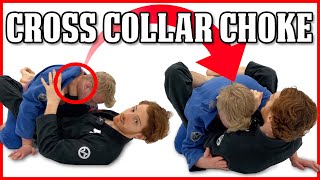
How to Actually FINISH The Cross Collar Choke from Guard
Stephan Kesting
ROGER GRACIE Shows How To Do the Perfect Cross Choke From Mount
Bernardo Faria BJJ Fanatics

Cross Collar Choke - Fundamentals Made Easy
Jordan Teaches Jiujitsu
How to Actually FINISH The Cross Collar Choke from Guard
Stephan Kesting
Cross Collar Choke - Fundamentals Made Easy
Jordan Teaches Jiujitsu