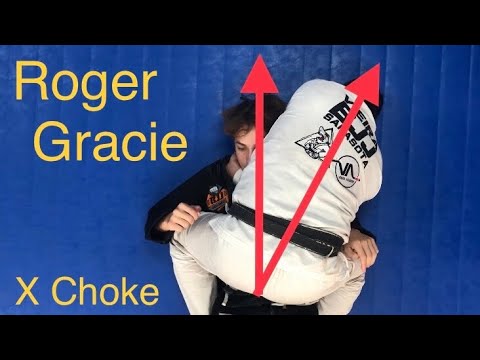
Roger Gracie Cross Choke
0
Cross Lapel Cross Choke·Jiu-Jitsu Channel
#choke #bjj #jiujitsu Learn Professor Thadeu Vieira’s perspective on the famous Roger Gracie Collar Cross Choke. Be the…
Translation: cross lapel cross choke
Cross lapel cross chokes are front-facing strangles where both hands grip the opponent's collar in a crossed configuration — each hand on the opposite side of the neck — and pull inward to compress both carotid arteries. [1],[2] This is the classical jūji-jime (十字絞め, cross strangle) configuration from Kodokan Judo, applied from guard, mount, or other front-facing positions. [1],[2] The cross-collar cross choke is mechanically powerful because the crossed forearms create a scissoring action where each wrist blade presses into one carotid artery simultaneously. [1],[3] Variations include palm-up/palm-down grip combinations (gyaku-jūji-jime vs. nami-jūji-jime) that alter the angle and depth of the strangle. [1],[4]
The cross lapel cross choke is one of the oldest codified strangles in judo. Jūji-jime (十字絞め) was established as a core Kodokan shime-waza by Jigoro Kano and appears in the earliest judo technical manuals. [1],[2] The technique was taught in three grip variations: nami-jūji-jime (normal cross), gyaku-jūji-jime (reverse cross), and kata-jūji-jime (half cross). [1],[3] Brazilian Jiu-Jitsu inherited the cross choke directly from judo and made it one of the first techniques taught to beginners, particularly from closed guard and mount. [4] Helio Gracie notably relied on the cross choke from guard as one of his primary competition techniques. [4]
The cross lapel choke uses both hands gripping opposite lapels in a crossing pattern to create bilateral carotid artery compression. [1]
Cross lapel chokes are fundamental judo shimewaza techniques adopted and refined in BJJ. [1]
Cross lapel chokes are among the most commonly attempted gi submissions in IBJJF competition. [1]
No images yet for this technique.
Sign in to suggest an image.
#choke #bjj #jiujitsu Learn Professor Thadeu Vieira’s perspective on the famous Roger Gracie Collar Cross Choke. Be the…
No instructional courses yet for this technique.
Sign in to suggest a course.
Risk of injury to the person this technique is applied to
Cross lapel choke uses crossed grips deep in the collar for bilateral carotid pressure
Skill level needed to execute this technique reliably
Whether this technique is allowed under major competition rule sets
Kodokan Judo — Juji-jime family
Japanese terminology sourced from Kodokan Judo — Juji-jime family
Official Kodokan ground technique classification system
Standard Japanese martial arts terminology (kanji/hiragana)
Established Japanese martial arts naming convention — native Japanese term (和語/漢語)
Japanese terminology sourced from Kodokan Judo — Juji-jime family
grip or squeeze strength, positional control
strong upper body for sustained compression
forearms, biceps, pectorals, core stabilisers
Every move, in any martial art, shares a few universal traits. Mix and match below to pinpoint the right tool — or compare equivalents across styles.
The cross collar choke from front-facing positions uses both hands gripping opposite sides of the collar in a crossed configuration to compress both carotid arteries simultaneously. [1,2] From guard, mount, or other front-facing positions, the attacker inserts each hand into the opposite collar with the wrist blades rotated toward the carotid arteries, then draws both elbows together while pulling the opponent's head into the chest to close the compression. [1,2] The technique can be executed with palm-down (nami-jūji-jime — normal cross strangle), palm-up (gyaku-jūji-jime — reverse cross strangle), or mixed grip with one palm up and one palm down (kata-jūji-jime — half cross strangle) configurations, per the Kodokan classification. [1,3]
Gyaku Juji Jime is the reverse cross strangle — both hands grip the lapels with palms facing up (reverse grip), crossing the forearms to create choking pressure. [1] The reverse grip creates a different angle of pressure compared to the normal and half cross strangles. [1] The third of the three Kodokan cross strangles. [1]
Kata Juji Jime is the half cross strangle — one hand grips the lapel palm-down while the other grips palm-up, creating an asymmetric cross choke that attacks from a slightly different angle than the normal version. [1] The mixed grip (one palm up, one palm down) creates a different pressure vector that can be harder to defend against. [1] One of the three Kodokan cross strangles. [1]
Nami Juji Jime is the normal cross strangle in judo — both hands grip the opponent's lapels with the palms facing down, and the forearms cross to create a scissors-like choking pressure on both sides of the neck. [1] It is the most basic of the three cross strangles in the Kodokan curriculum (the others being Kata Juji Jime and Gyaku Juji Jime). [1] Typically applied from mount or guard position. [1]
Roger Gracie emphasizes that turning your opponent's face away from the direction they want to bridge is critical—if their head and eyes are facing the other way, they cannot bridge powerfully because the head commands the whole body's movement.
Cross lapel cross chokes are front-facing strangles where both hands grip the opponent's collar in a crossed configuration — each hand on the opposite side of the neck — and pull inward to compress both carotid arteries. This is the classical jūji-jime (十字絞め, cross strangle) configuration from Kodokan Judo, applied from guard, mount, or other front-facing positions.
The cross lapel cross choke is one of the oldest codified strangles in judo. Jūji-jime (十字絞め) was established as a core Kodokan shime-waza by Jigoro Kano and appears in the earliest judo technical manuals.
IBJJF: legal — Legal at all belt levels, gi and no-gi — chokes are the safest submission cat…; IJF: legal — Legal (shime-waza) — strangulation techniques are one of three permitted subm…; ADCC: restricted — N/A (no-gi competition only — technique requires gi); Unified MMA: restricted — N/A (technique requires gi — not applicable in MMA); FIAS Sport Sambo: banned — All chokes prohibited in Sport Sambo; FIAS Combat Sambo: legal — Legal
Danger rating 8/10. Cross lapel choke uses crossed grips deep in the collar for bilateral carotid pressure
The standard setup chain: Achieve Controlling Position → Isolate the Neck → Set the Grip → Apply Pressure.
Standard counters include: Tuck Chin — protect the neck by lowering the chin to prevent the choke from sinking / Two-on-One Grip Fight — use both hands to strip the choking grip before it locks / Turn Into — rotate toward the choking arm to relieve carotid pressure / Posture Up — straighten the spine and create distance to break the choking angle.
Common variants: Standard grip variation (primary hand configuration for maximum choking pressure); Gi variation (uses the lapel or collar as an anchor for additional fric…); No-gi variation (adapted grip and positioning for submission grappling wit…); Transition finish (applied during a positional change to catch the opponent …).
Cross lapel chokes are among the most commonly attempted gi submissions in IBJJF competition.
Top errors to watch for: Gripping too low on the lapel — the grip must still reach the neck; gripping at the belt level doesn't create enough … / Not adjusting the forearm angle — the lower lapel grip changes the angle; adjust the elbow position to ensure the for… / Using the same finishing mechanics as the collar choke without adjustment — the lower grip requires slightly differen… / Not securing the first grip deeply enough — like all cross chokes, the first grip must pass the centre line.
The Cross Lapel Cross Choke is also known as Jūji-jime, Juji-jime, Cross Collar Choke, Cross Choke.