Cross Collar Choke - Fundamentals Made Easy
0
Cross Collar Choke From Mount·Jordan Teaches Jiujitsu
✅ BJJ Beginner Course: https://bjjbeginnercourse.com ✅ Jiu-Jitsu Theory Course: https://jiujitsutheorycourse.com 📩 Ne…
Translation: Cross Strangle — From Mount
The cross collar choke from mount uses the dominant mount position to apply a crossed-grip lapel strangle with gravity-assisted pressure. [1],[2] From mount, the attacker feeds both hands deep into the collar, crosses the forearms, and drops weight forward while squeezing to compress both carotid arteries. [1] The mount position limits the defender's hip escape options, making this one of the highest-percentage gi submissions from top position. [2]
The cross collar choke from mount is a classical application of juji-jime (十字絞) executed from the top-mount position, one of the most dominant positions in grappling. Jigoro Kano codified juji-jime within the Kodokan judo shime-waza syllabus, and the mounted cross collar choke is the most direct application of this technique — the practitioner's bodyweight assists the choking pressure. [1] In Brazilian Jiu-Jitsu, the cross collar choke from mount was a staple of Helio Gracie's teaching, as mount was considered the ultimate dominant position in the Gracie self-defence methodology. [2] Renzo Gracie and Royler Gracie identify the mounted cross collar choke as one of the fundamental submissions that demonstrates the principle of using positional dominance to amplify technique. [3] The technique featured prominently in early UFC and Vale Tudo events, where Royce Gracie and other BJJ practitioners used mount-based collar chokes against larger opponents. [2],[3]
The cross collar choke from mount uses gravity and positional dominance to enhance the collar grip strangle, making it extremely difficult to defend. [1]
The mounted cross collar choke was a signature attack of early BJJ practitioners, used by Royce Gracie in UFC 1 (1993). [1]
The mounted cross collar choke has been used in UFC and IBJJF competition since the earliest events. Royce Gracie submitted several opponents with this technique at UFC 1-4. [1]
No images yet for this technique.
Sign in to suggest an image.
✅ BJJ Beginner Course: https://bjjbeginnercourse.com ✅ Jiu-Jitsu Theory Course: https://jiujitsutheorycourse.com 📩 Ne…
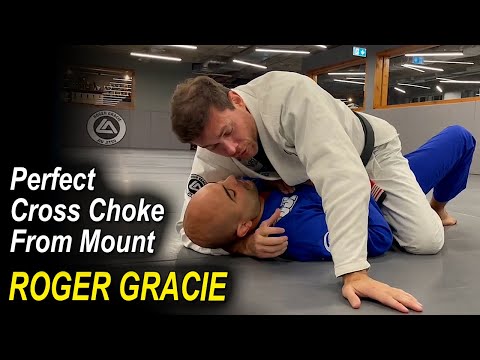
Roger Gracie Explains How To Do the Perfect Cross Choke From Mount - Roger Gracie teaches How To Do the Cross Choke From…
The cross collar choke from mount is executed by establishing a high, controlling mount position before initiating the submission. Both Jordan Teaches Jiu-Jitsu and Bernardo Faria BJJ Fanatics emphasize the critical importance of positioning and grip depth. Jordan stresses feeding one lapel to the opposite hand while pulling slack and achieving maximum depth—wrapping the wrist around the neck such that the hard part of the wrist contacts the soft part of the neck rather than the trachea. The second hand must grab the remaining lapel flap as close as possible to the first hand, with elbows positioned underneath rather than over the chin to avoid crushing the face. Jorge Gracie (via Bernardo Faria) adds nuanced positional details: maintaining a high mount prevents the opponent's elbows from creating space, and the attacker must stay slightly to the defending side when securing the first arm to resist bridge escapes. Jorge emphasizes feeding the entire arm through the collar before establishing the grip, and notes that the second hand often requires going behind the ear to bypass the opponent's two-handed defense. Both instructors agree that the finish involves bringing the elbows together tightly—opening the elbows enlarges the choking hole and is a common mistake—and that head placement on the mat or body positioning provides mechanical advantage for the finish.
Synthesized from 2 instructors
No instructional courses yet for this technique.
Sign in to suggest a course.
Risk of injury to the person this technique is applied to
Mount cross choke adds gravity and body weight to the strangle, increasing finishing pressure
Skill level needed to execute this technique reliably
Whether this technique is allowed under major competition rule sets
Kodokan Judo — Juji-jime
Japanese terminology sourced from Kodokan Judo — Juji-jime
Official Kodokan ground technique classification system
Standard Japanese martial arts terminology (kanji/hiragana)
Established Japanese martial arts naming convention — native Japanese term (和語/漢語)
Japanese terminology sourced from Kodokan Judo — Juji-jime
grip or squeeze strength, positional control
strong upper body for sustained compression
forearms, biceps, pectorals, core stabilisers
The cross collar choke from mount is the most fundamental gi submission from the mount position. Uses both hands gripping deep into the opponent's collar with the knuckles pressing into the carotid arteries. Taught in every BJJ school as the first mount submission. (Ribeiro, Jiu-Jitsu University; Gracie & Danaher, Mastering Jujitsu)
You need to wrap yourself around as deep as possible—deeper than most people initially think. Jordan Teaches Jiujitsu emphasizes that you want to get your wrist and forearm on the soft part of the opponent's neck rather than on the trachea, which requires going much deeper than feels natural at first.
Your elbow should go underneath the chin, not over it. Jordan Teaches Jiujitsu explains that placing your elbow over the chin will crush the opponent's face, whereas going underneath and bringing your elbows together creates a pure choke without facial pressure.
The most common mistake is opening your elbows during the finish instead of bringing them closer together. Jordan Teaches Jiujitsu recommends putting your head on the mat for base and pulling your elbows in toward your body to get the finish, rather than spreading them apart.
Focus on getting your whole arm deep through the opponent's defense first before worrying about the grip. Roger Gracie (via Bernardo Faria BJJ Fanatics) explains that once one arm is in deep, the opponent will use both hands to defend that side, so establish depth and position before securing the second hand grip.
Stay tall and deep initially to prevent escape, then drop your body down low when you're ready to finish. Roger Gracie emphasizes that staying very tall keeps the opponent from bridging you off, but when executing the choke, your body goes all the way down while staying low to prevent them from pushing you away.
The cross collar choke from mount uses the dominant mount position to apply a crossed-grip lapel strangle with gravity-assisted pressure. From mount, the attacker feeds both hands deep into the collar, crosses the forearms, and drops weight forward while squeezing to compress both carotid arteries.
The cross collar choke from mount is a classical application of juji-jime (十字絞) executed from the top-mount position, one of the most dominant positions in grappling. Jigoro Kano codified juji-jime within the Kodokan judo shime-waza syllabus, and the mounted cross collar choke is the most direct application of this technique — the practitioner's bodyweight assists the choking pressure.
IBJJF: legal — Legal at all belt levels, gi and no-gi — chokes are the safest submission cat…; IJF: legal — Legal (shime-waza) — strangulation techniques are one of three permitted subm…; ADCC: restricted — N/A (no-gi competition only — technique requires gi); Unified MMA: restricted — N/A (technique requires gi — not applicable in MMA); FIAS Sport Sambo: banned — All chokes prohibited in Sport Sambo; FIAS Combat Sambo: legal — Legal
Danger rating 8/10. Mount cross choke adds gravity and body weight to the strangle, increasing finishing pressure
The standard setup chain: Achieve Controlling Position → Isolate the Neck → Set the Grip → Apply Pressure.
Standard counters include: Tuck Chin — protect the neck by lowering the chin to prevent the choke from sinking / Two-on-One Grip Fight — use both hands to strip the choking grip before it locks / Turn Into — rotate toward the choking arm to relieve carotid pressure / Posture Up — straighten the spine and create distance to break the choking angle.
Common variants: Palm-up palm-down cross collar (standard gi choke with opposing hand rotations); Deep collar cross choke (fingers inserted deep past the label for maximum leverage); Loop choke variant (one collar grip feeds the loop for a tighter neck compres…).
The mounted cross collar choke has been used in UFC and IBJJF competition since the earliest events. Royce Gracie submitted several opponents with this technique at UFC 1-4.
Top errors to watch for: Losing mount while inserting the first grip — maintain base throughout; the grip entry should not compromise position… / Not placing the elbow on the mat — the first hand's elbow must post on the mat beside the opponent's head to anchor t… / Sitting too high — stay low on the mount with the hips forward; sitting high creates space for the opponent to bridge / Not driving the head forward for the finish — the head drives toward the mat above the opponent's head, adding weight….
The Cross Collar Choke From Mount is also known as Juji-jime — From Mount, Mounted Cross Choke, Mount Juji-jime, Mount Collar Choke.