Nami, Kata and Gyaku Juji Jime Part I: From Mount
0
Gyaku Juji Jime·Higashi Canada·Added by Admin
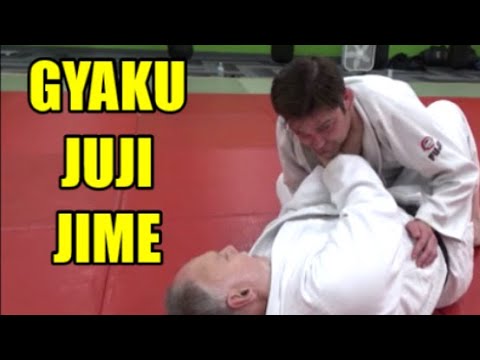
Tori: Sensei Jose Eudes Monteiro Uke: Kelvin Cheong Technique: Nami, Kata and Gyaku Juji Jime from Mount Follow us:…
Translation: reverse cross strangle
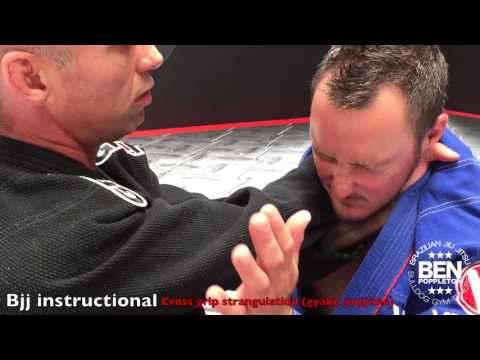
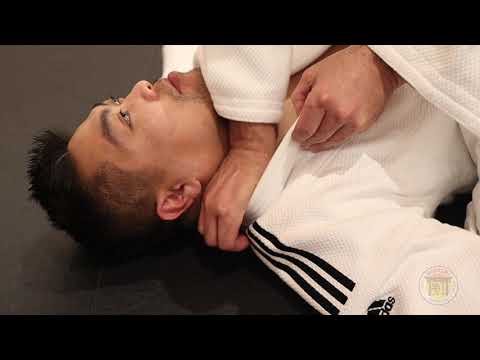
Gyaku Juji Jime is the reverse cross strangle — both hands grip the lapels with palms facing up (reverse grip), crossing the forearms to create choking pressure. [1] The reverse grip creates a different angle of pressure compared to the normal and half cross strangles. [1] The third of the three Kodokan cross strangles. [1]
Classified in the Kodokan Judo syllabus. [1]
Kodokan judo lineage: Jigoro Kano (1860–1938) systematized this technique as part of the Kodokan judo curriculum. Transmitted through the Kodokan instructor system to judo federations worldwide. Adopted into BJJ through Mitsuyo Maeda → Carlos Gracie → the Gracie family lineage. [1]
Recognized Kodokan judo technique. Used in IJF World Championships and Olympic judo competition. Frequency varies by weight class and era. [1]
No images yet for this technique.
Sign in to suggest an image.
Tori: Sensei Jose Eudes Monteiro Uke: Kelvin Cheong Technique: Nami, Kata and Gyaku Juji Jime from Mount Follow us:…
This is a BJJ instructional video about Cross grip strangulation (Gyaku Juji-jime) with Ben Poppleton, 3rd degree Blackb…
Gyaku Juji Jime (Reverse Cross Strangle) is an old technique that continues to work. This video focuses on this great la…
Gyaku Juji Jime is a cross-lapel strangling technique performed with both palms facing toward the practitioner (reversed orientation), distinguished from Nami Juji Jime where palms face away. Kata and Gyaku instruct that one hand features the thumb inserted and wrist dipped, while the second hand passes underneath with four fingers inserted and thumb out, executed by rotating the hands after insertion. All three instructors emphasize precise hand positioning as critical to effectiveness. Kata Gyaku notes that hand placement can be executed by turning either the first or second hand. WelcomeMattStevescott demonstrates the technique from bottom position (ne-waza), establishing an anchor hand before sliding the attacking hand underneath to avoid blocking the face, then rolling to the choking-side hip while pulling the opponent inward rather than pushing away. Bulldog Gym Tenerife stresses that Gyaku Juji Jime functions as a hand and wrist strangle rather than a hip-driven technique, requiring correct wrist twist positioning to defeat common defenses (opponent's postural escape or arm clamping). All instructors agree that relaxation, proper dipping depth, elbow positioning, and avoiding upward pulling are essential mechanical details. The technique traces to old jujutsu (gaeko) methodology and remains foundational in Brazilian Jiu-Jitsu submission work.
Synthesized from 3 instructors
No instructional courses yet for this technique.
Sign in to suggest a course.
Risk of injury to the person this technique is applied to
Blood choke.
Skill level needed to execute this technique reliably
Whether this technique is allowed under major competition rule sets
Kano, J. Kodokan Judo. Kodansha International.
[1] Kano, J. Kodokan Judo. Kodansha International.
Official Kodokan ground technique classification system
Standard Japanese martial arts terminology (kanji/hiragana)
Established Japanese martial arts naming convention — native Japanese term (和語/漢語)
[1] Kano, J. Kodokan Judo. Kodansha International.
wrist flexibility for the reverse grip, strong grip endurance
forearms (reverse grip), biceps, wrist extensors
Gyaku juji jime (reverse cross strangle) uses both hands gripping the opposite lapels with palms facing upward. One of the three juji-jime (cross strangle) variations in Kodokan judo. (Kano, Kodokan Judo)
Getting a solid anchor hand is critical. According to Steve Scott, you pull with one hand to open up the collar and establish that anchor before sliding your choking hand through.
Steve Scott recommends palm-up positioning because it lets you use your biceps and arms effectively, similar to the mechanics of doing curls.
Slide under, not over. Steve Scott emphasizes that going over will choke the face and your opponent can block it easily, making the technique ineffective.
Roll to your choking side while pulling your opponent toward you, working off your hip movement rather than just arm strength. Bulldog Gym Tenerife stresses that hand position must be correct—with wrists lifted and a twist applied—so that the choke works regardless of whether your opponent pushes or pulls.
Gyaku Juji Jime is the reverse cross strangle — both hands grip the lapels with palms facing up (reverse grip), crossing the forearms to create choking pressure. The reverse grip creates a different angle of pressure compared to the normal and half cross strangles.
Classified in the Kodokan Judo syllabus.
IJF Judo: Legal: legal — Kodokan classified technique; IBJJF: Legal {src:IBJJF Rules Book v6.0, June 2024|/sources/IBJJF: legal — Rules-v6.0-June-2024.pdf}; Unified MMA: Legal {src:Unified Rules of MMA, August 2025|/sources/Unified: legal — MMA-Rules-August-2025.pdf}; FIAS Sambo: Legal {src:FIAS International Sambo Competition Rules|/sources/FIAS: legal — Sambo-Rules.pdf}
Danger rating 7/10. High — blood choke.
The standard setup chain: Opponent defends Nami and Kata grips → switch to reverse for Gyaku → From mount → hands already near collar → establish reverse grips → Gyaku → Surprise attack → both hands shoot to collar palms-up → immediate Gyaku.
Standard counters include: Same defenses as other cross strangles — fight grips, posture, tuck chin / The reverse grip is often weaker — aggressive grip fighting is more effective.
Common variants: Deep Gyaku (maximum depth for strongest choke); Quick Gyaku (rapid setup for surprise); Gyaku from back (establishing reverse grips from behind).
Recognized Kodokan judo technique. Used in IJF World Championships and Olympic judo competition.
Top errors to watch for: Grip not truly reversed — one or both palms not fully facing up / Not crossing tight enough — the reverse grip has less natural leverage / Wrist alignment wrong — palms must face ceiling, not inward / Giving up when the grip feels awkward — it requires practice.
The Gyaku Juji Jime is also known as Gyaku Juji Jime, Gyaku-Juji-Jime, Reverse Cross Choke, Gyakujujijime.