Overview and Setup
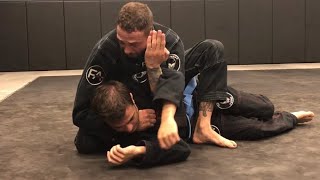
The instructor presents Roger Gracie's cross-lapel choke from mount position, emphasizing key details that distinguish effective execution from failed attempts. The technique is presented as a progression: the practitioner first assesses opportunity for an Ezekiel choke, then transitions to the cross choke if that option is unavailable.
Foot Positioning in Mount
Proper foot placement determines mount stability and resistance to bridge escapes. Practitioners with longer legs should cross their feet underneath the opponent's buttocks and widen their knees to distribute weight effectively; those with shorter legs may position feet against the opponent's hips to prevent forward movement during bridging attempts.
Weight Distribution on Solar Plexus
The critical innovation in Roger Gracie's approach involves concentrating weight directly on the opponent's solar plexus bone—the center point of the sternum—rather than distributing weight across the chest. This positioning simultaneously restricts breathing, prevents bridging escape, and keeps the hands free for collar control.
First Hand Placement and Elbow Repositioning
The practitioner inserts four fingers deep inside the opponent's collar behind the neck. The elbow initially contacts the heart area but must be immediately repositioned to rest on the solar plexus bone, creating a connection between the practitioner's solar plexus and their own elbow to maximize pressure.
Second Hand and Diagonal Body Alignment
The second hand is placed with the thumb behind the collar, with the elbow dropping diagonally between the neck and shoulder. This positioning requires the practitioner to lean rightward, shifting body weight off-center to prevent the opponent from rolling beneath them.
Head Control to Prevent Bridge Escape
The practitioner uses their elbow to push the opponent's jaw, rotating the head away from the direction of potential bridge escape. By controlling head position, the practitioner disrupts the opponent's natural body alignment, making leftward bridging mechanically difficult and psychologically uncomfortable.
Forearm Transition to Neck Control
The forearm positioned against the opponent's jaw is subtly repositioned downward to apply pressure directly against the neck. This transition maintains head control while establishing the pressure point for the final choke application.
Final Choke Execution
The practitioner elevates their head minimally off the ground—no more than one inch—and realigns their body with the opponent's. Moving the upper body leftward toward alignment immediately increases pressure on the opponent's neck, resulting in submission.
Roger Gracie Cross Choke
Key Takeaways
- •Overview and Setup
- •Foot Positioning in Mount
- •Weight Distribution on Solar Plexus
- •First Hand Placement and Elbow Repositioning
#choke #bjj #jiujitsu Learn Professor Thadeu Vieira’s perspective on the famous Roger Gracie Collar Cross Choke. Be the next champion too - Join Us: https://bit.ly/bjjchamp For the first time ever, professor Thadeu Vieira is releasing his secret Blue Print of Champions. The Vieira Jiu-Jitsu team has a unique success rate of 70% individual wins in tournaments. Method used by: IBJJF World Champions IBJJF U.S. Champions CBJJ Brazilian Champions IBJJF Pan Champions Dozens of Florida State Champions Get ready to jump into this extra work and have an edge against your competitors! Start now: https://bjjkidschamp.com
Frequently Asked Questions
What does this video teach about cross lapel cross choke?
This video covers overview and setup, foot positioning in mount, weight distribution on solar plexus. It provides detailed instruction from Jiu-Jitsu Channel.
How long does it take to learn cross lapel cross choke?
The basic mechanics can be understood in a single session, but developing reliable execution requires consistent drilling over weeks of practice. This 8-part breakdown helps structure your training by isolating each phase of the technique.
What are the key details for finishing cross lapel cross choke?
The forearm positioned against the opponent's jaw is subtly repositioned downward to apply pressure directly against the neck. This transition maintains head control while establishing the pressure point for the final choke application.