Knee on Belly to Arm Triangle!
0
Arm Triangle Choke — From Knee on Belly·TeachMeGrappling Coach Brian
This video I teach some details on mounting from knee on belly and going for the arm triangle. Check out the details an…
Translation: Shoulder Hold / Arm-and-Head Lock — From Knee on Belly
An arm triangle choke variation applied from the knee-on-belly position. The attacker drives the knee across the opponent’s torso to control posture, while isolating one arm against the opponent’s head. The top shoulder and chest compress the opponent’s trapped arm into the neck, while body weight and hip angle drive the choke. This setup combines positional dominance with immediate submission pressure.
An adaptation of the traditional kata gatame, integrated into modern BJJ and Judo as a submission threat from the mobile knee-on-belly control position.
The arm triangle transition from knee-on-belly was developed in BJJ as an attacking option from a dominant control position. [1]
Knee-on-belly to arm triangle is a common competition sequence at brown and black belt IBJJF events. [1]
No images yet for this technique.
Sign in to suggest an image.
This video I teach some details on mounting from knee on belly and going for the arm triangle. Check out the details an…
Jiu Jitsu Instructionals: https://roydeanacademy.com One Channel. Every Instructional: https://roydean.vhx.tv/browse S…
Jiu Jitsu Instructionals: https://roydeanacademy.com One Channel. Every Instructional: https://roydean.vhx.tv/browse S…
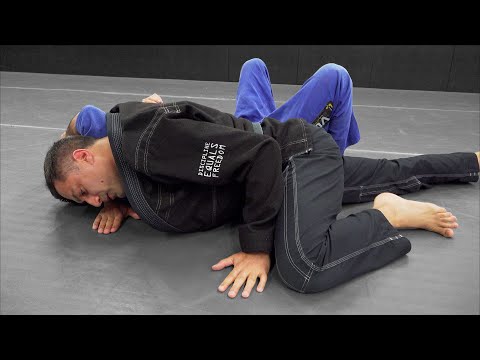
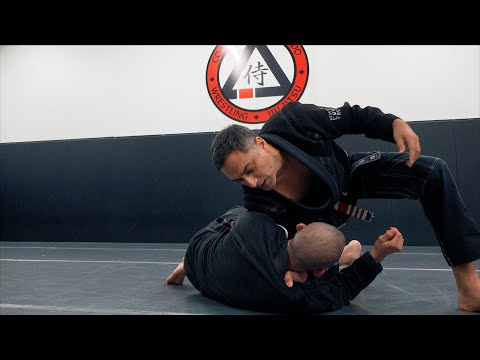
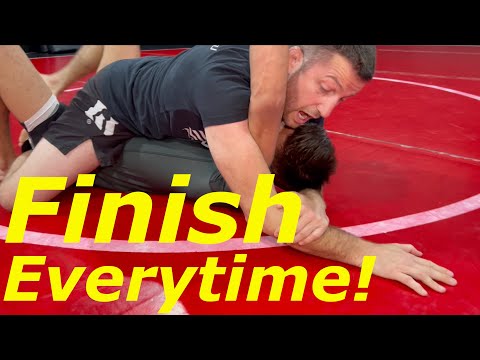
The arm triangle choke from knee on belly is executed by first establishing deep collar control and allowing or encouraging the opponent to turn into the attacker's body—a defensive response that paradoxically facilitates the technique. ROYDEAN emphasizes opening the collar deeply and creating a "ridge" with the fabric before circling the forearm around the opponent's head to form a wall with the top hand, while the bottom wrist rises into the neck. TeachMeGrappling Coach Brian stresses maintaining balance on the knee on belly position and methodically walking the opponent's arm across the body, keeping the right elbow out to prevent the opponent from clamping down and executing a bridge. Both instructors agree on the importance of controlling the opponent's head position—ROYDEAN mentions leaning into the neck to allow slight elevation, while Brian specifies keeping the head elevated to prevent the opponent from generating power. The choke is finished by pinching the elbow with the arms locked in either a gable grip (palm over palm) or by raising the bottom wrist up and into the neck. ROYDEAN introduces a "terminator" variation where the cuff is grabbed to turn the opponent and the tricep is controlled with body weight before rolling the hand up. Both instructors note that proper arm positioning—particularly preventing the bottom elbow from closing in—is critical to maintaining the lock. Brian emphasizes patient, methodical adjustment rather than rushing, and recommends having the opponent actively resist throughout the setup to practice realistic application.
Synthesized from 3 instructors
No instructional courses yet for this technique.
Sign in to suggest a course.
Risk of injury to the person this technique is applied to
Strong positional pressure and direct vascular choke; unconsciousness occurs quickly if not released.
Skill level needed to execute this technique reliably
Whether this technique is allowed under major competition rule sets
Kodokan Judo — Official Katame-waza Classification (肩固め Kata-gatame)
Japanese terminology sourced from Kodokan Judo — Official Katame-waza Classification (肩固め Kata-gatame)
Official Kodokan ground technique classification system
Established Japanese martial arts naming convention — native Japanese term (和語/漢語)
Japanese terminology sourced from Kodokan Judo — Official Katame-waza Classification (肩固め Kata-gatame)
hip flexibility, long legs relative to torso
longer limbs for easier figure-four lock around head and arm
hip adductors, hamstrings, quadriceps
Serves as a transitional attack that threatens immediate submission or forces defensive openings for mount or back takes.
From knee on belly, grab the collar to create a ridge, circle your elbow around the opponent's head starting from the middle, then drop down so your top arm becomes a wall and your bottom wrist comes up into the neck. If they push your knee off and turn into you, that's actually what you want—it helps you finish the choke.
For larger opponents or if you're having trouble, modify the grip by placing your hand flat on your forearm instead of using the pinky-in-crook grip, then roll it up the same way as you compress. This adjustment works just as well if you can't get the full grip.
TeachMeGrappling Coach Brian explains that closing your elbow is very bad because once your opponent clamps that arm and executes a bridge, you'll become off-balance enough to lose the position.
You should always knock your opponent onto their side before finishing—never try to finish from the knee on belly position itself. Once they're on their side, you can secure the choke more effectively.
An arm triangle choke variation applied from the knee-on-belly position. The attacker drives the knee across the opponent’s torso to control posture, while isolating one arm against the opponent’s head.
An adaptation of the traditional kata gatame, integrated into modern BJJ and Judo as a submission threat from the mobile knee-on-belly control position.
Danger: 9/10 | Strong positional pressure and direct vascular choke; unconsciousness occurs quickly if not released.
The standard setup chain: Achieve Controlling Position → Isolate the Neck → Set the Grip → Apply Pressure.
Standard counters include: Tuck Chin — protect the neck by lowering the chin to prevent the choke from sinking / Two-on-One Grip Fight — use both hands to strip the choking grip before it locks / Turn Into — rotate toward the choking arm to relieve carotid pressure / Posture Up — straighten the spine and create distance to break the choking angle.
Common variants: Arm isolation triangle from knee on belly; High knee-on-belly triangle; Knee-on-belly to triangle setup; Reverse triangle from knee on belly; Standard triangle from knee on belly.
Knee-on-belly to arm triangle is a common competition sequence at brown and black belt IBJJF events.
Top errors to watch for: Not trapping the arm tightly / Overcommitting weight forward (risking sweep) / Poor angle, resulting in crank instead of choke..
The Arm Triangle Choke — From Knee on Belly is also known as Kata Gatame — From Knee on Belly, Knee-on-Belly Arm Triangle, KOB Kata Gatame, Knee Ride Head-and-Arm Choke.