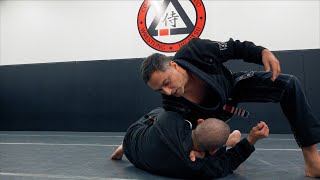
Entry from Side Control
The arm triangle choke is most easily accessed when the opponent pushes upward against the instructor's throat from side control. The practitioner retreats slightly, positioning the L-shaped portion of their hand below the opponent's elbow before driving it upward. The instructor's head then blocks inward to establish the initial grip structure.
Head Placement and Transition
The instructor must slide their neck past the opponent's elbow—a critical checkpoint for technique success. The practitioner bases out with their hands, then hops over the opponent's body while maintaining head position. Once fully transitioned, they sprawl out with a palm-over-palm grip to establish control.
Grip Variations and Finishing
The gable grip (palms together, no thumbs) is the preferred finishing position, though chain grips and single-arm variations exist. The practitioner rolls their shoulder forward while squeezing the opponent's arm tightly against their neck. Alternative finishes include the sit-through position or maintaining hip pressure without hand assistance.
Entry Refinement and Deception
An advanced entry involves dropping the head low toward the opponent's hip before coming up into the choke, creating misdirection. This approach prevents the opponent from anticipating the technique since they expect high-level head placement. The practitioner can finish using any preferred hand configuration once the position is secured.
The Darce Choke Setup
The Darce choke requires the practitioner to drop their shoulder below the opponent's lat to achieve proper arm extension. Beginning from a north-south position, the practitioner falls to their side, allowing gravitational alignment to establish the shoulder depth naturally. This positioning enables the bottom arm to extend through while the pinky anchors in the elbow crease.
Darce Execution and Control
The practitioner holds the opponent's head while shooting their arm through, then connects by placing the pinky in the elbow ridge. A critical detail: the pinky must anchor at the bottom of the bicep to prevent hand compression when applying pressure. The practitioner then bumps the opponent to remove their base before walking forward to tighten the choke.
Darce Grip Variations
A chain grip variation provides additional security by keeping both hands connected throughout the transition. The Jean Labelle grip—with the thumb positioned between the middle and index fingers—allows the practitioner to actively roll the opponent over rather than relying on falling. This aggressive variation gives the practitioner more control when the opponent resists the initial side fall.
Finishing from Forced Position
When forcing the opponent over using the Jean Labelle grip, the practitioner drives their shoulder forward while maintaining neck pressure. The instructor can step up and drive forward to tip the opponent if initial positioning meets resistance. Once the opponent is prone, the practitioner regrips and finishes the choke from a dominant ground position.
Head and Arm Triangle Chokes | The Jiu Jitsu Class | Grappling
Key Takeaways
- •Entry from Side Control
- •Head Placement and Transition
- •Grip Variations and Finishing
- •Entry Refinement and Deception
Jiu Jitsu Instructionals: https://roydeanacademy.com One Channel. Every Instructional: https://roydean.vhx.tv/browse Start your journey with this app bundle for iPhone: https://apps.apple.com/us/app-bundle/id1599303680 Become an Affiliate: https://www.roydean.tv/jointhecrew Roy Dean is a jiu jitsu expert and global teacher, with black belts in Judo, Aikido, Japanese and Brazilian Jiu Jitsu. With over 30 years of experience, he can transmit insights into the art that will revolutionize your understanding. The Book: http://bit.ly/blkamzn The Audiobook: https://www.audible.com/pd/B07ZRW26KL/?source_code=AUDFPWS0223189MWT-BK-ACX0-170098&ref=acx_bty_BK_ACX0_170098_rh_us Roy Dean Personal: https://www.instagram.com/roydean_ Roy Dean Academy IG: https://www.instagram.com/roydeanacademy #martialarts #submissions #chokes Thanks for watching How to Do Head and Arm Chokes | The Jiu Jitsu Class | Grappling
Related Techniques
Frequently Asked Questions
What does this video teach about arm triangle choke — from knee on belly?
This video covers entry from side control, head placement and transition, grip variations and finishing. It provides detailed instruction from ROYDEAN.
How long does it take to learn arm triangle choke — from knee on belly?
The basic mechanics can be understood in a single session, but developing reliable execution requires consistent drilling over weeks of practice. This 8-part breakdown helps structure your training by isolating each phase of the technique.
What are the key details for finishing arm triangle choke — from knee on belly?
A chain grip variation provides additional security by keeping both hands connected throughout the transition. The Jean Labelle grip—with the thumb positioned between the middle and index fingers—allows the practitioner to actively roll the opponent over rather than relying on falling. This aggressive variation gives the practitioner more control when the opponent resists the initial side fall.