Basic Arm Triangle Setup from Knee on Belly
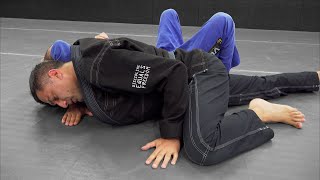
From the knee on belly position, the instructor inserts his hand deep into the opponent's collar. He allows the opponent to push the knee away and turn into him—this natural reaction is essential to the technique's success. The practitioner then grabs the ridged collar material and circles his forearm around the opponent's head to create a barrier.
Finishing the Standard Arm Triangle Choke
With the forearm positioned as a wall across the opponent's head, the top hand locks in place while the bottom wrist drives upward into the neck. The choke is completed by raising the bottom elbow and applying pressure through the forearm against the carotid artery. This palm-up, palm-down configuration is the fundamental entry point for all arm triangle variations.
The Terminator Choke Variation
When the opponent remains flat and resists the initial choke attempt, the instructor adapts by gripping the opponent's gi cuff with four fingers. He pulls the arm across the body while using his chest to block the tricep, then rolls his hand up to apply the choke. This variation is particularly effective when the opponent actively defends against the standard approach.
Weight Distribution and Positional Adjustments
If the terminator choke does not immediately succeed, the instructor can lift his knee off the opponent to consolidate his weight onto the tricep, improving leverage. This positional shift allows him to roll his bottom wrist upward more effectively into the neck. If this still fails, he can transition back to the standard arm triangle configuration.
Finishing When the Choke Stalls
When the arm triangle is nearly complete but lacks final tightness, the instructor leans his weight into the opponent's neck while allowing him to rise slightly, using a hook to control him. This creates space to pull with the lat muscle and retract the elbow, dramatically increasing choking pressure. The technique demonstrates how small positional adjustments can overcome defensive resistance.
Darce Choke from Half Guard Against Underhook
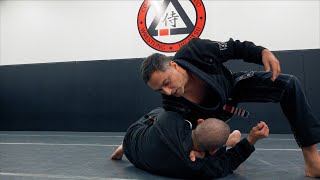
From half guard when the opponent establishes an underhook, the instructor threatens an armlock by straightening his arm against the opponent's elbow on the ground. This pressure forces the opponent to thread his arm through to escape the lock threat. Once the arm is repositioned, the instructor dives his shoulder below the opponent's lat and establishes the darce choke position.
Darce Choke Grip and Finish Details
The instructor secures the choke by placing his pinky finger into the crook of his own elbow, keeping his grip flat rather than compressed. He rolls his wrist upward while pushing forward with his chest to apply maximum pressure to the opponent's neck. For larger opponents, modifying the grip by placing the hand flat on the forearm achieves the same result when the standard configuration proves insufficient.
Adaptations for Different Body Types
The instructor emphasizes that larger opponents may require grip modifications, such as placing the hand flat on the forearm instead of using the pinky-crook connection. When unable to achieve the ideal grip configuration, the practitioner can still generate sufficient pressure by compressing with the middle of the forearm and rolling upward. These adjustments ensure the technique remains effective across all body types and sizes.
Which Knee on Belly Choke is Right For You?
Key Takeaways
- •Basic Arm Triangle Setup from Knee on Belly
- •Finishing the Standard Arm Triangle Choke
- •The Terminator Choke Variation
- •Weight Distribution and Positional Adjustments
Jiu Jitsu Instructionals: https://roydeanacademy.com One Channel. Every Instructional: https://roydean.vhx.tv/browse Start your journey with this app bundle for iPhone: https://apps.apple.com/us/app-bundle/id1599303680 Become an Affiliate: https://www.roydean.tv/jointhecrew 00:00 Introduction 00:10 Palm Up Palm Down Choke 01:29 Terminator Choke 03:12 Blocked Choke Counter 04:24 Underhook to D'arce 06:11 Short Arm D'arce Roy Dean is a jiu jitsu expert and global teacher, with black belts in Judo, Aikido, Japanese and Brazilian Jiu Jitsu. With over 30 years of experience, he can transmit insights into the art that will revolutionize your understanding. The Book: http://bit.ly/blkamzn The Audiobook: https://www.audible.com/pd/B07ZRW26KL/?source_code=AUDFPWS0223189MWT-BK-ACX0-170098&ref=acx_bty_BK_ACX0_170098_rh_us Roy Dean Personal: https://www.instagram.com/roydean_ Roy Dean Academy IG: https://www.instagram.com/roydeanacademy #bjj #collarchokes #darce Thanks for watching Knee on Belly Chokes | Brazilian Jiu Jitsu | The Jiu Jitsu Class Volume 2
Related Techniques
Frequently Asked Questions
What does this video teach about arm triangle choke — from knee on belly?
This video covers basic arm triangle setup from knee on belly, finishing the standard arm triangle choke, the terminator choke variation. It provides detailed instruction from ROYDEAN.
How long does it take to learn arm triangle choke — from knee on belly?
The basic mechanics can be understood in a single session, but developing reliable execution requires consistent drilling over weeks of practice. This 8-part breakdown helps structure your training by isolating each phase of the technique.
What are the key details for finishing arm triangle choke — from knee on belly?
The instructor secures the choke by placing his pinky finger into the crook of his own elbow, keeping his grip flat rather than compressed. He rolls his wrist upward while pushing forward with his chest to apply maximum pressure to the opponent's neck. For larger opponents, modifying the grip by placing the hand flat on the forearm achieves the same result when the standard configuration proves insufficient.