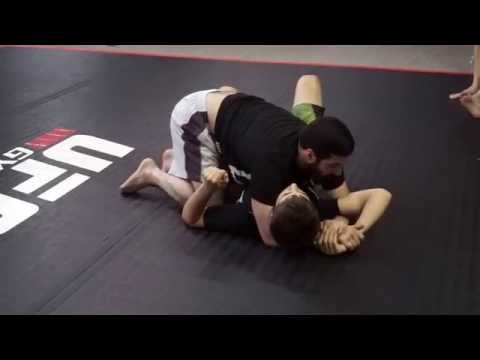
Americana to head and arm triangle choke
0
Arm Triangle Choke·Rachel Smith
MMA class - BJJ technique
肩固め(Kata Gatame)
TraditionalTranslation: Shoulder Hold / Arm-and-Head Lock
The arm triangle choke (kata-gatame) is a family of blood chokes that use the attacker's arms in combination with the opponent's own trapped shoulder to compress both carotid arteries. [1],[2] The defining mechanism is a triangular structure formed by the attacker's arm on one side of the neck and the opponent's own shoulder pressed against the other side, creating bilateral vascular compression. The attacker typically threads one arm under the opponent's head and clasps hands (or grips the biceps in a figure-four), then drives the opponent's trapped arm across the neck to complete the seal. Arm triangles can be applied from mount, side control, half guard, north-south, and even standing positions, making them among the most versatile choke families in grappling. The technique is high-percentage because even partial application creates significant discomfort and positional control. [3]
Kata-gatame (肩固め, shoulder hold) is one of the original Kodokan Judo osaekomi-waza (pinning techniques) classified by Jigoro Kano. [1] In judo's traditional classification it is primarily a pin, but its choking potential was recognized and developed extensively in Brazilian Jiu-Jitsu and MMA. The arm triangle became one of the most common submission finishes in the UFC, used effectively by fighters including Khabib Nurmagomedov and Rafael dos Anjos from top position. [2] In modern BJJ competition, arm triangle systems have been developed from virtually every top position.
The arm triangle (kata-gatame) is one of the highest-percentage chokes from top position, using the opponent's own trapped shoulder as a compression point against the neck to create bilateral carotid occlusion. [1],[2] The technique works identically in gi and no-gi, making it a staple in both BJJ competition and MMA. [1] When applied from side control with correct sprawl pressure, defensive options are extremely limited. [2],[3]
No images yet for this technique.
Sign in to suggest an image.
MMA class - BJJ technique
No instructional courses yet for this technique.
Sign in to suggest a course.
Risk of injury to the person this technique is applied to
Can render unconscious quickly; requires careful training and tap awareness.
Skill level needed to execute this technique reliably
Whether this technique is allowed under major competition rule sets
Kodokan Judo — Official Katame-waza Classification (肩固め Kata-gatame)
Japanese terminology sourced from Kodokan Judo — Official Katame-waza Classification (肩固め Kata-gatame)
Official Kodokan ground technique classification system
Established Japanese martial arts naming convention — native Japanese term (和語/漢語)
Japanese terminology sourced from Kodokan Judo — Official Katame-waza Classification (肩固め Kata-gatame)
hip flexibility, long legs relative to torso
longer limbs for easier figure-four lock around head and arm
hip adductors, hamstrings, quadriceps
Can transition from failed triangle or armbar attempts; commonly chained in positional sequences.
Instead of completing the Americana, grab under the opponent's head with your arm and hand, then search to turn as if you're attacking—this creates the arm triangle position. Rachel Smith demonstrates this as a effective transition when the Americana isn't available.
The arm triangle choke (kata-gatame) is a family of blood chokes that use the attacker's arms in combination with the opponent's own trapped shoulder to compress both carotid arteries. The defining mechanism is a triangular structure formed by the attacker's arm on one side of the neck and the opponent's own shoulder pressed against the other side, creating bilateral vascular compression.
Kata-gatame (肩固め, shoulder hold) is one of the original Kodokan Judo osaekomi-waza (pinning techniques) classified by Jigoro Kano. In judo's traditional classification it is primarily a pin, but its choking potential was recognized and developed extensively in Brazilian Jiu-Jitsu and MMA.
Danger: 9/10 | Can render unconscious quickly; requires careful training and tap awareness.
The standard setup chain: Slide around opponent’s trapped arm, lock head → Control opponent’s arm, pivot to side → side control → Underhook arm, drive shoulder into neck → north-south.
Standard counters include: Tuck Chin — protect the neck by lowering the chin to prevent the choke from sinking / Two-on-One Grip Fight — use both hands to strip the choking grip before it locks / Turn Into — rotate toward the choking arm to relieve carotid pressure / Posture Up — straighten the spine and create distance to break the choking angle.
Common variants: Classic arm triangle (head-and-arm); Mounted arm triangle; Side control arm triangle; North-south arm triangle; From turtle to arm triangle roll.
The arm triangle is a frequent finish in UFC competition. Khabib Nurmagomedov, Jon Jones, and numerous other champions have finished fights with the arm triangle.
Top errors to watch for: Head placement too high or low / Insufficient shoulder pressure / Arm not fully trapped / Poor body alignment reduces choke effectiveness.
The Arm Triangle Choke is also known as Kata Gatame, Arm Triangle, Side Headlock, Kata Gatame Choke.