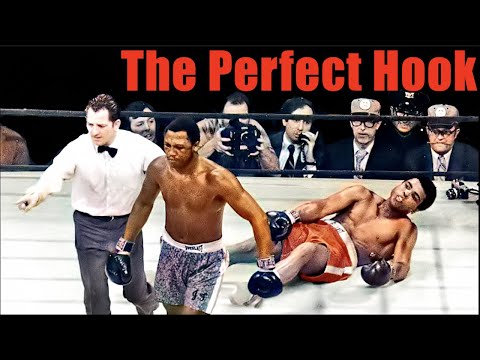
Smokin Joe Frazier's Terrifying Hook & Head Movement Explained - Technique Breakdown
http://www.modernmartialartist.com/downloads/power-of-the-pros/ There’s a line from a classic martial arts film “When my…
リードフック(頭)(Rīdo Fukku (Atama))
HybridTranslation: lead hook to head
The lead hook to the head targets the chin, temple, or jaw with the lead hand, making it the primary knockout variant of the hook. [1] The chin and temple are preferred targets because lateral impact to these areas maximises rotational acceleration of the head, which is the primary mechanism for producing concussive knockouts. [1] Dempsey emphasised that the hook to the head should follow a tight arc to minimise telegraphing, with the fist turning over at the point of impact. [1] The lead hook to the head has produced more championship-ending knockouts in boxing history than any other single punch variation. [2]
A fundamental boxing punch. [1]
The lead hook is one of the highest-knockout-rate punches in boxing and MMA. [1]
No images yet for this technique.
Sign in to suggest an image.
No instructional courses yet for this technique.
Sign in to suggest a course.
Risk of injury to the person this technique is applied to
Hooks/uppercuts; generate rotational force, high KO rate (Walilko et al. 2005)
Skill level needed to execute this technique reliably
Whether this technique is allowed under major competition rule sets
Karate-Do Kyohan: The Master Text (Gichin Funakoshi, 1935)
Alias sources — [1] Championship Fighting (Dempsey, 1950) [2] Boxing (Fleischer, 1958) [3] The Sweet Science (Liebling, 1956)
History sources — [1] Championship Fighting (Dempsey, 1950) [2] Boxing's Greatest Fighters (Sugar, 2006)
Mixed Japanese-Western terminology — combines traditional Japanese terms with katakana loanwords
Alias sources — [1] Championship Fighting (Dempsey, 1950) [2] Boxing (Fleischer, 1958) [3] The Sweet Science (Liebling, 1956)
History sources — [1] Championship Fighting (Dempsey, 1950) [2] Boxing's Greatest Fighters (Sugar, 2006)
hip rotation, horizontal arm acceleration, tight elbow angle
compact build for short-range hooks, strong core
obliques, hip rotators, pectorals, biceps, forearms
A hybrid punch between a hook and an uppercut, traveling in a 45-degree upward arc and landing with the palm facing partially upward, effective at close range.
A compact hook thrown with a sharply bent elbow at less than 90 degrees, effective at close range and inside fighting with reduced telegraphing.
A hook thrown with a more extended arm and wider arc, generating greater force at medium range but with more telegraphing.
Frazier relied almost entirely on head movement to corner opponents by moving straight at them while dodging every punch they threw, creating openings for his hook without taking damage.
According to David Christian's analysis of Frazier's technique, rhythm and timing were crucial—Frazier seemed to dance to an unpredictable beat with no consistent tempo, making his hooks harder to anticipate and defend against.
A lead hook targeting the opponent's jaw, temple, or ear, thrown at head height with the fist traveling parallel to the ground.
The lead hook to the head targets the chin, temple, or jaw with the lead hand, making it the primary knockout variant of the hook. The chin and temple are preferred targets because lateral impact to these areas maximises rotational acceleration of the head, which is the primary mechanism for producing concussive knockouts.
Unified MMA: legal — Legal striking technique; WBC/Boxing: legal — Legal — punches are the core technique of boxing; WKF: legal — Legal, jodan/chudan punch scores 1 point (yuko) — controlled contact required; Kyokushin: restricted — Body punches legal at full power, head punches banned; WT: restricted — Punches to trunk only (1 point), punches to head banned; ITF: legal — Legal — hand techniques to head and body both permitted; WAKO: legal — Legal in Full Contact and Low Kick formats; K: legal — 1/GLORY — Legal — full power punches to head and body; IFMA: legal — Legal
Danger rating 6/10. High — hooks/uppercuts; generate rotational force, high KO rate (Walilko et al. 2005)
The standard setup chain: Setup with Straight Punch → Pivot the Lead Foot → Arc the Arm → Follow Through.
Standard counters include: Slip — move the head off the centre line to evade the punch / Parry — deflect the incoming punch with a quick hand redirection / Counter Cross — time a straight punch over the incoming attack.
Common variants: Standard lead hook (short-arc punch targeting the jaw with lead hand); Check hook (pivoting away while throwing the hook as the opponent adv…); Shovel hook (upward-angled hook targeting the body at close range); Long-range hook (extended arm hook for catching opponents at distance).
The lead hook is one of the highest-knockout-rate punches in boxing and MMA.
Top errors to watch for: Throwing the hook at forehead or top-of-head height — this hits hard bone and hurts your hand more than them / Opening the arc too wide, which slows the punch and makes it visible from a mile away / Not turning the hip and instead arm-punching — the hook becomes a push without any concussive snap / Rising up on the toes as you throw, which lifts you out of position and weakens the base.
The Lead Hook To Head is also known as Rīdo Fukku (Atama), Left Hook to the Temple, Lead Hook Upstairs, Head Hook.