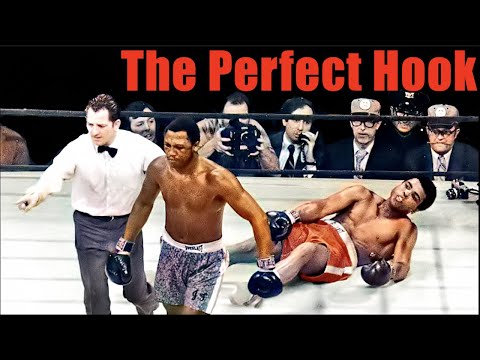
Smokin Joe Frazier's Terrifying Hook & Head Movement Explained - Technique Breakdown
0
Tight Hook·The Modern Martial Artist
http://www.modernmartialartist.com/downloads/power-of-the-pros/ There’s a line from a classic martial arts film “When my…
Translation: tight hook
The tight hook is a short-arc hook thrown with the elbow bent at approximately 90 degrees, designed for close-range power delivery with minimal telegraphing. [1] Dempsey described the tight hook as the correct form of the technique, emphasising that the shorter the arc, the faster and more difficult to defend the punch becomes. [1] The tight hook became the preferred form in modern boxing, with the wide, looping hooks of the bare-knuckle era gradually falling out of favour as defensive skills improved. [2] Haislet documented the tight hook as the standard form taught to amateur boxers due to its defensive safety and efficiency. [2]
The tight hook is a compact, short-arc hook for close-range fighting. [1]
A boxing technique for inside fighting. [1]
Used in boxing and MMA. [1]
No images yet for this technique.
Sign in to suggest an image.
http://www.modernmartialartist.com/downloads/power-of-the-pros/ There’s a line from a classic martial arts film “When my…
No instructional courses yet for this technique.
Sign in to suggest a course.
Risk of injury to the person this technique is applied to
Hooks/uppercuts; generate rotational force, high KO rate (Walilko et al. 2005)
Skill level needed to execute this technique reliably
Whether this technique is allowed under major competition rule sets
Muay Thai: The Art of Fighting (Yod Ruerngsa, Khun Kao Charuad & James Cartmell, 2002)
Alias sources — [1] Championship Fighting (Dempsey, 1950) [2] Boxing (Fleischer, 1958) [3] Boxing Mastery (Hatmaker, 2004)
History sources — [1] Championship Fighting (Dempsey, 1950) [2] Boxing (Haislet, 1940)
Standard katakana transliteration of Western martial arts terminology (外来語) — used in Japanese MMA, boxing, and BJJ communities
Alias sources — [1] Championship Fighting (Dempsey, 1950) [2] Boxing (Fleischer, 1958) [3] Boxing Mastery (Hatmaker, 2004)
History sources — [1] Championship Fighting (Dempsey, 1950) [2] Boxing (Haislet, 1940)
hip rotation, horizontal arm acceleration, tight elbow angle
compact build for short-range hooks, strong core
obliques, hip rotators, pectorals, biceps, forearms
Frazier relied on exceptional head movement and rhythm to set up his hooks, using unpredictable footwork and tempo to corner opponents while dodging their punches. According to David Christian at The Modern Martial Artist, Frazier's rhythm seemed to follow no consistent beat, making it difficult for opponents to time their defense against his strikes.
David Christian emphasizes that footwork is fundamental to effective hook execution. His book 'Footwork Wins Fights' explores how proper footwork mechanics directly enhance striking power and positioning.
A compact hook thrown with a sharply bent elbow at less than 90 degrees, effective at close range and inside fighting with reduced telegraphing.
The tight hook is a short-arc hook thrown with the elbow bent at approximately 90 degrees, designed for close-range power delivery with minimal telegraphing. Dempsey described the tight hook as the correct form of the technique, emphasising that the shorter the arc, the faster and more difficult to defend the punch becomes.
Unified MMA: legal — Legal striking technique; WBC/Boxing: legal — Legal — punches are the core technique of boxing; WKF: legal — Legal, jodan/chudan punch scores 1 point (yuko) — controlled contact required; Kyokushin: restricted — Body punches legal at full power, head punches banned; WT: restricted — Punches to trunk only (1 point), punches to head banned; ITF: legal — Legal — hand techniques to head and body both permitted; WAKO: legal — Legal in Full Contact and Low Kick formats; K: legal — 1/GLORY — Legal — full power punches to head and body; IFMA: legal — Legal
Danger rating 6/10. High — hooks/uppercuts; generate rotational force, high KO rate (Walilko et al. 2005)
The standard setup chain: Setup with Straight Punch → Pivot the Lead Foot → Arc the Arm → Follow Through.
Standard counters include: Slip — move the head off the centre line to evade the punch / Parry — deflect the incoming punch with a quick hand redirection / Counter Cross — time a straight punch over the incoming attack.
Common variants: Standard hook (horizontal-arc punch targeting the jaw or temple); Tight hook (compact, short-range hook for close-quarters fighting); Body hook (targeting the ribs or liver with a downward-angled hook); Check hook (pivoting on the lead foot while throwing the hook as a co…).
Used in boxing and MMA.
Top errors to watch for: Opening the arc on the tight hook, turning it into a standard or wide hook — the whole point is the short distance / Not committing body rotation because the arm motion is small — the body must still turn fully / Throwing it from mid-range where a standard hook would be more appropriate — the tight hook needs close proximity / Pushing the fist forward instead of rotating it around the axis — it becomes a short straight punch.
The Tight Hook is also known as Taito Fukku, Short Hook, Close-Range Hook, Inside Hook.