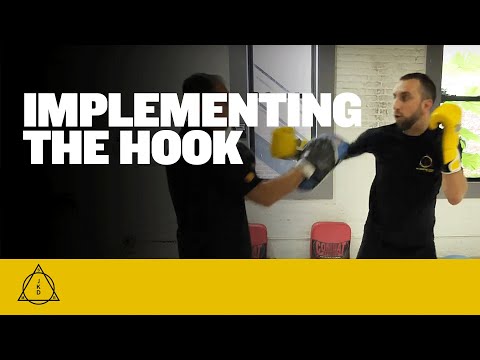
How to Set up the Lead Hook Punch | Basic Mechanics & Technique
0
Lead Hook·NY Martial Arts Academy·Added by Admin
As one of the fastest and most effective ways to strike an opponent, learning how and when to use the lead hook is cruci…
Translation: lead hook
The lead hook is thrown with the front hand in a short horizontal arc, pivoting on the lead foot to generate power through torso rotation. [1] Dempsey described the lead hook as one of the most devastating punches in boxing, capable of producing knockouts through the rotational acceleration imparted to the opponent's head. [1] The technique was elevated to an art form by Joe Louis, whose short, compact left hook became one of the most feared weapons in heavyweight boxing during the 1930s-1940s. [2] Sugar Ray Robinson's left hook was later considered the most technically perfect execution of the punch in boxing history. [3]
The lead hook is one of the most dangerous punches in boxing, delivering force at a perpendicular angle to the opponent's jaw that maximises rotational acceleration of the head, which is the primary mechanism for producing knockouts. [1] Dempsey described the hook as the 'most devastating' punch when thrown correctly with a tight arc and full hip rotation. [1] Biomechanical studies have confirmed that hook punches generate greater rotational head acceleration than straight punches of equivalent force. [2]
The lead hook was refined within Western boxing, with Joe Louis (1914-1981) widely regarded as having perfected the short, compact left hook as a finishing weapon. [1] The technique was further developed by fighters including Sugar Ray Robinson, whose left hook was considered one of the most technically perfect punches in boxing history. [1]
Joe Louis used the left hook to score 52 knockouts in his 66-3 career, including his famous first-round knockout of Max Schmeling in 1938. [1] Mike Tyson's lead hook, thrown from his peek-a-boo guard, was central to his 44 knockout victories and became one of the most feared punches in heavyweight history. [1] In MMA, the lead hook is among the top three knockout-producing punches according to UFC statistics. [2]
No images yet for this technique.
Sign in to suggest an image.
As one of the fastest and most effective ways to strike an opponent, learning how and when to use the lead hook is cruci…
No instructional courses yet for this technique.
Sign in to suggest a course.
Risk of injury to the person this technique is applied to
Hooks/uppercuts; generate rotational force, high KO rate (Walilko et al. 2005)
Skill level needed to execute this technique reliably
Whether this technique is allowed under major competition rule sets
Karate-Do Kyohan: The Master Text (Gichin Funakoshi, 1935)
Alias sources — [1] Championship Fighting (Dempsey, 1950) [2] Karate-Do Kyohan (Funakoshi, 1935) [3] Boxe Française (Charlemont, 1899)
Effectiveness sources — [1] Championship Fighting (Dempsey, 1950) [2] Biomechanics of Striking Arts, in Martial Arts Medicine (Kordi et al., 2009)
Standard katakana transliteration of Western martial arts terminology (外来語) — used in Japanese MMA, boxing, and BJJ communities
Alias sources — [1] Championship Fighting (Dempsey, 1950) [2] Karate-Do Kyohan (Funakoshi, 1935) [3] Boxe Française (Charlemont, 1899)
Effectiveness sources — [1] Championship Fighting (Dempsey, 1950) [2] Biomechanics of Striking Arts, in Martial Arts Medicine (Kordi et al., 2009)
hip rotation, horizontal arm acceleration, tight elbow angle
compact build for short-range hooks, strong core
obliques, hip rotators, pectorals, biceps, forearms
Every move, in any martial art, shares a few universal traits. Mix and match below to pinpoint the right tool — or compare equivalents across styles.
A lead hook targeting the opponent's ribcage or midsection, thrown with a lower trajectory and often accompanied by bending the knees.
A lead hook targeting the opponent's jaw, temple, or ear, thrown at head height with the fist traveling parallel to the ground.
The lead hook works best right after a middle-line strike like an uppercut or cross. NY Martial Arts Academy teaches that you should throw fast crisp shots first (like a jab or cross) to set up the hook, then finish the combination with power from the hook.
According to NY Martial Arts Academy, the formula is to start with speed on your initial shots and end with power on the hook. This cadence and rhythm—fast on the jab and cross, powerful on the hook—creates an effective offensive combination.
Yes. NY Martial Arts Academy demonstrates using the lead hook as a counter by chopping it over the top when an opponent comes in or throws their lead hand, positioning your lead hand higher to catch and counter their offense.
A hook thrown with the lead hand, pivoting on the lead foot and rotating the torso to generate power through a short horizontal arc.
The lead hook is thrown with the front hand in a short horizontal arc, pivoting on the lead foot to generate power through torso rotation. Dempsey described the lead hook as one of the most devastating punches in boxing, capable of producing knockouts through the rotational acceleration imparted to the opponent's head.
Unified MMA: legal — Legal striking technique; WBC/Boxing: legal — Legal — punches are the core technique of boxing; WKF: legal — Legal, jodan/chudan punch scores 1 point (yuko) — controlled contact required; Kyokushin: restricted — Body punches legal at full power, head punches banned; WT: restricted — Punches to trunk only (1 point), punches to head banned; ITF: legal — Legal — hand techniques to head and body both permitted; WAKO: legal — Legal in Full Contact and Low Kick formats; K: legal — 1/GLORY — Legal — full power punches to head and body; IFMA: legal — Legal
Danger rating 6/10. High — hooks/uppercuts; generate rotational force, high KO rate (Walilko et al. 2005)
The standard setup chain: Setup with Straight Punch → Pivot the Lead Foot → Arc the Arm → Follow Through.
Standard counters include: Slip — move the head off the centre line to evade the punch / Parry — deflect the incoming punch with a quick hand redirection / Counter Cross — time a straight punch over the incoming attack.
Common variants: Standard lead hook (short-arc punch targeting the jaw with lead hand); Check hook (pivoting away while throwing the hook as the opponent adv…); Shovel hook (upward-angled hook targeting the body at close range); Long-range hook (extended arm hook for catching opponents at distance).
Joe Louis used the left hook to score 52 knockouts in his 66-3 career, including his famous first-round knockout of Max Schmeling in 1938. Mike Tyson's lead hook, thrown from his peek-a-boo guard, was central to his 44 knockout victories and became one of the most feared punches in heavyweight history.
Top errors to watch for: Throwing the lead hook without setting it up — naked lead hooks are easy to see and counter / Using the arm to generate power instead of pivoting through the hips — the arm stays fixed, the body does the work / Reaching with the hook by extending the arm past 90 degrees, turning it into a wide slap / Not returning the fist to guard after delivery — the hand must snap back to the chin.
The Lead Hook is also known as Rīdo Fukku, Left Hook, Kagi Tsuki, Lead Croche.