How to Hook in Boxing | Step by Step Basic Guide
0
Hook·Frank's Noble Art
In this video I will show you how to throw a hook in boxing *FIND YOUR NEXT SET OF GLOVES HERE* *The Noble Art Crimso…
Translation: hook
The hook punch is one of the fundamental power punches in boxing, delivered in a short arc targeting the chin, temple, or body. [1] Dempsey described the hook as 'the most devastating punch in boxing' when thrown with proper form — short arc, full hip rotation, and a locked arm angle. [1] The hook evolved within the bare-knuckle boxing tradition but was refined after the adoption of gloves, which protected the hand during the lateral impact. [2] Historical accounts credit fighters like Tom Cribb (early 19th century) and later John L. Sullivan with popularising hooking techniques in the prize ring. [3] Haislet documented the hook as requiring a 90-degree arm angle and emphasised that power derives from hip rotation rather than arm swing. [4]
The hook is one of the fundamental punches in boxing, alongside the jab, cross, and uppercut. [1]
The hook is one of the highest-KO-rate punches in boxing and MMA. [1]
No images yet for this technique.
Sign in to suggest an image.
In this video I will show you how to throw a hook in boxing *FIND YOUR NEXT SET OF GLOVES HERE* *The Noble Art Crimso…
This document contains all playlists at each level of the membership: https://docs.google.com/document/d/1-IiC9KYudG6Tmy…
No instructional courses yet for this technique.
Sign in to suggest a course.
Risk of injury to the person this technique is applied to
Hooks/uppercuts; generate rotational force, high KO rate (Walilko et al. 2005)
Skill level needed to execute this technique reliably
Whether this technique is allowed under major competition rule sets
Muay Thai: The Art of Fighting (Yod Ruerngsa, Khun Kao Charuad & James Cartmell, 2002)
Alias sources — [1] Karate-Do Kyohan (Funakoshi, 1935) [2] Boxe Française (Charlemont, 1899) [3] Championship Fighting (Dempsey, 1950)
History sources — [1] Championship Fighting (Dempsey, 1950) [2] The Art of Boxing and Manual of Training (Price, 1867) [3] Boxing's Greatest Fighters (Sugar, 2006) [4] Boxing (Haislet, 1940)
Standard katakana transliteration of Western martial arts terminology (外来語) — used in Japanese MMA, boxing, and BJJ communities
Alias sources — [1] Karate-Do Kyohan (Funakoshi, 1935) [2] Boxe Française (Charlemont, 1899) [3] Championship Fighting (Dempsey, 1950)
History sources — [1] Championship Fighting (Dempsey, 1950) [2] The Art of Boxing and Manual of Training (Price, 1867) [3] Boxing's Greatest Fighters (Sugar, 2006) [4] Boxing (Haislet, 1940)
hip rotation, horizontal arm acceleration, tight elbow angle
compact build for short-range hooks, strong core
obliques, hip rotators, pectorals, biceps, forearms
Every move, in any martial art, shares a few universal traits. Mix and match below to pinpoint the right tool — or compare equivalents across styles.
A hook thrown with the lead hand, pivoting on the lead foot and rotating the torso to generate power through a short horizontal arc.
A hook thrown with the rear hand, requiring greater hip rotation and weight transfer to generate power through a longer arc from the rear position.
According to Precision Striking, front-loading tension into the hook steals your power. Instead, you want to start slow and relax in the early stages, then accelerate into the shot at the end, allowing the initial turn to be a natural whip rather than forcing the movement.
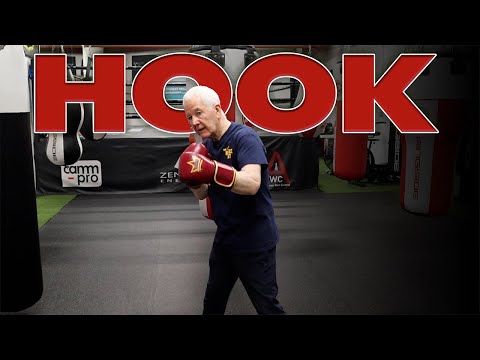
Frank's Noble Art emphasizes keeping your back hand up and taking your chin over to get it out of danger. You must also maintain a straight line down the arm, forearm, and wrist without bending the wrist, and deliver with the knuckle part of the glove while never exposing your thumb.
Frank's Noble Art stresses turning the body and shoulders to deliver the punch with full impact and meaning. Precision Striking adds that you should let the hand do the work rather than the shoulder, and drop the shoulder in the socket while keeping the hand at the same level for better leverage and connectivity.
Frank's Noble Art advises that you should look your opponent in the eyes, know where they are, and suddenly decide to throw the hook when the opportunity presents itself—never telegraph the punch. Precision Striking also notes that a good lead hook must adapt to the situation and be thrown from all ranges since opponents never stand still.
A short, powerful punch delivered in a horizontal or semi-circular arc with the elbow bent at approximately 90 degrees, targeting the head or body from the side.
The hook punch is one of the fundamental power punches in boxing, delivered in a short arc targeting the chin, temple, or body. Dempsey described the hook as 'the most devastating punch in boxing' when thrown with proper form — short arc, full hip rotation, and a locked arm angle.
Unified MMA: legal — Legal striking technique; WBC/Boxing: legal — Legal — punches are the core technique of boxing; WKF: legal — Legal, jodan/chudan punch scores 1 point (yuko) — controlled contact required; Kyokushin: restricted — Body punches legal at full power, head punches banned; WT: restricted — Punches to trunk only (1 point), punches to head banned; ITF: legal — Legal — hand techniques to head and body both permitted; WAKO: legal — Legal in Full Contact and Low Kick formats; K: legal — 1/GLORY — Legal — full power punches to head and body; IFMA: legal — Legal
Danger rating 6/10. High — hooks/uppercuts; generate rotational force, high KO rate (Walilko et al. 2005)
The standard setup chain: Setup with Straight Punch → Pivot the Lead Foot → Arc the Arm → Follow Through.
Standard counters include: Slip — move the head off the centre line to evade the punch / Parry — deflect the incoming punch with a quick hand redirection / Counter Cross — time a straight punch over the incoming attack.
Common variants: Standard hook (horizontal-arc punch targeting the jaw or temple); Tight hook (compact, short-range hook for close-quarters fighting); Body hook (targeting the ribs or liver with a downward-angled hook); Check hook (pivoting on the lead foot while throwing the hook as a co…).
The hook is one of the highest-KO-rate punches in boxing and MMA.
Top errors to watch for: Arm-punching the hook with no hip rotation — this halves the power and makes it a pushing slap / Winding up by pulling the elbow back first, which telegraphs the hook obviously / Throwing the hook from too far away — it is a mid to close-range weapon and misses badly at distance / Dropping the rear hand when throwing the lead hook, inviting the counter cross.
The Hook is also known as Fukku, Kagi Tsuki, Croche, Hook Punch.