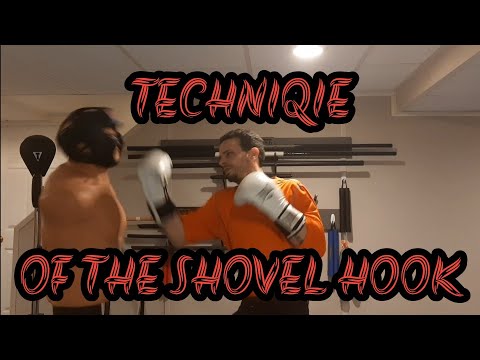
TECHNIQUE OF THE SHOVEL HOOK
0
Shovel Hook·PRIDE MARTIAL ARTS
Technique of the shovel hook how to for boxers and mma fighters at home or in the gym. As a amazon associate i earn mon…
Translation: shovel hook
The shovel hook is a hybrid punch combining elements of the hook and uppercut, thrown at a 45-degree angle in a 'shovelling' motion. [1] The technique occupies the space between a conventional hook and an uppercut, making it effective at close range when neither a pure hook nor a pure uppercut has the correct angle. [1] Haislet described the shovel hook as a 'short, digging' punch particularly effective for inside fighting. [2] The shovel hook was a signature weapon of Mike Tyson, who used the short digging punch from his peek-a-boo guard to devastating effect during his championship reign (1986-1990). [3]
The shovel hook is a short hook thrown from close range at an upward angle. [1]
A close-range boxing punch. [1]
Used in boxing and MMA infighting. [1]
No images yet for this technique.
Sign in to suggest an image.
Technique of the shovel hook how to for boxers and mma fighters at home or in the gym. As a amazon associate i earn mon…
No instructional courses yet for this technique.
Sign in to suggest a course.
Risk of injury to the person this technique is applied to
Hooks/uppercuts; generate rotational force, high KO rate (Walilko et al. 2005)
Skill level needed to execute this technique reliably
Whether this technique is allowed under major competition rule sets
The Essence of Okinawan Karate-Do (Shoshin Nagamine, 1976)
Alias sources — [1] Championship Fighting (Dempsey, 1950) [2] Boxing (Fleischer, 1958) [3] The Sweet Science (Liebling, 1956)
History sources — [1] Championship Fighting (Dempsey, 1950) [2] Boxing (Haislet, 1940) [3] Boxing's Greatest Fighters (Sugar, 2006)
Standard katakana transliteration of Western martial arts terminology (外来語) — used in Japanese MMA, boxing, and BJJ communities
Alias sources — [1] Championship Fighting (Dempsey, 1950) [2] Boxing (Fleischer, 1958) [3] The Sweet Science (Liebling, 1956)
History sources — [1] Championship Fighting (Dempsey, 1950) [2] Boxing (Haislet, 1940) [3] Boxing's Greatest Fighters (Sugar, 2006)
hip rotation, horizontal arm acceleration, tight elbow angle
compact build for short-range hooks, strong core
obliques, hip rotators, pectorals, biceps, forearms
The shovel hook is a hybrid strike that's half uppercut, half hook, coming on an angle between the two techniques.
Always shadowbox the shovel hook first before using it on focus mitts or a century bob, since a heavy bag lacks the chin anatomy needed to properly practice the strike.
Keep your non-throwing hand up to protect yourself—don't drop it below your head—and stay lined up with your opponent while maintaining proper head position throughout the slip and delivery.
Use your hip to generate power, let your feet follow the motion, and snap your hand back toward the jaw for maximum effectiveness.
A hybrid punch between a hook and an uppercut, traveling in a 45-degree upward arc and landing with the palm facing partially upward, effective at close range.
The shovel hook is a hybrid punch combining elements of the hook and uppercut, thrown at a 45-degree angle in a 'shovelling' motion. The technique occupies the space between a conventional hook and an uppercut, making it effective at close range when neither a pure hook nor a pure uppercut has the correct angle.
Unified MMA: legal — Legal striking technique; WBC/Boxing: legal — Legal — punches are the core technique of boxing; WKF: legal — Legal, jodan/chudan punch scores 1 point (yuko) — controlled contact required; Kyokushin: restricted — Body punches legal at full power, head punches banned; WT: restricted — Punches to trunk only (1 point), punches to head banned; ITF: legal — Legal — hand techniques to head and body both permitted; WAKO: legal — Legal in Full Contact and Low Kick formats; K: legal — 1/GLORY — Legal — full power punches to head and body; IFMA: legal — Legal
Danger rating 6/10. High — hooks/uppercuts; generate rotational force, high KO rate (Walilko et al. 2005)
The standard setup chain: Setup with Straight Punch → Pivot the Lead Foot → Arc the Arm → Follow Through.
Standard counters include: Slip — move the head off the centre line to evade the punch / Parry — deflect the incoming punch with a quick hand redirection / Counter Cross — time a straight punch over the incoming attack.
Common variants: Standard hook (horizontal-arc punch targeting the jaw or temple); Tight hook (compact, short-range hook for close-quarters fighting); Body hook (targeting the ribs or liver with a downward-angled hook); Check hook (pivoting on the lead foot while throwing the hook as a co…).
Used in boxing and MMA infighting.
Top errors to watch for: Throwing the shovel hook from too far away — it is a pocket weapon that requires you to be in close / Confusing it with a wide hook and throwing it horizontally instead of maintaining the upward diagonal angle / Not bending the knees to generate the upward drive — the power comes from rising through the legs / Dropping the opposite hand while throwing, since the shovel hook's motion tends to pull the body sideways.
The Shovel Hook is also known as Shoberu Fukku, Short Hook, Inside Hook, Compact Hook.