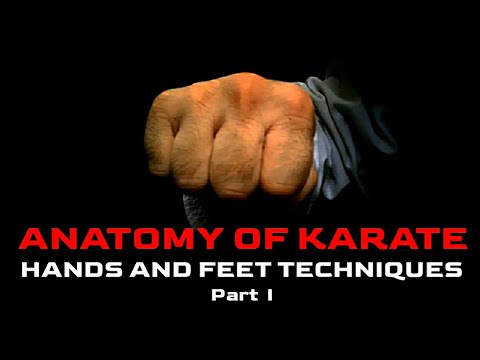
ANATOMY OF KARATE HANDS AND FEET TECHNIQUES PART - I | KYOKUSHIN VLOG-29
0
Nihon Ken·Kyokushin Society
ANATOMY OF KARATE HANDS AND FEET TECHNIQUES PART - I Welcome back to another Kyokushin Society Vlog where we discuss k…
Translation: two-knuckle fist
Nihon Ken is a karate striking technique using the extended middle and index finger knuckles as the impact surface. [1] The hand forms a partial fist with the index and middle fingers extended at the second knuckle joint, creating two protruding points that concentrate force into a narrow striking area. [1] This formation allows precise targeting of vulnerable areas such as the philtrum (upper lip groove), the space between the eyes (nasion), and the throat — areas too small for a standard seiken fist to effectively target. [1] Like ippon ken (single-knuckle fist), nihon ken requires extensive knuckle conditioning through makiwara and sand bag training to prevent self-injury. [1]
Nihon ken is documented in traditional Okinawan and Japanese karate as one of several specialized fist formations alongside ippon ken and hiraken. [1] It appears in the striking curriculum of Shotokan, Goju-Ryu, and Kyokushin styles, typically taught at intermediate to advanced levels after basic fist conditioning is established. [1]
A precision weapon for attacking vulnerable soft-tissue targets that a standard fist cannot isolate. [1] The two-point contact concentrates force into a very small area, creating disproportionate pain on nerve clusters and pressure points. More stable than ippon ken due to the wider two-knuckle base, but less precise. Primarily a self-defense and traditional training technique — not practical in sport competition. [1]
Used in WKF karate kumite (controlled contact) and Kyokushin full-contact competition. Banned in boxing, TKD, and most kickboxing rulesets. Appears in MMA where legal. [1]
No images yet for this technique.
Sign in to suggest an image.
ANATOMY OF KARATE HANDS AND FEET TECHNIQUES PART - I Welcome back to another Kyokushin Society Vlog where we discuss k…
No instructional courses yet for this technique.
Sign in to suggest a course.
Risk of injury to the person this technique is applied to
Concentrated two-point impact to soft tissue targets (throat, eyes) can cause serious injury. Self-injury risk to unconditioned knuckles.
Skill level needed to execute this technique reliably
Whether this technique is allowed under major competition rule sets
Oyama, M. This Is Karate / Essentials of Karate.
[1] Oyama / Funakoshi / Nakayama, Karate technique manuals — hand formation and striking surface chapters
Official karate technique names (和語/漢語)
Established Japanese martial arts naming convention — native Japanese term (和語/漢語)
[1] Oyama / Funakoshi / Nakayama, Karate technique manuals — hand formation and striking surface chapters
extensive knuckle conditioning (months of makiwara training), precise finger lock, strong wrist alignment
thick knuckle structure, strong forearm musculature
forearm flexors (fist compression), finger extensors (knuckle lock), wrist stabilizers (alignment), triceps (drive)
Nihon ken (two-knuckle fist) uses two extended knuckles — broader than ippon ken but still concentrated for precision striking. Targets the philtrum, nasion, and other small vulnerable areas. (Oyama, This Is Karate; Nakayama, Dynamic Karate)
No. According to Kyokushin Society, you should master proper punches, kicks, and hand/foot conditioning before training with weapons like bostaf, nunchucks, or sai. Once your hand and feet techniques are mastered properly, they become your main weapons, and only then should you start practicing with external weapons.
Kyokushin Society emphasizes that you must harden the surfaces of your hands and feet—specifically your hand knuckles and shin bones—through proper conditioning so that when you defend or retaliate, your bones will not get damaged.
Keeping your wrist straight enables you to transmit the maximum amount of force on impact, as explained in Kyokushin Society's technique breakdown.
Nihon Ken is a karate striking technique using the extended middle and index finger knuckles as the impact surface. The hand forms a partial fist with the index and middle fingers extended at the second knuckle joint, creating two protruding points that concentrate force into a narrow striking area.
Nihon ken is documented in traditional Okinawan and Japanese karate as one of several specialized fist formations alongside ippon ken and hiraken. It appears in the striking curriculum of Shotokan, Goju-Ryu, and Kyokushin styles, typically taught at intermediate to advanced levels after basic fist conditioning is established.
WKF Karate: Not permitted: banned — only standard closed fist and controlled techniques allowed; Unified MMA: Technically legal as a punch but impractical with gloves {src:Unified Rules of MMA, August 2025|/sources/Unified: banned — MMA-Rules-August-2025.pdf}; Olympic Karate: Not permitted {src:WKF Kumite Rules 2026|/sources/WKF: banned — Kumite-Rules-2026.pdf}; Kyokushin: Permitted in bare: legal — knuckle formats
Danger rating 7/10. High — concentrated two-point impact to soft tissue targets (throat, eyes) can cause serious injury. Self-injury risk to unconditioned knuckles.
The standard setup chain: Inside block (uchi uke) → deflect punch → immediate nihon ken to philtrum → Grab opponent's lapel → pull forward → nihon ken to space between eyes → Sweep front leg → opponent stumbles → nihon ken to exposed throat.
Standard counters include: Distance management — nihon ken requires precise close range / Forearm block — deflect the hand offline before the knuckles contact / Body movement — even small shifts negate the precision-dependent strike.
Common variants: Vertical nihon ken (knuckles aligned vertically for narrow targets like the p…); Horizontal nihon ken (knuckles aligned side-by-side for wider targets like the …); Rising nihon ken (upward strike under the chin); Thrusting nihon ken (straight drive to the throat).
Used in WKF karate kumite (controlled contact) and Kyokushin full-contact competition. Banned in boxing, TKD, and most kickboxing rulesets.
Top errors to watch for: Insufficient knuckle conditioning — leads to fractures on hard targets / Loose finger lock — the extending knuckles fold on impact, injuring the fingers / Poor wrist alignment — force transfers into the wrist instead of the target / Using against padded areas — nihon ken is designed for soft-tissue and pressure-point targets only.
The Nihon Ken is also known as Nihon Ken, Nihon-Ken, Two Knuckle Fist, Fore-Knuckle Fist, Double Knuckle Strike.