3 ways for Ippon-Ken 一本拳,Japanese Karate Grand Master 10th Dan demonstrates .
0
Ippon Ken·OSITA-HA KARATE
Japanese Karate Grand Master 66 years old, Free weight Kumite State Champion in the U.S. in 1980, All Japan Kata Champi…
Translation: one-knuckle fist
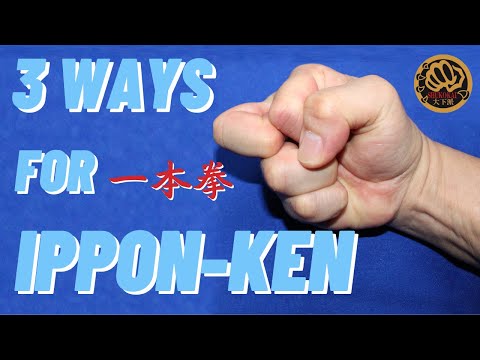
Ippon Ken is a single-knuckle fist strike where the middle finger's knuckle protrudes from the fist to create a concentrated point of impact. [1] The fist is formed by extending the middle finger's second knuckle forward while the remaining fingers are tightly closed, and the thumb braces the formation. [1] The concentrated pressure point is used to attack small, precise targets — the temple, philtrum (between nose and upper lip), and pressure points. [1]
Documented in traditional karate manuals. [1]
Used in WKF karate kumite (controlled contact) and Kyokushin full-contact competition. Banned in boxing, TKD, and most kickboxing rulesets. Appears in MMA where legal. [1]
No images yet for this technique.
Sign in to suggest an image.
Japanese Karate Grand Master 66 years old, Free weight Kumite State Champion in the U.S. in 1980, All Japan Kata Champi…
#ipponken #ippon #ken #weakpoints #weak #point #8weakpoitsinkarate #karateweakpoints #humanbodyweakpoits #shotokan #kara…
Ippon Ken is a pointed-fist striking technique in karate with three primary variations, as detailed by OSITA-HA KARATE. The first variant, Nakayubi Ippon Ken, uses the middle finger as the striking point with a tightly formed fist, targeting sensitive areas such as the eyes, throat, and temple. However, this version has a structural weakness: the middle finger can easily collapse inward upon impact with hard targets, reducing effectiveness. The second variant, Oyayubi Ippon Ken, employs the thumb knuckle as the striking surface, executed with a snapping motion directed at similar target areas. The third and most refined version, termed "Real Ippon Ken" by the instructor, incorporates a structural locking mechanism where the index finger is secured to prevent inward collapse during impact, significantly improving durability and striking efficacy. This locked configuration is emphasized as superior to common improper formations. The technique requires rapid fist formation combined with hip-driven snap mechanics to deliver power effectively. OSITA-HA KARATE notes that while Ippon Ken variations are too dangerous for standard karate competition, they remain vital components of applied self-defense methodology in real combat scenarios.
Synthesized from 2 instructors
No instructional courses yet for this technique.
Sign in to suggest a course.
Risk of injury to the person this technique is applied to
Concentrated pressure on vulnerable points like the temple can cause unconsciousness.
Skill level needed to execute this technique reliably
Whether this technique is allowed under major competition rule sets
Oyama, M. This Is Karate / Essentials of Karate.
[1] Oyama / Funakoshi, Karate technique manuals
Official karate technique names (和語/漢語)
Established Japanese martial arts naming convention — native Japanese term (和語/漢語)
[1] Oyama / Funakoshi, Karate technique manuals
strong knuckle conditioning (makiwara), precise aim, tight fist formation
practitioners with finger conditioning training
forearm flexors (fist compression), wrist stabilizers (alignment), triceps (extension)
Ippon ken (one-knuckle fist) uses a single extended knuckle as the striking surface — concentrating all force into approximately 1 cm². Targets pressure points and vulnerable soft tissue. Requires extensive knuckle conditioning on makiwara. (Oyama, This Is Karate; Nakayama, Dynamic Karate)
Ippon Ken is a single-knuckle fist strike where the middle finger's knuckle protrudes from the fist to create a concentrated point of impact. The fist is formed by extending the middle finger's second knuckle forward while the remaining fingers are tightly closed, and the thumb braces the formation.
Documented in traditional karate manuals.
WKF Karate: Legal: legal — controlled contact; Unified MMA: Legal {src:Unified Rules of MMA, August 2025|/sources/Unified: legal — MMA-Rules-August-2025.pdf}; WAKO Kickboxing: Legal {src:WAKO Full Contact Rules|/sources/WAKO: legal — Full-Contact-Rules.pdf}
Danger rating 6/10. High — concentrated pressure on vulnerable points like the temple can cause unconsciousness.
The standard setup chain: Grab opponent's gi lapel → pull forward → ippon ken to philtrum (upper lip) → Inside block (uchi uke) deflects opponent's punch → immediate ippon ken to temple → Sweep opponent's front leg → as they stumble → ippon ken to solar plexus.
Standard counters include: Distance management — the technique requires very precise range / Forearm block — deflect the hand offline before the knuckle contacts / Body movement — even small shifts negate the precision-dependent strike.
Common variants: Index finger ippon ken (using the index finger knuckle); Middle finger ippon ken (using the middle finger (most common)); Nihon ken (two-knuckle fist (index + middle)).
Used in WKF karate kumite (controlled contact) and Kyokushin full-contact competition. Banned in boxing, TKD, and most kickboxing rulesets.
Top errors to watch for: Loose fist formation — the protruding knuckle will collapse / Striking hard bone (forehead, skull) — the single knuckle can't handle it / Using as a power punch from long range — it's a precision weapon / Not conditioning the knuckle — unprepared knuckles are fragile.
The Ippon Ken is also known as Ippon Ken, Ippon-Ken, Single Knuckle Fist, One-Knuckle Punch, Nakadaka Ken.